


 736 / 912

728 Chapter 21
Copyright © 2017 Pearson Education, Inc.
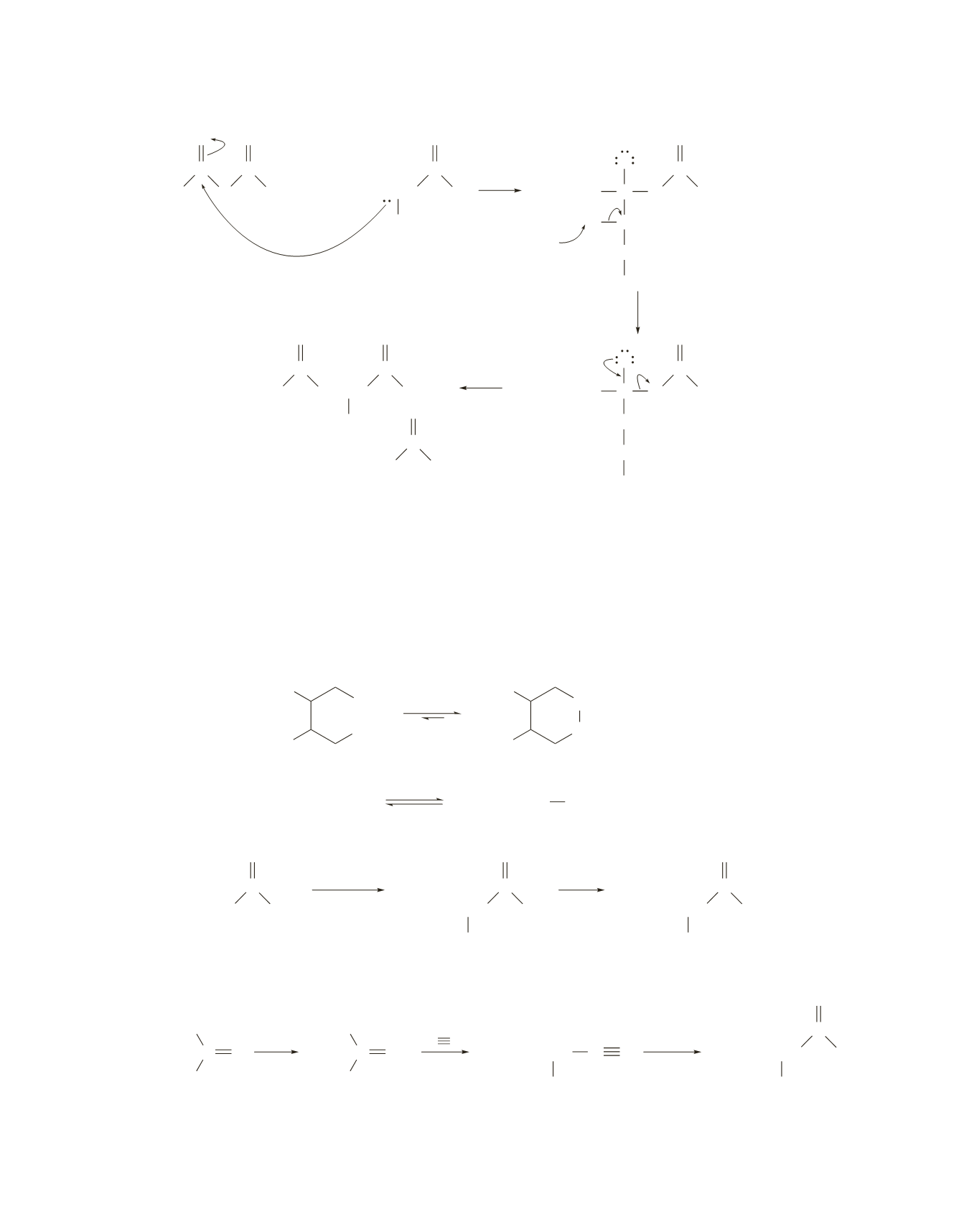
73.
H
2
NCH O
−
R
+
(CH
3
)
3
CO O OC(CH
3
)
3
C
(CH
3
)
3
CO
O
O OC(CH
3
)
3
NH
CHCOO
−
R
H
_
+
B
..
C
(CH
3
)
3
CO O OC(CH
3
)
3
NH
CHCOO
−
R
HB
+
NHCH O
−
R
(CH
3
)
3
CO
(CH
3
)
3
CO O
−
+
C
O
C
O
C
O
C
O
C
O
C
O
C
O
C
O
O
_
74.
Oxidation of dithiothreitol is an intramolecular reaction, so it occurs with a larger rate constant than the
oxidation of 2-mercaptoethanol, which is an intermolecular reaction. The reverse reduction reaction should
occur with about the same rate constant in both cases.
Increasing the rate of the oxidation reaction while keeping the rate of the reduction reaction constant is
responsible for the greater equilibrium constant because
K
eq
=
k
1
>
k
-
1
, where
k
1
is the rate constant for
oxidation and
k
-
1
is the rate constant for reduction.
HO
HO
SH
SH
k
1
k
−
1
HO
HO
S
S
2 HOCH
2
CH
2
SH
k
1
k
−
1
HOCH
2
CH
2
S SCH
2
CH
2
OH
75.
a.
(CH
3
)
2
CHCH
2
O
1. Br
2
, PBr
3
2. H
2
O
(CH
3
)
2
CHCH O
Br
NH
3
excess
(CH
3
)
2
CHCH O NH
4
+
NH
3
+
+
−
valine
C
O
C
O
C
O
b.
(CH
3
)
2
CHCH O
NH
3
+
valine
C O
H
(CH
3
)
2
CH
an aldehyde
NH
3
C NH
an imine
trace
acid
C N
−
HCl
(CH
3
)
2
CHCH C N
NH
3
+
HCl, H
2
O
C
O
H
(CH
3
)
2
CH