



 735 / 912

Chapter 21 727
Copyright © 2017 Pearson Education, Inc.
71.
The p
K
a
of the carboxylic acid group of the amino acid is lower than the p
K
a
of the carboxylic acid group of
the dipeptide because the positively charged ammonium group of the amino acid is more strongly electron
withdrawing than the amide group of the peptide. This causes the amino acid to be a stronger acid and,
therefore, have a lower p
K
a
.
+
+
NHCH
2
OH
H
3
NCH
2
H
3
NCH
2
OH
lower p
K
a
C
O
C
O
C
O
The p
K
a
of the ammonium group of the dipeptide is lower than the p
K
a
of the ammonium group of the
amino acid because the amide group of the dipeptide is more strongly electron withdrawing than the
carboxylate group of the amino acid.
+
+
NHCH
2
O
−
H
3
NCH
2
H
3
NCH
2
O
−
lower p
K
a
C
O
C
O
C
O
72.
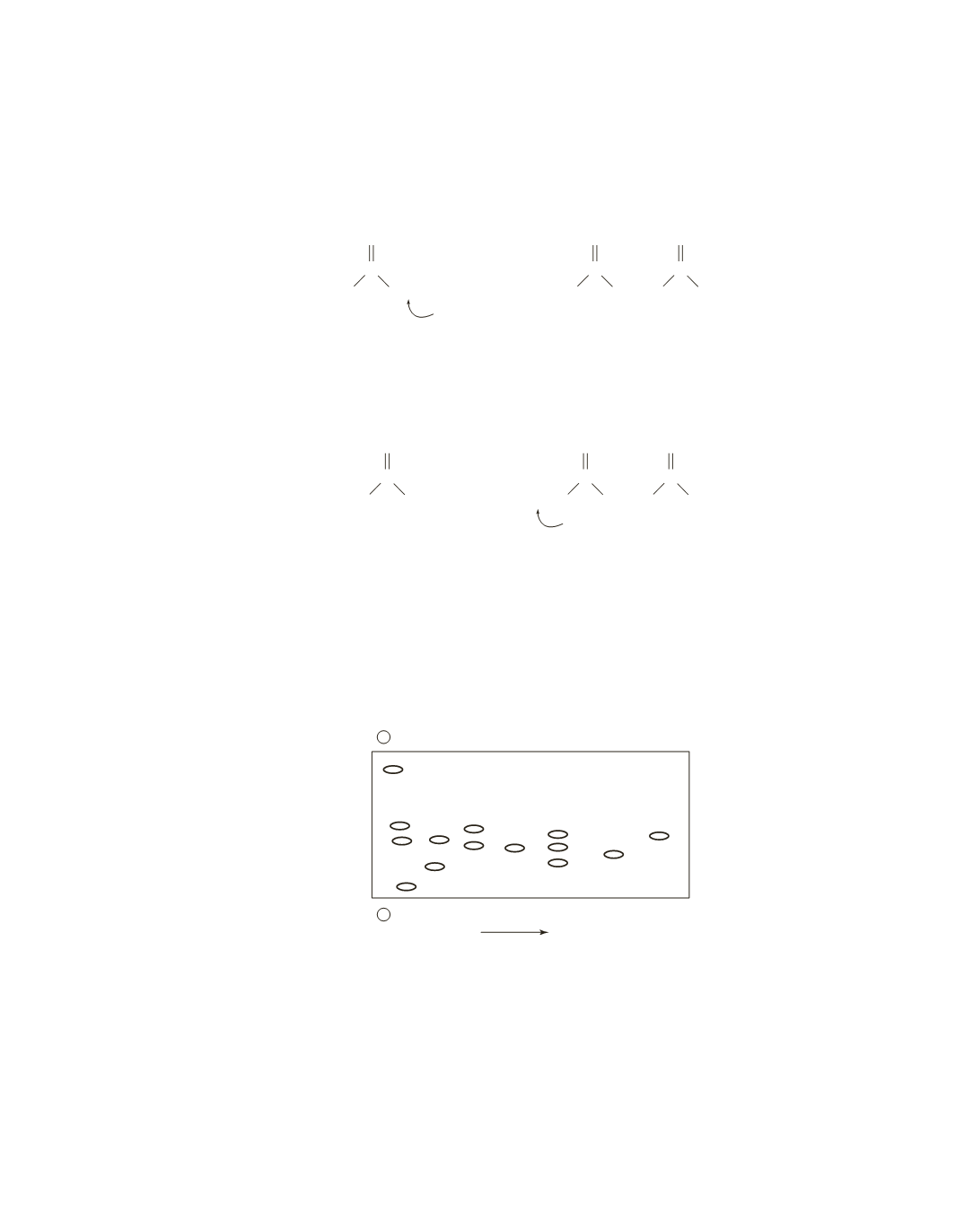
Finding that there is one less spot than the number of amino acids tells you that the spots for two of the
amino acids superimpose. Because leucine and isoleucine have identical polarities, they are good candidates
for being the amino acids that migrate to the same location.
Val
1
pI
=
5.97
2
, Trp
1
pI
=
5.89
2
, and Met
1
pI
=
5.75
2
can be ordered based on their pI values, because
the one with the greatest pI will be the one with the greatest amount of positive charge at pH
=
5. (See
Problem 52.)
Arg
chromatography
−
+
electrophoresis
pH = 5
Asp
Glu
Pro
Ser
Tyr
Thr
Gly
Met
Phe
Leu
Ile
Trp
Val
Ala