



 730 / 912

722 Chapter 21
Copyright © 2017 Pearson Education, Inc.
60.
An amino acid is insoluble in diethyl ether (a relatively nonpolar solvent) because an amino acid exists as
a highly polar zwitterion at neutral pH. Carboxylic acids and amines are less polar because they either are
neutral or have a single charge depending on the extent of dissociation in diethyl ether.
61.
You would (correctly) expect serine and cysteine to have lower p
K
a
values than alanine, because a
hydroxymethyl and a thiomethyl group are more electron withdrawing than a methyl group. Because oxygen
is more electronegative than sulfur, you would expect serine to have a lower p
K
a
than cysteine. The fact that
cysteine has a lower p
K
a
than serine can be explained by stabilization of serine’s carboxyl proton by hydrogen
bonding to the
b
-OH group of serine, which causes it to have less of a tendency to be removed by a base.
HC
H
2
C
O
H
O
C
O
H
H
3
N
+
62.
Each compound has two groups that can act as a buffer, one amino group and one carboxyl group. There-
fore, the compound in higher concentration (0.2 M glycine) is a more effective buffer.
63.
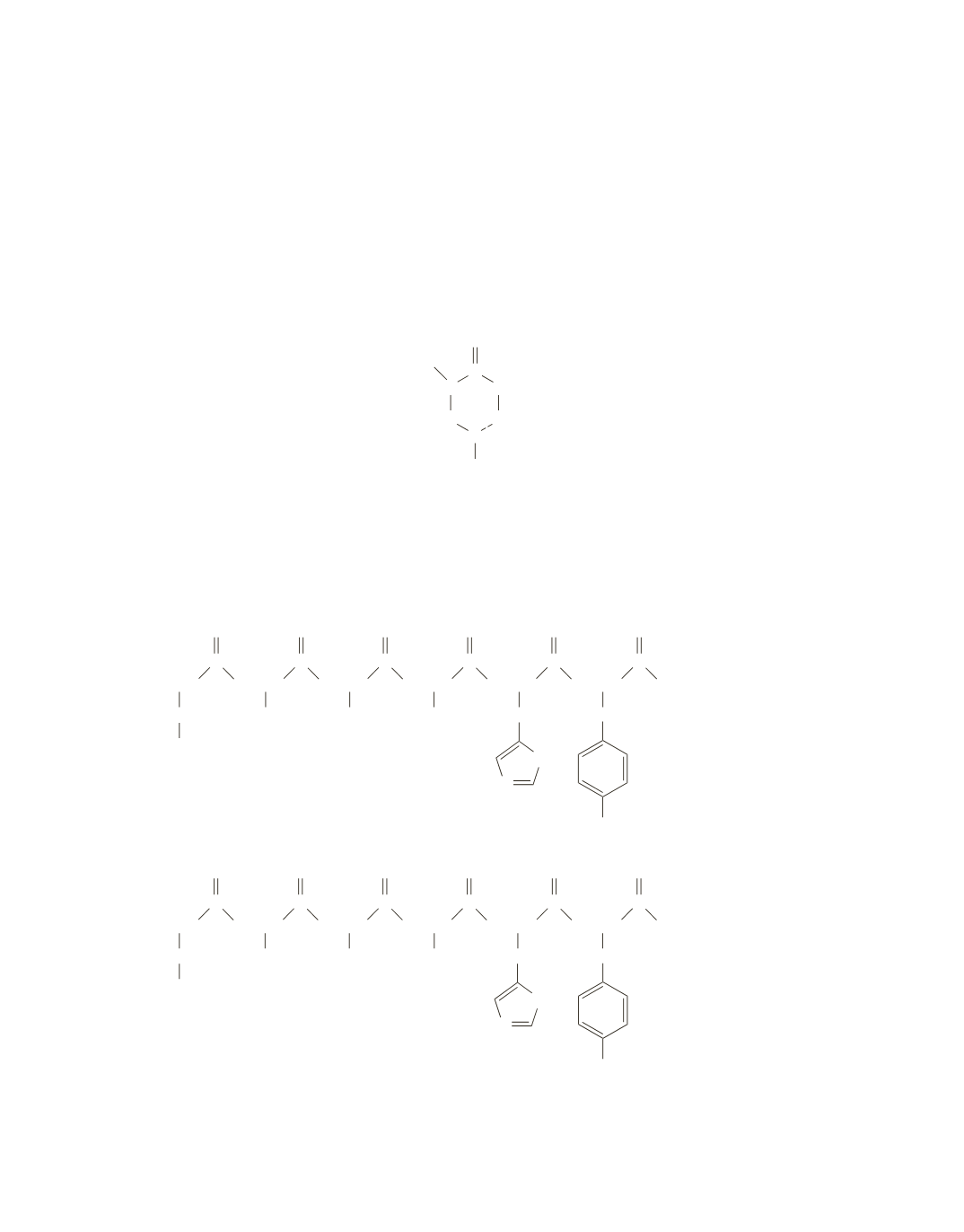
Groups that are not fully charged at the given pH are shown in the form that predominates at that pH. For
example, tyrosine has a p
K
a
=
9.11, so at pH
=
7, it is shown in its acidic form (with its proton).
a.
OH
N
NH
+
NHCH
CH
2
NHCH
CH
2
OH
H
CH
2
COOH
NHCH
CH
2
SH
NHCH
NHCH
CH
2
OH
H
3
NCH
(CH
2
)
4
NH
3
+
+
C
O
C
O
C
O
C
O
C
O
C
O
b.
+
+
+
(CH
2
)
4
NH
3
NHCH
NHCH
CH
2
OH
H
3
NCH
NHCH
CH
2
SH
CH
2
COO
−
OH
NHCH
CH
2
NHCH
CH
2
O
−
N
H
NH
C
O
C
O
C
O
C
O
C
O
C
O