



 729 / 912

Chapter 21 721
Copyright © 2017 Pearson Education, Inc.
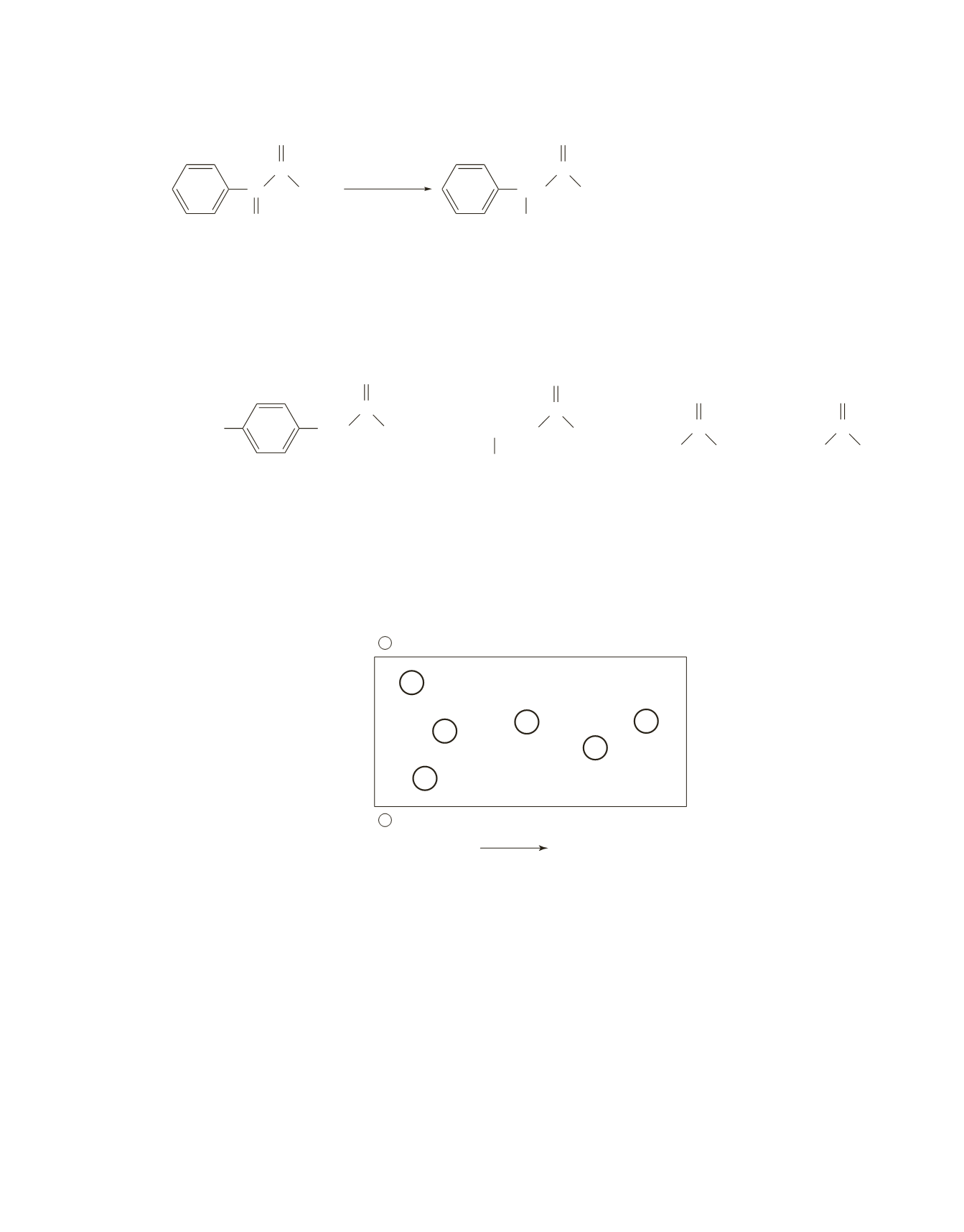
55.
C OH
C
O
O
CH O
C
O
NH
3
1. excess NH
3
trace acid
2. H
2
, Pd/C
+
−
56.
The student is correct. At the pI, the total of the positive charges on the tripeptide’s amino groups must be
one to balance the one negative charge of the carboxylate group. When the pH of the solution is equal to
the p
K
a
of a lysine residue, the three lysine groups each have one-half of a positive charge for a total of one
and one-half positive charges. Therefore, the solution must be more basic than this to have just one positive
charge.
57.
a.
CH H
HO
C
O
2
b.
CH
H
C
O
CH
3
CH
3
CH
2
c.
H
C
O
H N
2
NH
+
C
2
NHCH
2
CH
2
CH
2
58.
In a solution of pH
=
5,
His
will have an overall positive charge and
Glu
will have an overall negative
charge.
His
, therefore, will migrate to the cathode, and
Glu
will migrate to the anode.
Ser
is more polar than
Thr
(both have OH groups, but
Thr
has an additional carbon).
Thr
is more polar than
Met
(
Met
has SCH
2
CH
2
instead of CH(OH)CH
3
).
Met
is more polar than
Leu
(
Leu
has four carbons instead of the sulfur and three carbons that
Met
has).
chromatography
+
−
Glu
Ser
His
Thr
Met
Leu
electrophoresis
pH = 5
59.
We know that “Fragment 3” (Leu-Pro-Phe) is at the C-terminal end of the polypeptide. Now the only
question we need to answer is which of the two fragments obtained by cleavage with cyanogen bromide,
which begin with Gly and end with Met, is nearest the C-terminal end of the polypeptide. The answer is
obtained from “Fragment 4” obtained from trypsin cleavage. The Met nearest the C-terminal end must be
preceded by Arg or Lys. Therefore, the polypeptide has the following sequence:
Gly
@
Leu
@
Tyr
@
Phe
@
Lys
@
Ser
@
Met
@
Gly
@
Leu
@
Tyr
@
Lys
@
Val
@
Ile
@
Arg
@
Met
@
Leu
@
Pro
@
Phe