


 726 / 912

718 Chapter 21
Copyright © 2017 Pearson Education, Inc.
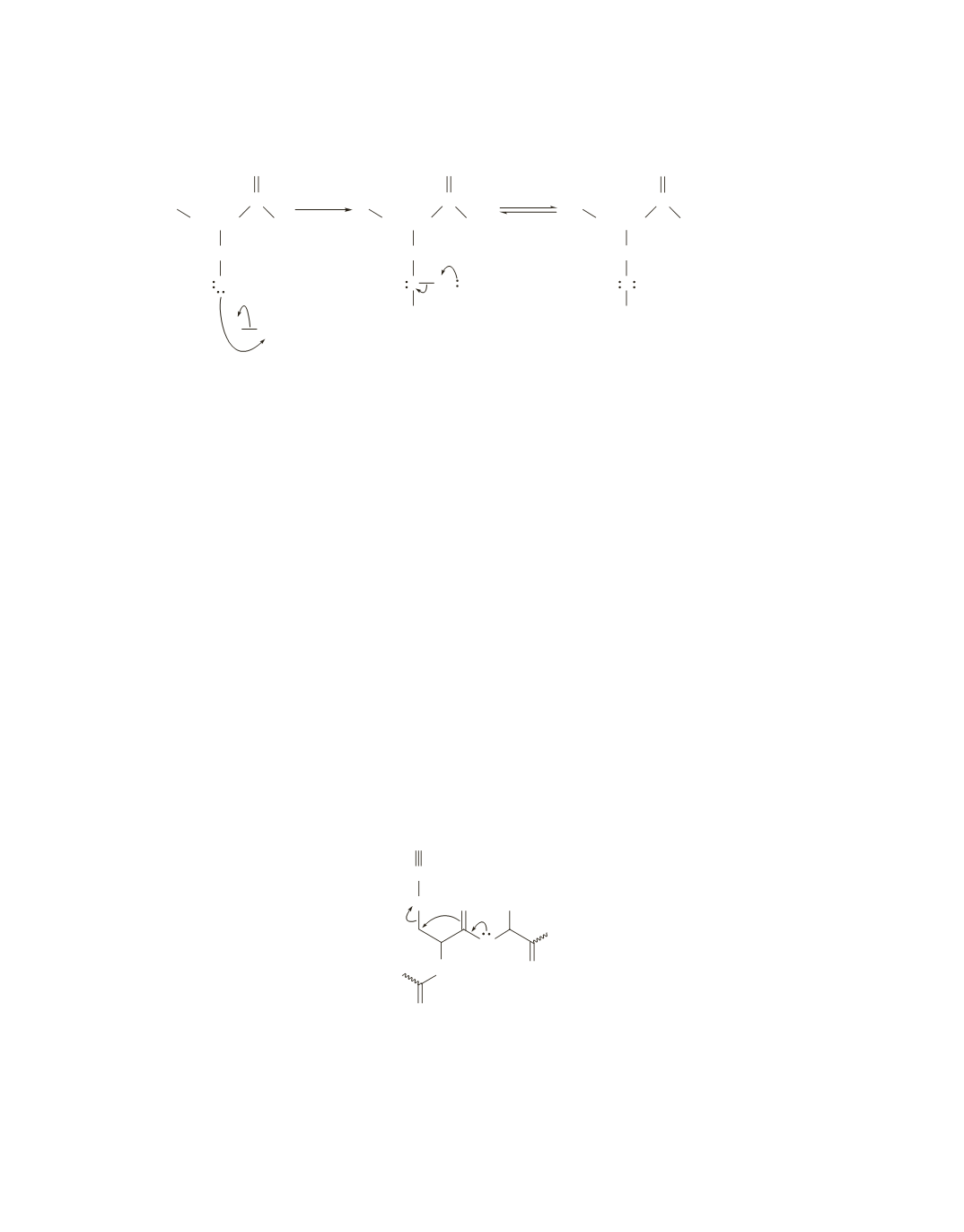
37.
It is an S
N
2 reaction followed by dissociation of a proton.
+
I
−
HB
+
I CH
2
COOH
NHCH
CH
2
SH
NHCH
CH
2
S
S
CH
2
COOH
+
NHCH
C
O
C
O
C
O
CH
2
CH
2
COOH
H B
38.
Because insulin has two peptide chains, treatment with Edman’s reagent would release two PTH-amino
acids in approximately equal amounts.
39.
Knowing that the N-terminal amino acid is Gly, look for a peptide fragment that contains Gly.
“Fragment 6” tells you that the second amino acid is Arg.
“Fragment 5” tells you that the next two are Ala-Trp or Trp-Ala.
“Fragment 4” tells you that Glu is next to Ala, so the third and fourth amino acids must be Trp-Ala and the
fifth is Glu.
“Fragment 7” tells you that the sixth amino acid is Leu.
“Fragment 8” tells you that the next two are Met-Pro or Pro-Met.
“Fragment 3” tells you that Pro is next to Val, so the seventh and eighth amino acids must be Met-Pro and
the ninth is Val.
“Fragment 2” tells you that the last amino acid is Asp.
Gly
@
Arg
@
Trp
@
Ala
@
Glu
@
Leu
@
Met
@
Pro
@
Val
@
Asp
40.
Cysteine can react with cyanogen bromide, but the sulfur would not be positively charged, so it would be
a poor leaving group. In addition, the lactone would not be formed because it would have a strained four-
membered ring. Without lactone formation, the imine would not be formed, so cleavage cannot occur.
N
NH
O R
S
C
N
O
O
H
poor
leaving
group
formation of a four-
membered ring
41.
a.
His-Lys Leu-Val-Glu-Pro-Arg Ala-Gly-Ala
b.
Leu-Gly-Ser-Met-Phe-Pro-Tyr Gly-Val
42.
Solved in the text.