



 728 / 912

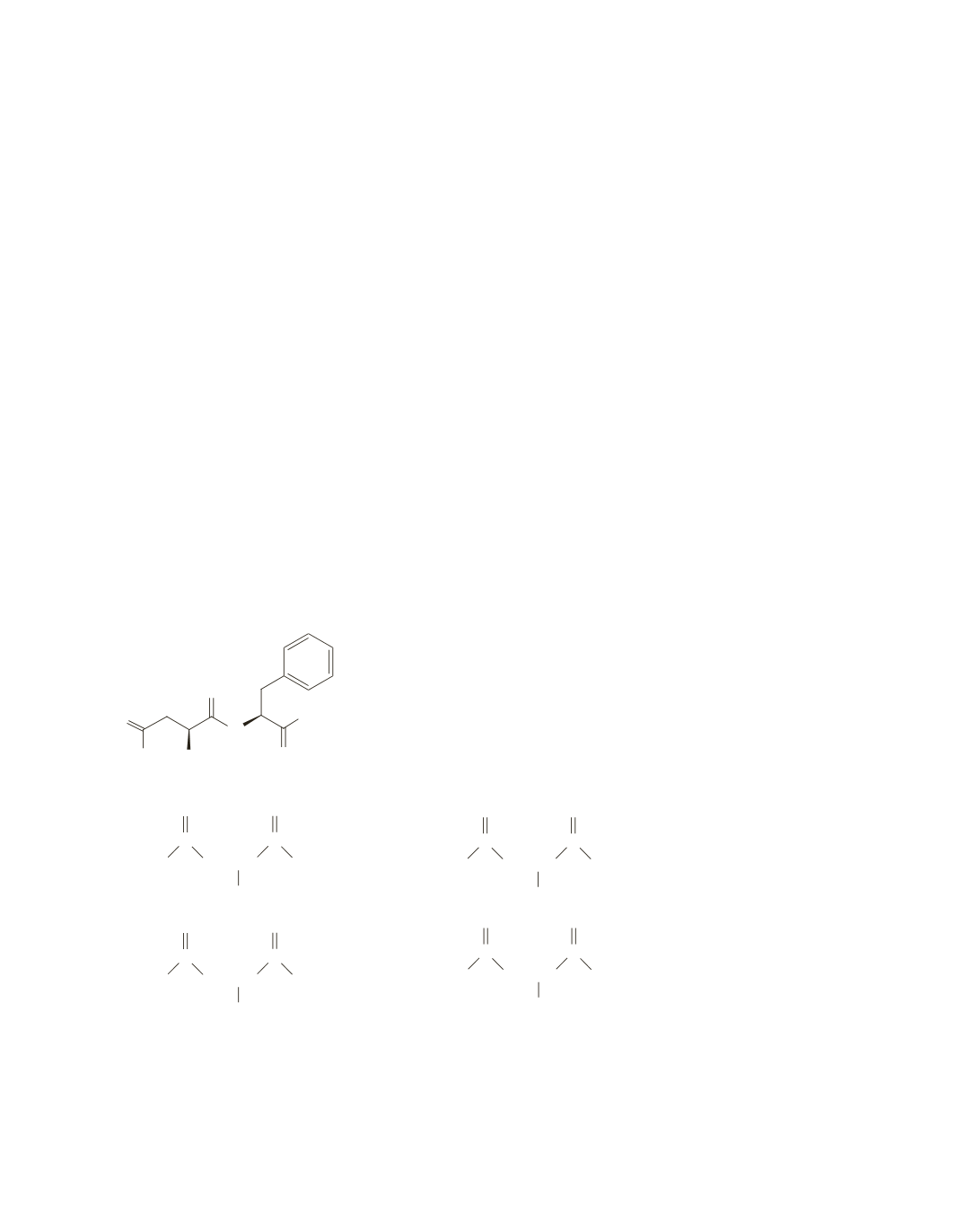
720 Chapter 21
Copyright © 2017 Pearson Education, Inc.
48.
Lemon juice contains citric acid. Some of the side chains of the enzyme will become protonated in an
acidic solution. This will change the charge of the group (for example, a negatively charged aspartate, when
protonated, becomes neutral; a neutral lysine, when protonated, becomes positively charged). Because the
shape of an enzyme is determined by the interaction of the side chains, changing the charges of the side
chains causes the enzyme to undergo a conformational change that leads to denaturation. When the enzyme
is denatured, it loses its ability to catalyze the reaction that causes apples to turn brown.
49.
a.
pH
=
9.69
b.
pH
=
(its pI)
c.
pH
=
2.34
50.
a.
Val-Arg-Gly-Met-Arg-Ala Ser
b.
Ser-Phe-Lys-Met Pro-Ser-Ala-Asp
c.
Arg Ser-Pro-Lys Lys Ser-Glu-Gly
51.
a.
The p
K
a
of 6.0 indicates that the amino acid is histidine.
b.
Because it requires two equivalents of hydroxide ion to get to a neutral pH, the amino acid has two
acidic groups. The p
K
a
of 9.8 indicates that the amino acid is aspartic acid.
c.
The p
K
a
values indicate that the amino acid is most likely alanine. However, it could be isoleucine.
52.
As an amino acid moves from a solution with a pH equal to its pI to a more basic solution, the amino acid
becomes more and more negatively charged. Because asparagine has a lower pI than leucine, in a solution
of pH
=
7.3, asparagine has moved farther from its pI than has leucine. Asparagine, therefore, will have a
higher percentage of negative charge at pH
=
7.3.
53.
H
OCH
3
O
+
_
O
N
O
O NH
3
54.
a.
HO CH
2
CH OH
NH
3
+
C
O
C
O
b.
−
HO CH
2
CH O
NH
3
+
C
O
C
O
c.
−
O CH
2
CH O
−
C
O
C
O
NH
3
+
d.
−
O CH
2
CH O
−
C
O
C
O
NH
2