



 721 / 912

Chapter 21 713
Copyright © 2017 Pearson Education, Inc.
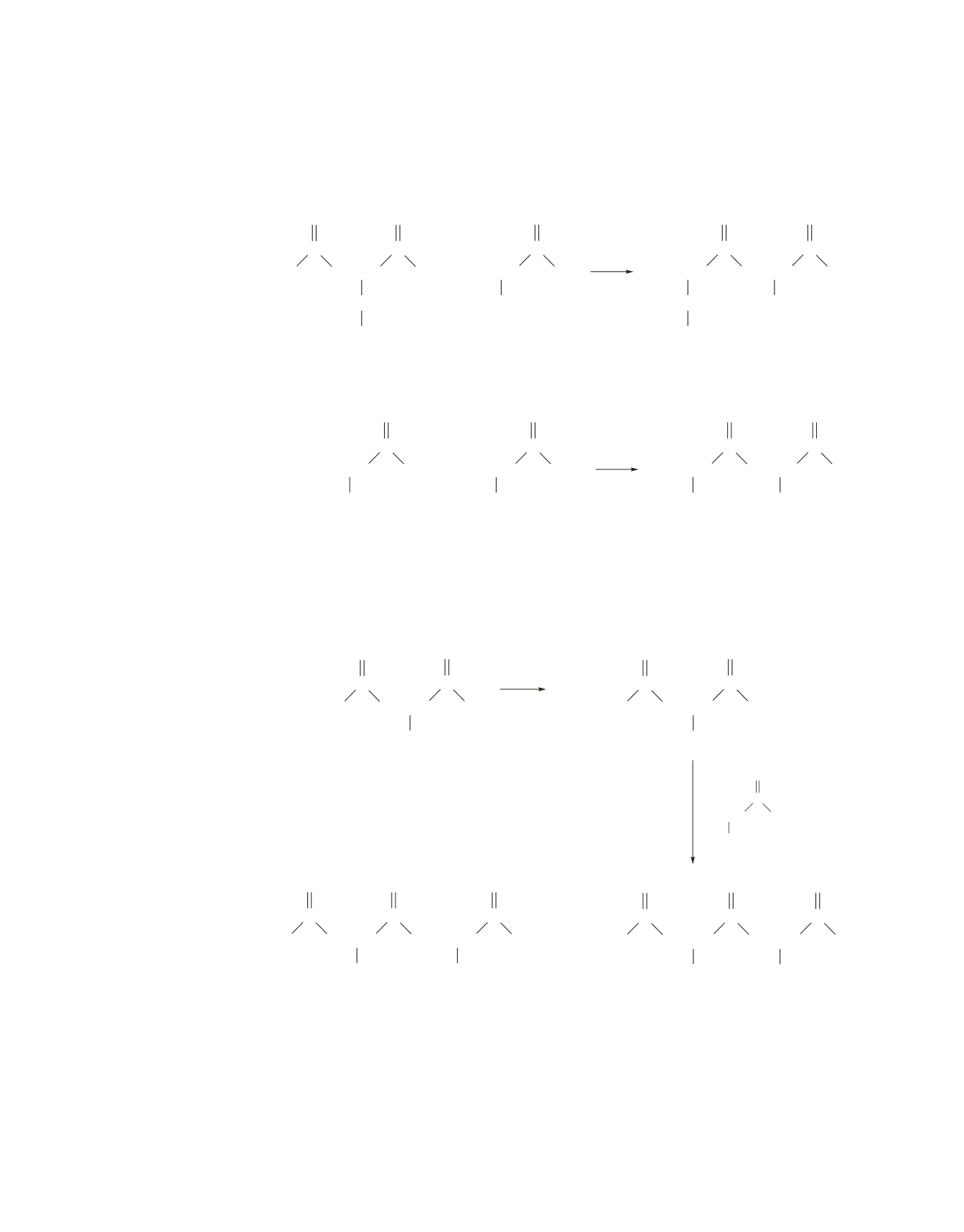
32.
Leu-Val
and
Val-Val
will be formed because the amino group of leucine is protected, so leucine cannot
react with a carboxyl group (that is, leucine cannot be the C-terminal amino acid). The amino group of
valine can react equally easily with the carboxyl group of leucine and the carboxyl group of valine.
NHCH O
−
CH
2
CH(CH
3
)
2
(CH
3
)
3
CO
H
3
NCH O
−
CH(CH
3
)
2
N-protected leucine
valine
+
H
3
NCH NHCH O
−
H
3
NCH NHCH O
−
H
3
NCH O
−
valine
+
H
3
NCH O
−
valine
Leu-Val
Val-Val
+
+
+
+
+
C
O
C
O
C
O
C
O
C
O
C
O
C
O
C
O
C
O
CH(CH
3
)
2
CH(CH
3
)
2
CH(CH
3
)
2
CH(CH
3
)
2
CH(CH
3
)
2
CH
2
CH(CH
3
)
2
33.
If valine’s carboxyl group is activated with thionyl chloride, the OH group of serine, as well as the NH
2
group of serine, would react readily with the very reactive acyl chloride, forming both an ester (with its OH
group) and an amide (with its NH
2
group).
O
−
CH(CH
3
)
2
CH Cl
SOCl
2
CH(CH
3
)
2
C
O
C
O
H
2
NCH O
−
CH
2
OH
C
O
+
CH
CH
NHCH O
−
CH
2
OH
amide
CH(CH
3
)
2
OCH
2
CH O
−
ester
NH
2
CH(CH
3
)
2
C
O
C
O
C
O
C
O
NHCH
(CH
3
)
3
CO
C
O
NH
(CH
3
)
3
CO
C
O
NH
(CH
3
)
3
CO
C
O
NH
(CH
3
)
3
CO
C
O
If valine’s carboxyl group is activated with DCCD, an imidate will be formed. Because an imidate is less
reactive than an acyl chloride, the imidate will react with the more reactive NH
2
group in preference to the
less reactive OH group.