



 719 / 912

Chapter 21 711
Copyright © 2017 Pearson Education, Inc.
25.
Convert the amino acids into esters using SOCl
2
followed by ethanol. Then treat the esters with pig liver
esterase. Because the enzyme hydrolyzes only esters of l-amino acids, the products will be the l-amino
acid, ethanol, and the ester of the d-amino acid. These compounds can be readily separated. After they are
separated, the d-amino acid can be obtained by acid-catalyzed hydrolysis of the ester of the d-amino acid.
This separation technique is called a kinetic resolution because the enantiomers are separated (resolved) as
a result of reacting at different rates in the enzyme-catalyzed reaction.
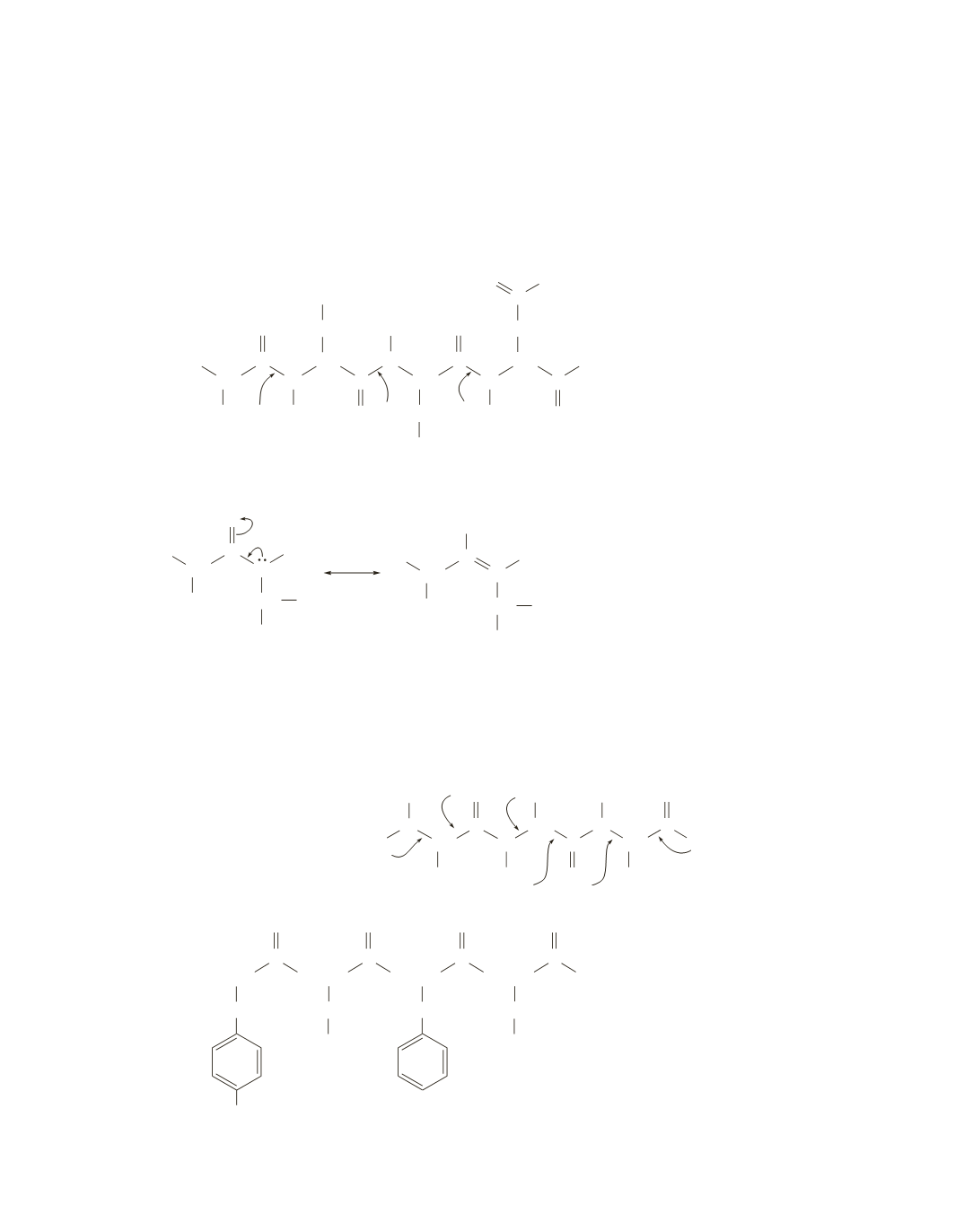
26.
+
H
3
N
CH
C
N
CH
C
N
CH
C
N
CH
C
O
O
O
O
O
H
H
H
CHOH
CH
3
CH
2
COO
−
CH
3
CH
2
C
NH
2
O
−
The peptide bonds are indicated by arrows.
27.
CH
C
N
O
CH
H
CH
C
N
O
−
CH
H
+
The less stable con guration has the R groups
on the same side of the double bond.
28.
The bonds on either side of the
a
-carbon can freely rotate. In other words, the bond between the
a
-carbon
and the carbonyl carbon and the bond between the
a
-carbon and the nitrogen (the bonds indicated by
arrows) can freely rotate. The bond between the C and N (the peptide bond) cannot rotate because it has
partial double-bond character.
N
CH
C
N
CH
C
N
CH
C
H O
O
R
H
H O R
29.
a.
O
−
+
H
3
NCH
C
NHCH NHCH
C
O
CH
2
CH
2
SH
O
CH
2
C
NHCH
C
O
SH
O
CH
2
OH