



 714 / 912

706 Chapter 21
Copyright © 2017 Pearson Education, Inc.
Solutions to Problems
1.
a.
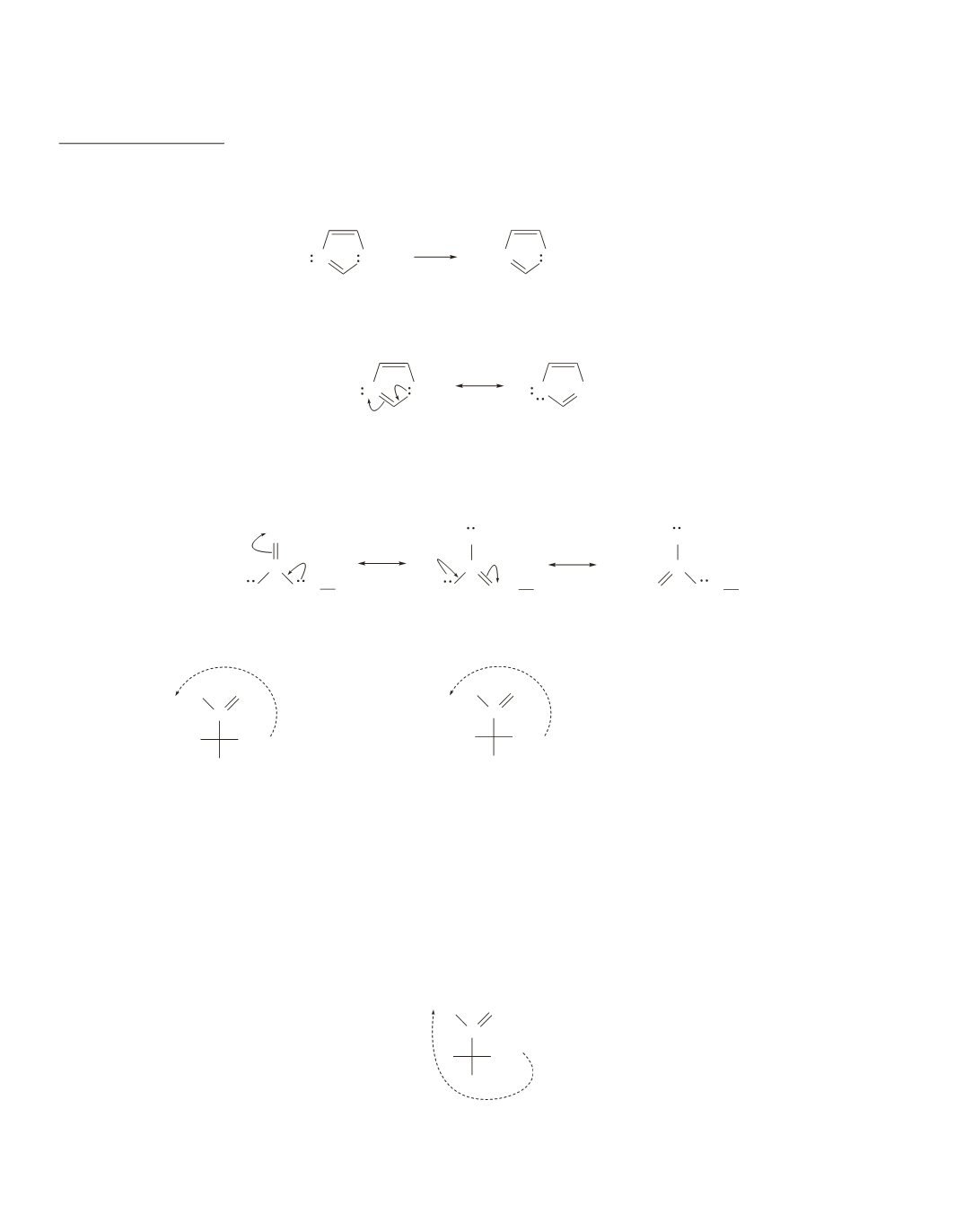
When the imidazole ring is protonated, the double-bonded nitrogen is the one that accepts the proton.
(Its lone pair is in an
sp
2
orbital.)
HCl
+
Cl
_
+
N NH
HN NH
The lone-pair electrons on the single-bonded nitrogen (
p
electrons) are delocalized and, therefore, are
not available to be protonated.
N NH
+
_
N NH
b.
The lone-pair electrons on the double-bonded nitrogen are protonated because the lone-pair electrons
on the other nitrogens are delocalized and, therefore, cannot be protonated. In addition, protonation of
the double-bonded nitrogen leads to a highly resonance-stabilized conjugate acid.
C
NH
2
NH
H
2
N
C
NH
2
NH
H
2
N
+
C
NH
H
2
N
+
+
NH
2
2.
a.
d-alanine is (
R
)-alanine
b.
d-asparate is (
R
)-aspartate
C
H NH
3
CH
3
−
O O
+
D
-alanine
(
R
)-alanine
C
H NH
3
CH
2
COO
−
−
O O
+
D
-aspartate
(
R
)-aspartate
c.
The
a
-carbons of all the d-amino acids except cysteine have the
R
-configuration. Similarly, the
a
-carbons of all the l-amino acids except cysteine have the
S
-configuration.
In all the amino acids except cysteine, the amino group has the highest priority and the carboxyl group
has the second-highest priority. In cysteine, the thiomethyl group has a higher priority than the carbox-
ylate group because sulfur has a greater atomic number than oxygen, causing the counterclockwise
arrow to be a clockwise arrow.
H NH
1
2
3
3
CH
2
SH
+
D
-cysteine
(
S
)-cysteine
C
−
O O