



 671 / 912

Chapter 19 663
Copyright © 2017 Pearson Education, Inc.
30.
a.
4-chloro-3-isopropylpyridine
b.
2-isopropyl-3-methylazacyclopropane
c.
4-ethyl-2,2,3-trimethyloxacyclobutane
31.
The products of the reaction show that the hydrogen is removed from the
b
-carbon that is bonded to the
most hydrogens. Therefore, we can conclude that the transition state has a carbanion-like one. (See page
417 in the text.)
32.
a.
CH
3
CH
3
N
OH
+
CH
2
CHCH
3
c.
+
CH
2
CH
2
CH
3
NCH
2
CHCH
3
OH CH
3
b.
CH
3
N
OH
+
CH
2
CHCH
3
d.
CH
2
CHCH
2
CH
2
CH
2
CH
2
NCH
3
OH
The carbon of the methyl group is the
-carbon that is bonded to the most
hydrogens.
33.
a.
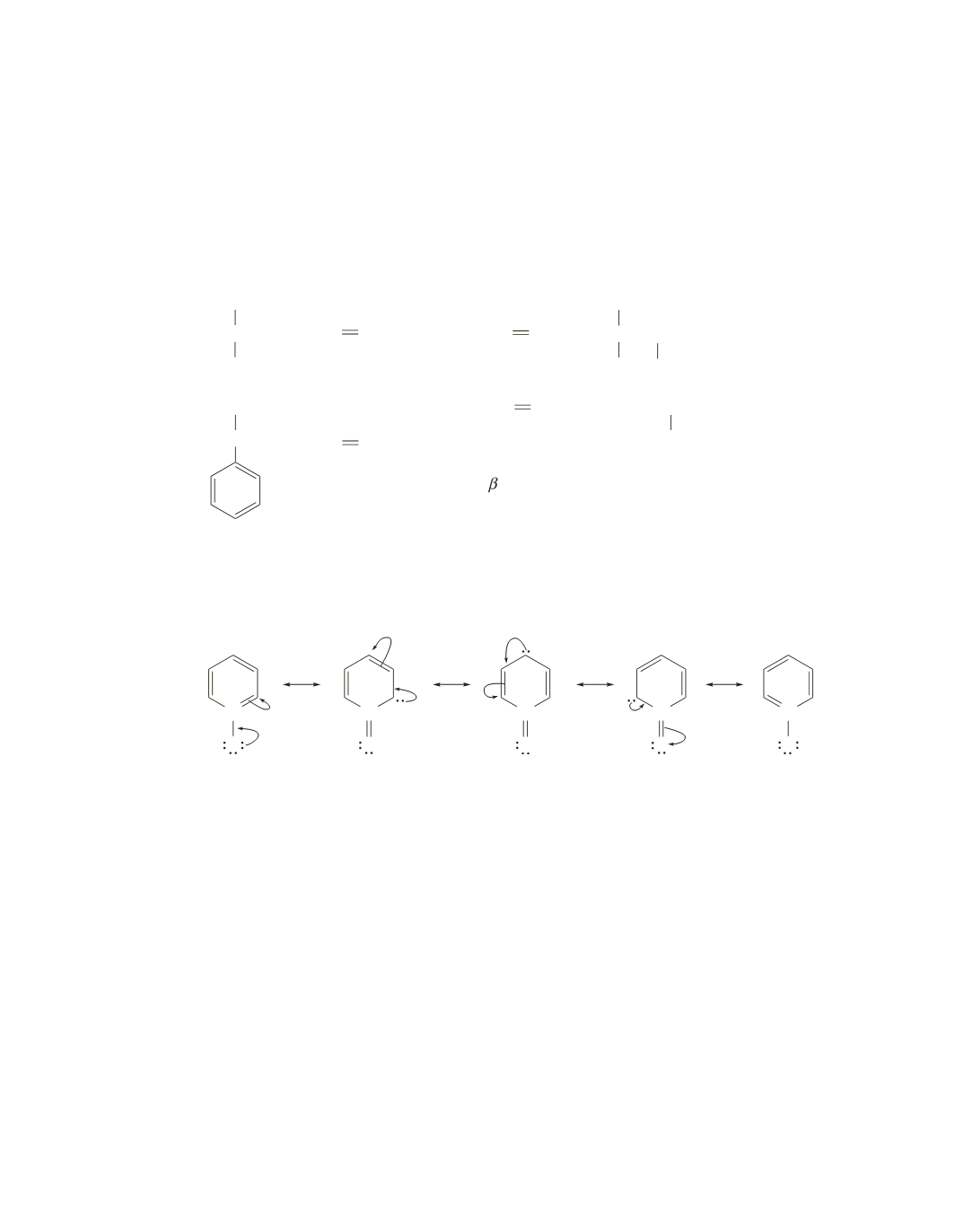
The increase in the electron density of the ring as a result of resonance electron donation by oxygen
causes pyridine-
N
-oxide to be more reactive toward electrophilic aromatic substitution than pyridine
because the extra electron density stabilizes the carbocation intermediate.
N
O
N
O
N
O
N
O
N
O
+
+
+
+
+
−
−
−
−
−
b.
In Section 18.13, we saw that substituents that are able to donate electrons by resonance into the ring
are ortho/para directors. Therefore, pyridine-
N
-oxide will undergo electrophilic aromatic substitution
at the 2- and 4-positions. Because the 2-positions are somewhat sterically hindered, pyridine-
N
-oxide
undergoes electrophilic substitution primarily at the 4-position.
34.
Pyrrolidine is a saturated nonaromatic compound, whereas pyrrole and pyridine are unsaturated aromatic
compounds. The C-2 hydrogens of pyrrolidine are at
d
2.82 ppm, about where one would expect the signal
for hydrogens bonded to an
sp
3
carbon adjacent to an electron-withdrawing amino group.
The C-2 hydrogens of pyrrole and pyridine are expected to be at a higher frequency because of diamagnetic
anisotropy (Section 14.8). Because the nitrogen of pyrrole donates electrons into the ring and the nitrogen of
pyridine withdraws electrons from the ring, the C-2 hydrogens of pyrrole are in an environment with a greater
electron density, so they should show a signal at a lower frequency relative to the C-2 hydrogens of pyridine.
Thus, the C-2 hydrogens of pyrrole are at
d
6.42 ppm, and the C-2 hydrogens of pyridine are at
d
8.50 ppm.