



 676 / 912

668 Chapter 19
Copyright © 2017 Pearson Education, Inc.
b.
S NO
2
Br
2
S NO
2
Br
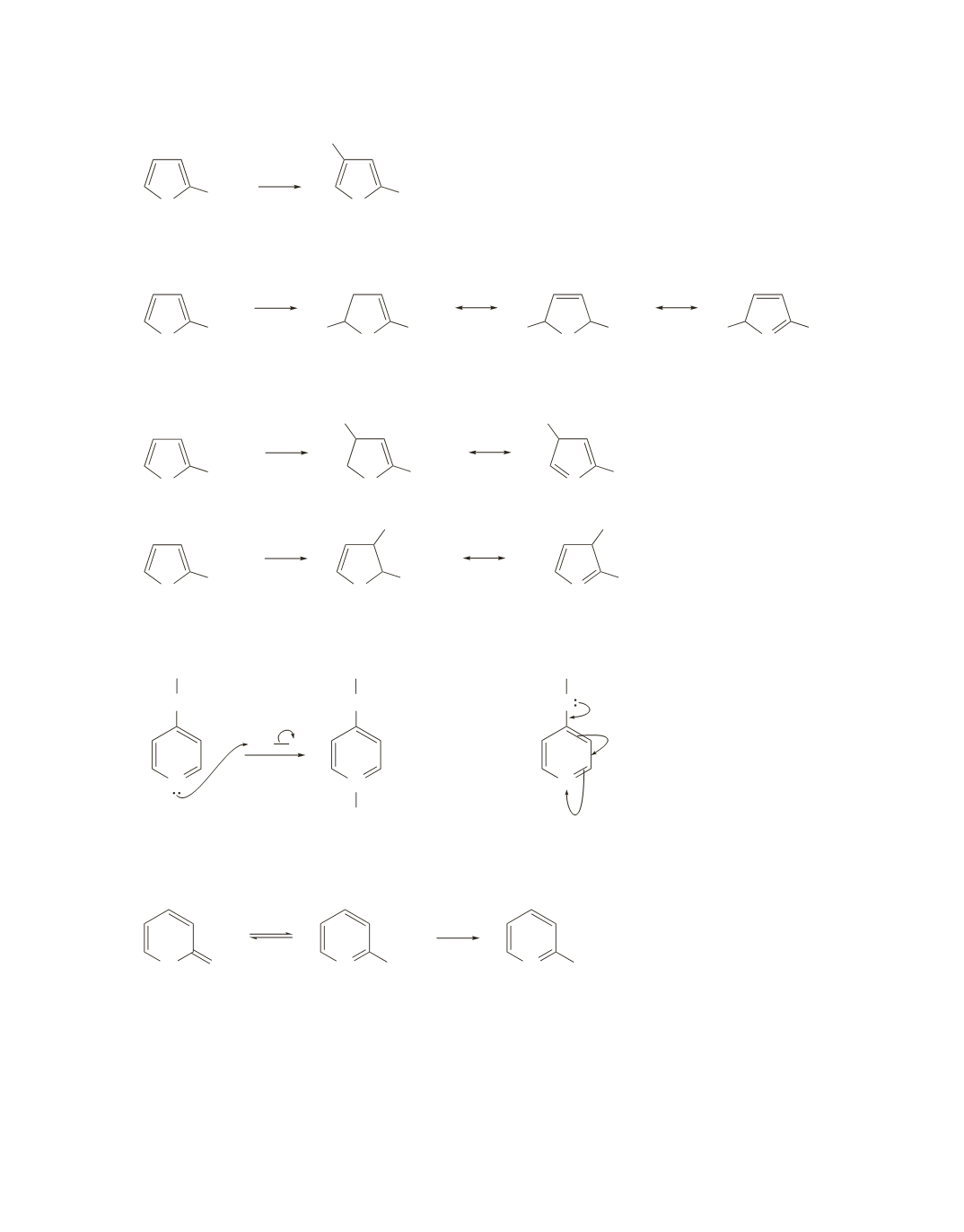
You can understand why the bromo substituent goes to this position by examining the relative stabili-
ties of the possible carbocation intermediates.
S NO
2
Y
+
S NO
2
Y
+
S NO
2
Y
+
S NO
2
Y
+
relatively
unstable
S NO
2
Y
+
S NO
2
+
S NO
2
+
Y
Y
S NO
2
Y
+
S NO
2
+
S NO
2
+
Y
Y
relatively
unstable
c.
CH
3
N
N
CH
3
I
−
+
I
N
CH
3
N
CH
3
CH
3
N
CH
3
CH
3
N
CH
3
The other nitrogen is not alkylated, because its lone pair is delocalized into the pyridine ring. Therefore,
it is not available to react with the alkyl halide.
d.
N
H
O
N OH
N Cl
PCl
3
PCl
3
substitutes a Cl for an OH, as it does in alcohols and carboxylic acids.