



 668 / 912

660 Chapter 19
Copyright © 2017 Pearson Education, Inc.
23.
N
+
A
H H
>
N
H
+
>
B
N
N
H
C
+
H
>
N
H H
+
D
>
N
N
H
E
>
N
H
F
>
N
H
G
A
is the most acidic, because it becomes aromatic when it loses a proton.
B
,
C
, and
D
are the next most acidic, because in all three, the proton is bonded to a positively charged nitrogen.
B
and
C
are more acidic than
D
, because in
B
and
C
, the proton to be lost is bonded to an
sp
2
nitrogen,
which is more electronegative than the
sp
3
nitrogen in
D
.
B
is more acidic than
C
, because the uncharged nitrogen in
C
can donate electrons by resonance to the positively
charged nitrogen, which stabilizes the protonated form since the positive charge is shared by two nitrogens.
Neutral compounds
E
,
F
, and
G
are the least acidic.
E
and
F
are more acidic than
G
, because
E
and
F
lose
a proton from an
sp
2
nitrogen, whereas a proton is lost from a less electronegative
sp
3
nitrogen in
G
.
E
is more acidic than
F
, because the negative charge on
E
’s conjugate base can be delocalized onto the
second nitrogen.
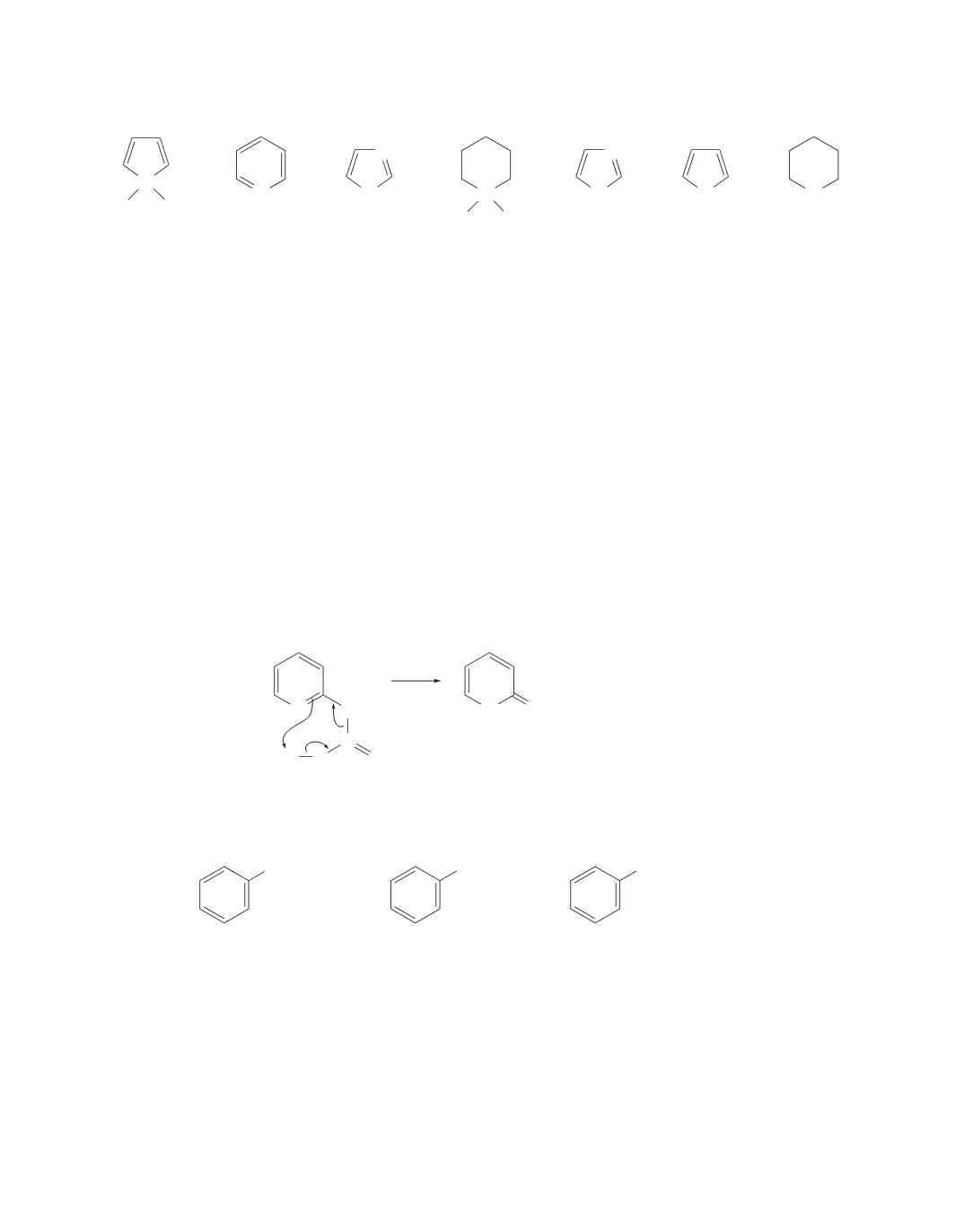
24.
The compound on the right (the compound shown below) is easier to decarboxylate, because the electrons
left behind when CO
2
is removed can be delocalized onto nitrogen, forming a stable neutral species as a
result of proton donation to nitrogen. The electrons left behind when the other compound loses CO
2
cannot
be delocalized.
N CH
2
C
O OH
N
H
CH
2
+
CO
2
25.
The
N
-,
O
-, and
S
-substituted benzenes have the same relative reactivity toward electrophilic aromatic
substitution as the
N
-,
O
-, and
S
-containing five-membered heterocyclic rings and for the same reason.
NHCH
3
OCH
3
SCH
3
>
>
The
N
-substituted benzene is more reactive than the
O
-substituted benzene, because nitrogen is more
effective than oxygen at donating electrons into the benzene ring since it is less electronegative than
oxygen. (Recall that electrophilic substitution is aided by electron donation to the ring because it stabilizes
the carbocation formed in the rate-limiting step.)
The
S
-substituted benzene is the least reactive because the lone-pair electrons of sulfur are in a 3
p
orbital,
whereas the lone-pair electrons of nitrogen and oxygen are in a 2
p
orbital. Electron delocalization by over-
lap of the 3
p
orbital of sulfur and the 2
p
orbital of carbon is less effective than electron delocalization by
overlap of the 2
p
orbital of nitrogen and the 2
p
orbital of carbon.