


 531 / 912

Chapter 16 523
Copyright © 2017 Pearson Education, Inc.
25.
NaBH
4
2. H
2
O
1.
Raney
nickel
H
2
Pd/C
H
2
CHCH
2
OH
CH
3
CH
CH
3
CH
2
CH
2
CH
2
OH
H
CH
3
CH
2
CH
2
CH H
CH
3
CH
C
O
C
O
26.
a.
CHCH
3
OH
c.
CH
2
COCH
3
O
OH
b.
COCH
3
O
d.
CH
2
CH
2
OH
OH
+
CH
3
OH
27.
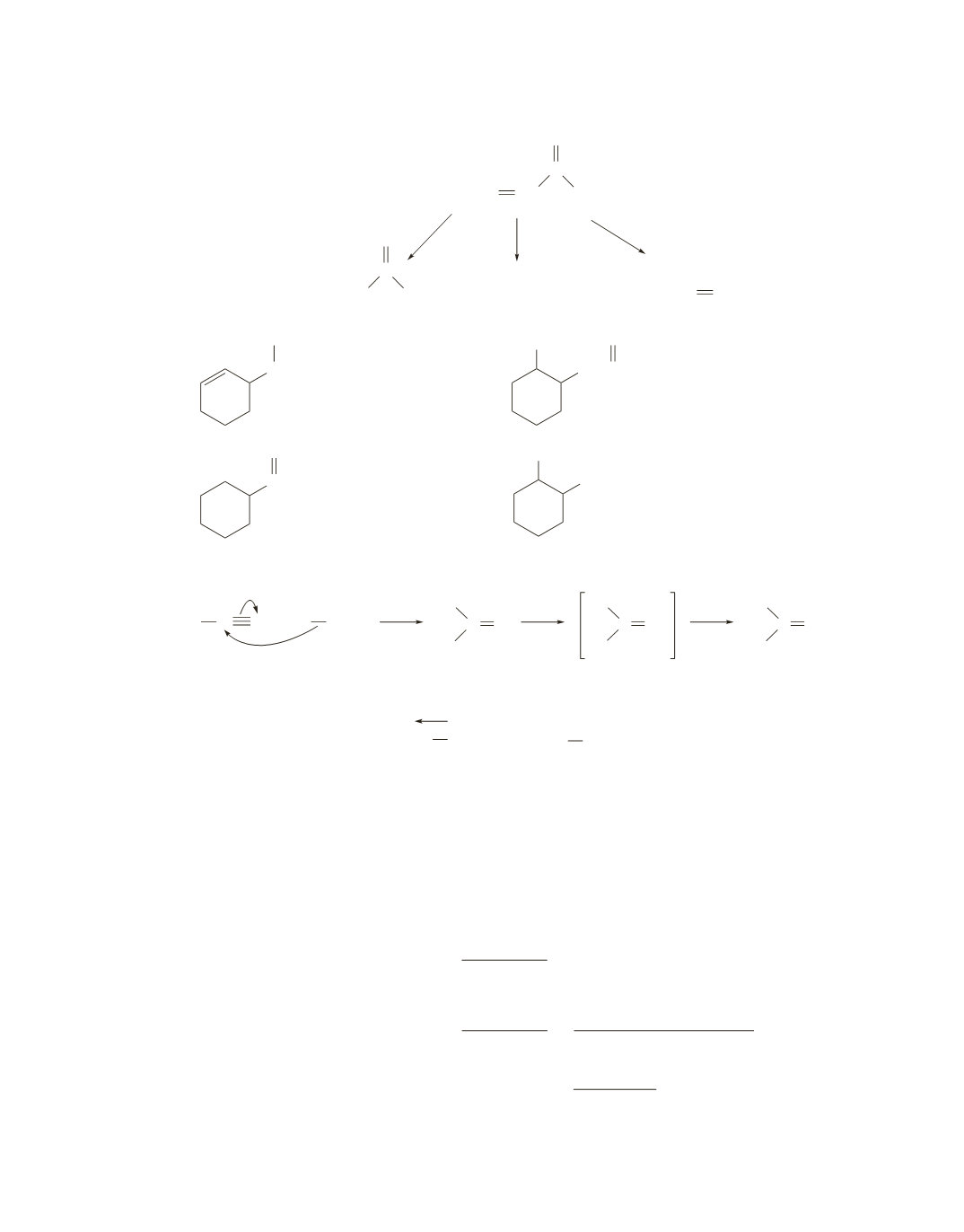
The nitrile reacts with the Grignard reagent to form an imine, which can then be hydrolyzed to a ketone.
CR
N
+
R MgBr
C N
R
R
HCl
C NH
R
R
H
2
O
HCl
C O
R
R
+
+
NH
4
−
28.
The OH group withdraws electrons inductively, and this makes the ammonium ion a stronger acid.
HO NH
3
CH
3
NH
3
+
+
29.
Figure 16.2 for imine formation when the amine is hydroxylamine (
p
K
a
of its conjugate acid
=
6.0
)
shows that the maximum rate is obtained when the pH is about 1.5 units lower than the
p
K
a
of the amine’s
conjugate acid. Therefore, for an amine such as ethylamine whose conjugate acid has a
p
K
a
11
, imine
formation should be carried out at about
pH
=
9.5.
30.
For the derivations of the equations used to calculate the amount of a compound that is present in either its
acidic or basic form, refer to Special Topic I in this
Study Guide and Solutions Manual
.
a.
fraction present in the acidic form
=
3
H
+
4
K
a
+
3
H
+
4
3
H
+
4
K
a
+
3
H
+
4
=
3.2
*
10
-
5
3.2
*
10
7
+
3.2
*
10
-
5
=
3.2
*
10
-
5
3.2
*
10
7
=
1
*
10
-
12