



 535 / 912

Chapter 16 527
Copyright © 2017 Pearson Education, Inc.
b.
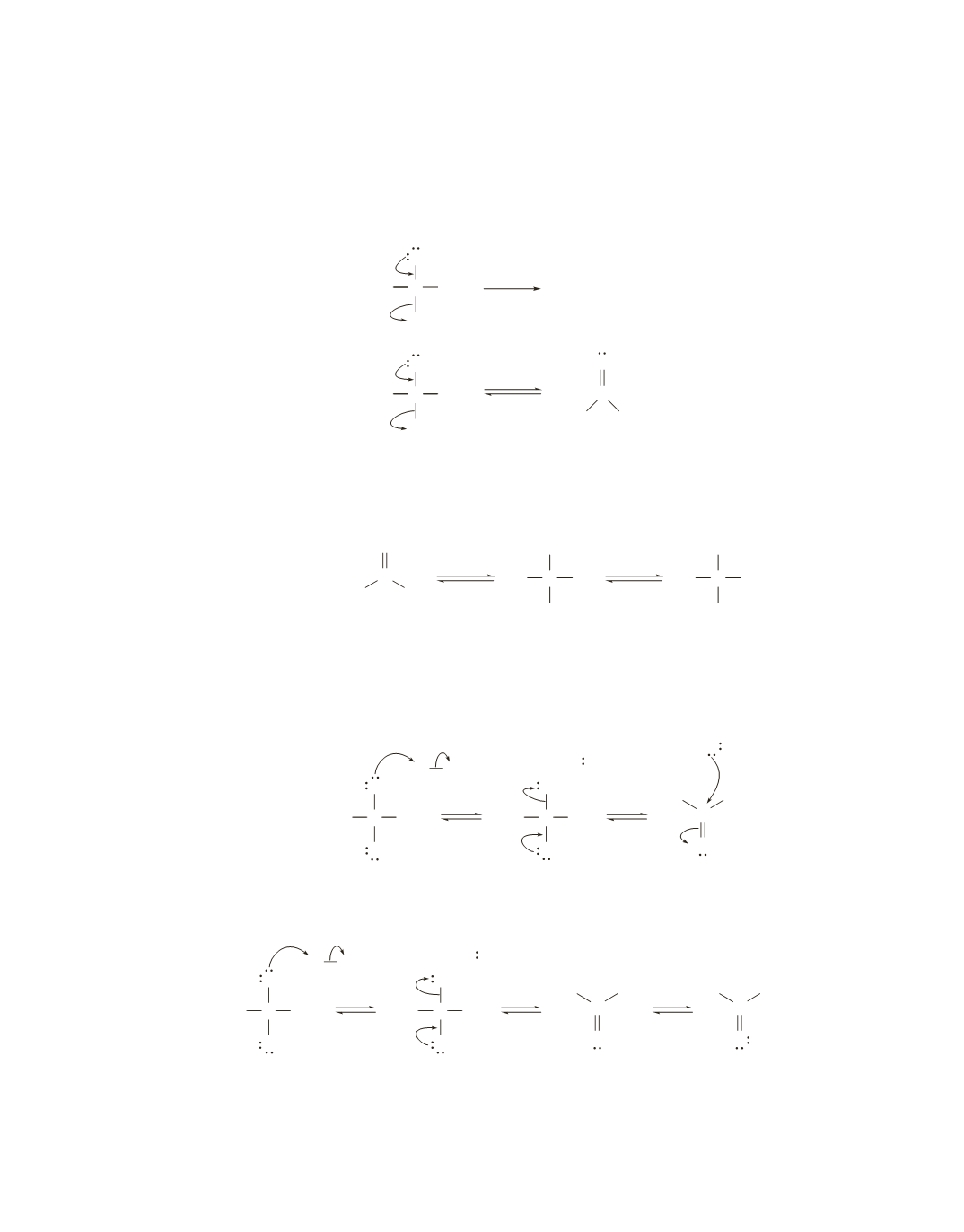
In order for an acetal to form, the
CH
3
O
group in the hemiacetal must eliminate an OH group.
Hydroxide ion is too basic to be eliminated by a
CH
3
O
group (because the charge that develops on the
oxygen in the transition state is positive), but water, a much weaker base, can be eliminated by a
CH
3
O
group. In other words, the OH group must be protonated before it can be eliminated by a
CH
3
O
group.
Therefore, acetal formation must be carried out in an acidic solution.
R C H
OCH
3
OH
×
R C H
OCH
3
OH
H
+
R H
+
OCH
3
+
H
2
O
C
c.
Hydrate formation can be catalyzed by hydroxide ion because a group does not have to be eliminated
after hydroxide ion attacks the aldehyde or ketone.
R H
C
O
HO
−
H
2
O
C
O
−
R
OH
H
C
OH
R
OH
H
41.
When a tetrahedral intermediate collapses, the intermediate that is formed is unstable because of the
positive charge on the
sp
2
oxygen atom. In the case of an acetal, the only way to form a neutral species is to
reform the acetal.
H B
+
B
R C H
OR
OR
R C H
OR
OR
H
+
C
OR
R H
unstable
RO
H
+
acetal
In the case of a hydrate, a neutral species can be formed by loss of a proton.
H B
+
B
R C H
OH
OH
R C H
OH
OH H
2
O
H
2
O
C
R H
unstable
hydrate
C
O
R H
+
HB
+
+ +
OH
H
+