


 540 / 912

532 Chapter 16
Copyright © 2017 Pearson Education, Inc.
e.
Br
P(C
6
H
5
)
3
P(C
6
H
5
)
3
P(C
6
H
5
)
3
CH
3
(CH
2
)
3
Li
+
+
−
C
O
CH
3
CH
3
CH
3
C
CH
3
(C
6
H
5
)
3
P O
+
f.
−
H
+
+
H
2
O
+
H
CH
2
CH
2
Br
MgBr
Mg
Et
2
O
+
H
2
O
+
−
O
CH
2
CH
3
CH
2
CH
3
Cl
HC
l
CHCH
3
CHCH
3
H
2
SO
4
CH
3
CH O
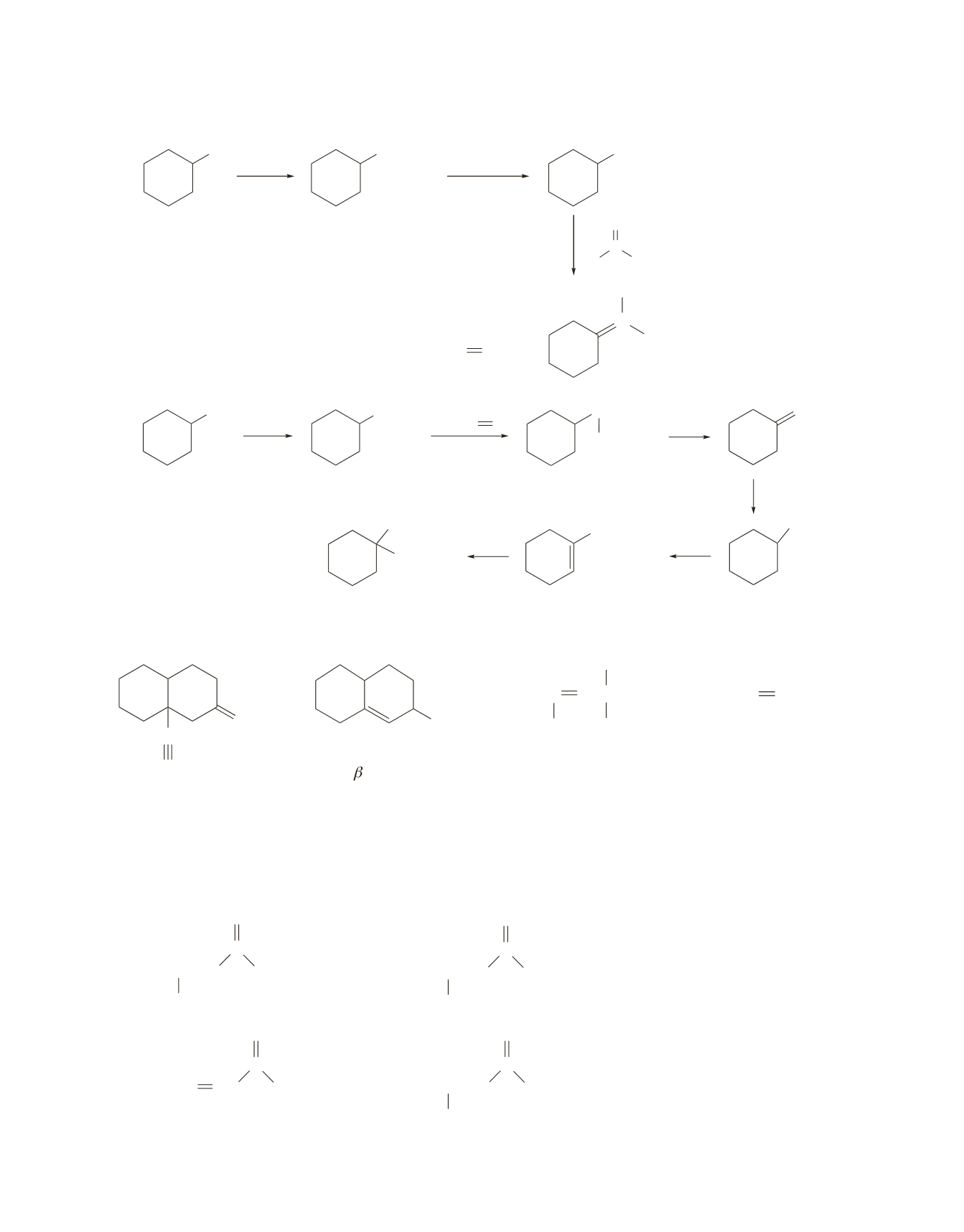
To see why 1-ethylcyclohexene is the final product of the dehydration, see page 470 in the text.
51.
O
C
a.
N
weak base favors
conjugate addition
OH
b.
steric hindrance
at the
-carbon
favors direct addition
c.
CH
3
C
CH
3
CHCCH
3
OH
CH
3
strong base favors
direct addition
d.
CH
3
CH CHCH
2
OH
strong base favors
direct addition
52.
Conjugate addition occurs in
a
and
c
because the nucleophile is a relatively weak base. Nucleophilic
addition–elimination occurs in
b
because the carbonyl group is very reactive. Because excess base is used
in part
d
, both nucleophilic addition–elimination and conjugate addition occur.
a.
CH
3
CHCH
2
OCH
3
Br
b.
CH OCH
3
CH
3
CH
CH
3
3
CHCH
2
OCH
NH
2
c.
CH
3
CHCH
2
NH
2
NH
2
d.
C
O
C
O
C
O
C
O