


 517 / 912

Chapter 15 509
Copyright © 2017 Pearson Education, Inc.
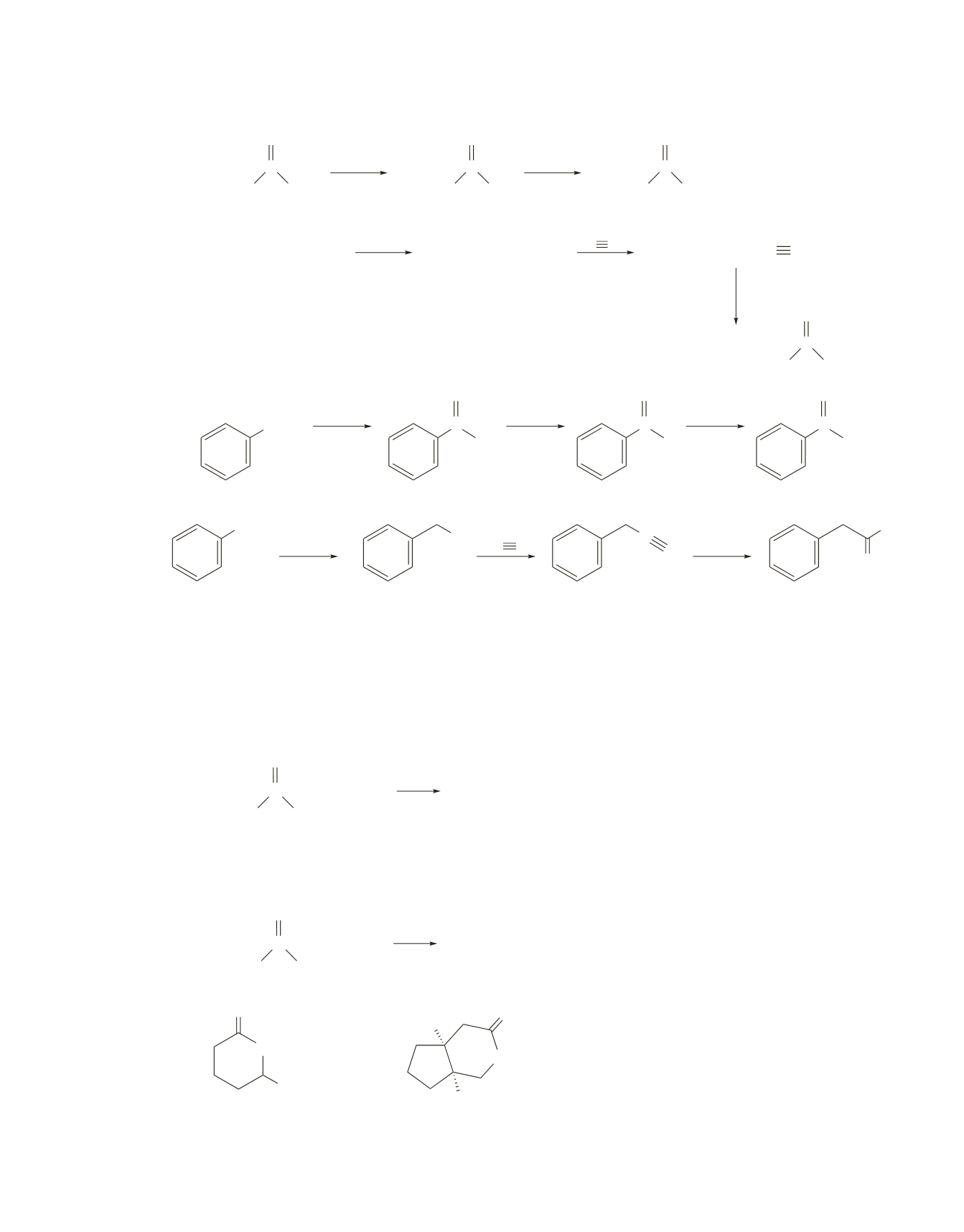
85.
CH
3
CH
2
NH
2
HCl
H
2
O,
CH
3
CH
2
OH
CH
3
CH
2
Cl
SOCl
2
CH
3
CH
2
CH
2
CH
2
Cl
−
C N
CH
3
CH
2
CH
2
CH
2
C N
HCl,
CH
3
CH
2
CH
2
CH
2
OH
+
SOCl
2
CH
3
CH
2
CH
2
CH
2
OH
H
2
O
NH
4
a.
b.
+
C
O
C
O
C
O
C
O
c.
OH
CH
3
Cl
NHCH
3
C
O
C
O
C
O
H
2
CrO
4
SOCl
2
excess
CH
3
NH
2
d.
CH
3
Br
C N
OH
O
NBS,
peroxide
C N
H
2
O
HCl,
−
86.
The acid-catalyzed hydrolysis of acetamide forms acetic acid and ammonium ion. It is an irreversible
reaction because the p
K
a
of an acetic acid is less than the p
K
a
of the ammonium ion. Therefore, it is
impossible to have the carboxylic acid in its reactive acidic form and ammonia in its reactive basic form.
If the solution is sufficiently acidic to have the carboxylic acid in its acidic form, ammonia will also be in
its acidic form, so it will not be a nucleophile.
+
NH
4
+
no reaction
The ammonium ion is not nucleophilic.
C
OH
CH
3
O
If the pH of the solution is sufficiently basic to have ammonia in its nucleophilic basic form, the carboxylic
acid will also be in its basic form; a negatively charged carboxylate ion cannot be attacked by nucleophiles.
+
NH
3
no reaction
The carboxylate ion is not attacked by nucleophiles.
C
O
−
CH
3
O
87.
O
O
CH
2
CH
3
O
O
H
H
+
CH
3
CH
2
OH
a.
b.