


 515 / 912

Chapter 15 507
Copyright © 2017 Pearson Education, Inc.
79.
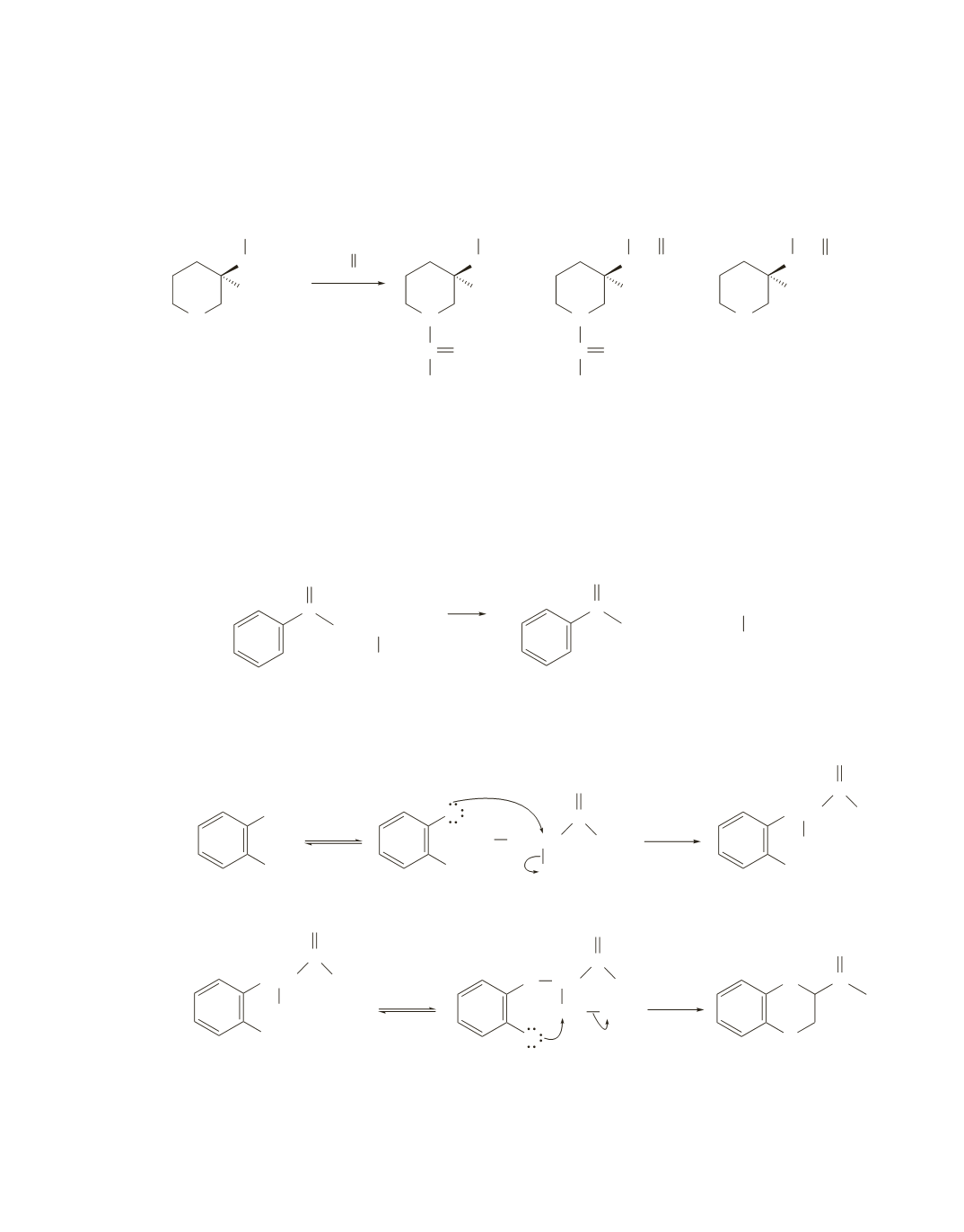
The amine is a better nucleophile than the alcohol but, because the acyl chloride is very reactive, it can
react easily with both nucleophiles. Therefore, steric hindrance is the most important factor in determining
the rate of formation of the products. The amino group is less sterically hindered than the alcohol group, so
that will be the group most easily acetylated.
N
H
CH
2
CH
3
CHOH
CH
3
CCl
O
pyridine
N
CH
2
CH
3
CHOH
C
CH
3
O
N
CH
2
CH
3
CHOCCH
3
C
CH
3
O
O
N
H
CH
2
CH
3
CHOCCH
3
O
major product
minor product
minor product
Pyridine (a tertiary amine)
is used for the second
equivalent of amine
(page 738 in the text).
CH
3
CH
3
CH
3
CH
3
80.
The spectrum shows that the compound has four different kinds of hydrogens with relative ratios 2:1:1:6.
The doublet at 0.9 ppm that integrates to 6 protons suggests that the compound has an isopropyl group. The
signal at 3.4 ppm that integrates to 2 hydrogens indicates a methylene group that is attached to an oxygen.
We can conclude that the spectrum is that of isobutyl alcohol. The molecular formula indicates that the
compound that undergoes hydrolysis is an ester. Subtracting the atoms due to the isobutyl group lets us
identify the ester as isobutyl benzoate.
HCl
H
2
O
+
HOCH
2
CHCH
3
CH
3
C
O
OCH
2
CHCH
3
CH
3
C
OH
O
81.
a.
K
2
CO
3
causes the solution to be at a pH that will cause the reactant to lose one of its protons. The
electron-withdrawing carbonyl group makes its
a
-carbon more susceptible to nucleophilic attack than
its
b
-carbon.
b.
OH
OH
OH
O
−
Br CH
2
CH OCH
3
Br
OH
OCH
+
−
Br
CH
2
Br
A
O
O
+
−
Br
B
HO
−
A
O
O
2
CH
CH Br
−
K
2
CO
3
OCH
3
OCH
3
OCH
3
C
O
C
O
OH
OCH
+
−
Br
CH
2
Br
OCH
3
C
O
C
O
C
O
The
intramolecular
formation of
B
occurs more rapidly than the
intermolecular
formation of
A
because
in the reaction that forms
B
, the reagents do not have to wander through the solution to find one another.