


 476 / 912

468 Chapter 14
Copyright © 2017 Pearson Education, Inc.
38.
The greater the extent of hydrogen bonding, the greater the chemical shift. Therefore, the
1
H
NMR spec-
trum of pure ethanol would have the signal for the OH proton at a greater chemical shift because it would
be hydrogen bonded to a greater extent.
39.
RO H
+
OH
−
RO
− +
H OH
40.
It is the
1
H
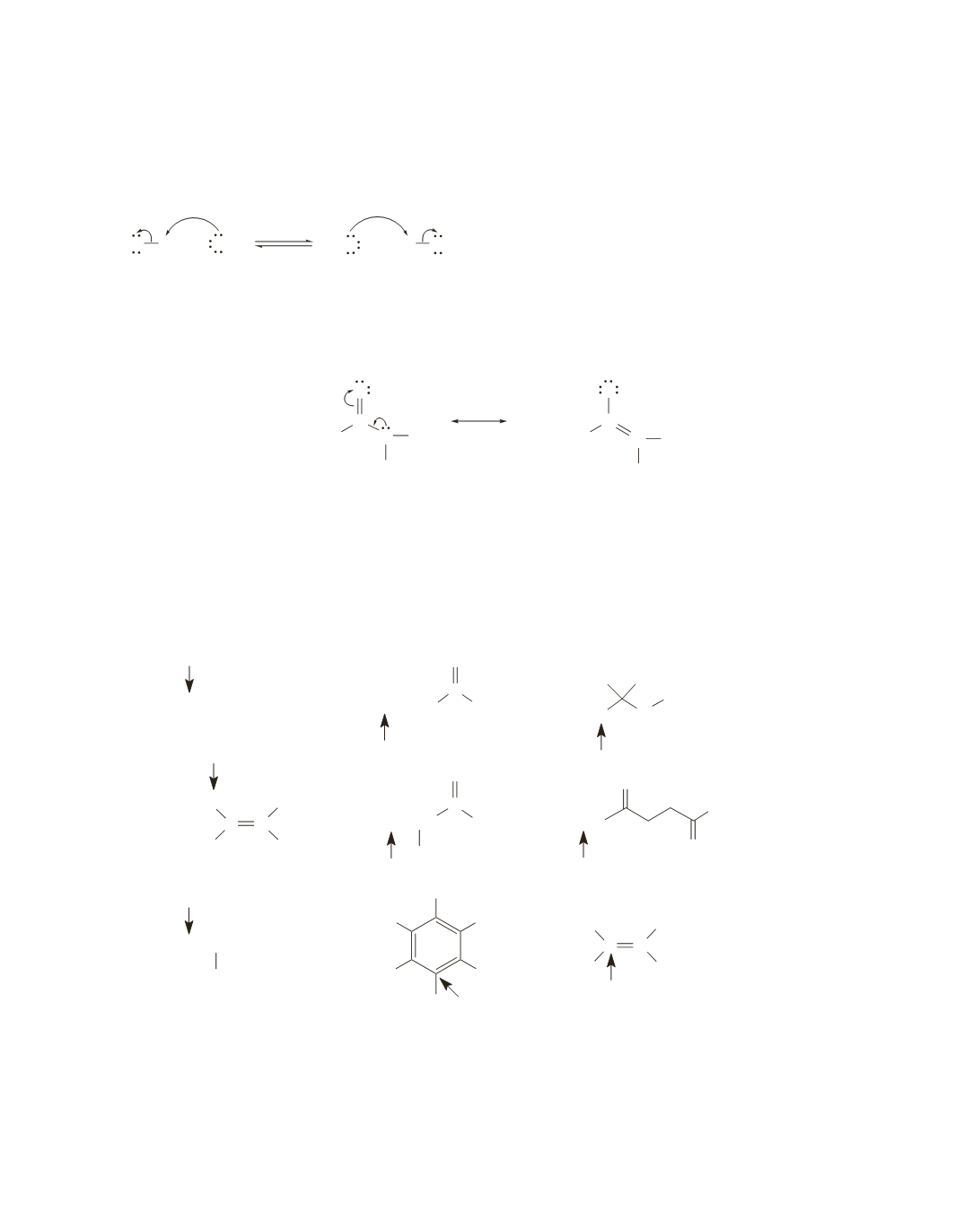
NMR spectrum of propanamide. Notice that the signals for the N—H protons are unusually
broad. Because of the partial double-bond character of the C—N bond, there is no free rotation about the
C—N bond, so the two N—H protons are not chemically equivalent. The quartet and triplet are character-
istic of an ethyl group.
O
N
CH
3
CH
2
H
H
O
−
C
N H
H
+
C
CH
3
CH
2
41.
a. 1.
3
2.
3
3.
2
4.
4
5.
3
6.
4
7.
3
8.
3
9.
2
b.
An arrow is drawn to the carbon that gives the signal at the lowest frequency.
CH
3
CH
2
CH
2
Br
1.
2.
9.
4.
5.
6.
8.
7.
CH
3
CHCH
3
3.
Br
C C
H
H
H
3
C
H
3
C
Cl
H
H
H
H
H
C C
Br
H
H
H
CH
3
CH
2
C
OCH
3
O
H
3
C O
CH
3
H
3
C CH
3
CH
3
CH
3
O
O
CH
3
CH
CH
3
C
H
O
42.
Each spectrum is described going from left to right:
1.
triplet triplet quartet
3.
doublet quartet
5.
doublet doublet quartet