


 482 / 912

474 Chapter 14
Copyright © 2017 Pearson Education, Inc.
63.
a.
CH
3
CH
2
CH
2
CH
2
OCH
3
c.
O
C
CH
3
CH OCH
3
Cl
b.
O
C
CH
3
C OCH
3
CH
3
CH
3
d.
O
C
CH
3
CH
2
CH
2
OH
64.
a.
19
19
OH
30
70
b.
26 36
24
71
OH
The numbers indicate the ppm value of the signal given by that carbon.
65.
The broad signal at
2.9
ppm is for the
H
a
proton that is bonded to the oxygen. The signal for the
H
b
pro-
tons at
4.2
ppm is split into a doublet by the
H
e
proton. The
H
c
proton and the
H
d
proton are each split by
the
H
e
proton; the coupling constant is greater for the trans protons. Thus, the
H
c
proton is at
5.1
ppm and
the
H
d
proton is at
5.3
ppm. The
H
e
proton at
6.0
ppm is split by the
H
b
protons and by the
H
c
proton
and the
H
d
proton.
H
CH
2
OH
CC
H
H
c
e
d
b a
66.
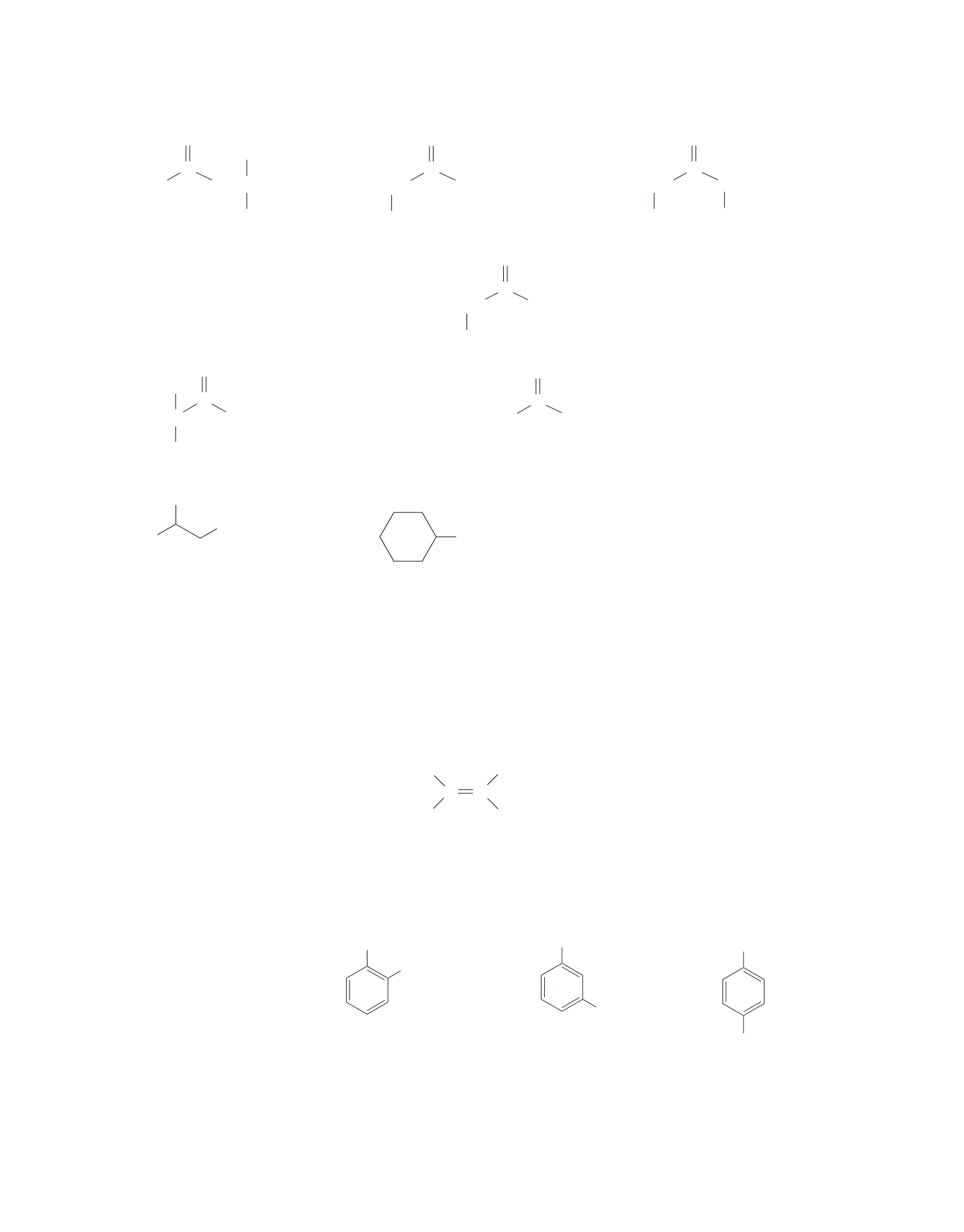
Each compound will have two doublets in the 6.5–8.1 ppm region. In addition, in that region,
A
will have
two doublet of doublets,
B
will have one doublet of doublets and a singlet, and
C
will have no other signals.
NO
2
OCH
3
OCH
3
NO
2
OCH
3
NO
2
A
B
C
In the 6.5–8.1 ppm region:
NO
2
OCH
3
OCH
3
NO
2
OCH
3
NO
2
A
B
C
b.
O
C
CH
3
CH CH
2
CH
2
CH
3
CH
3
c.
O
C
CH
3
CH CHCH
3
CH
3
CH
3
62.
a.
CH
2
CCH
3
CH
3
CH
3
CH
3
O
C
NO
2
OCH
3
OCH
3
NO
2
OCH
3
NO
2
A
B
C
four signals
two doublets and
two doublets of doublets
four signals
one singlet,
two doublets, and
one doublet of doublets
two signals
two doublets