



 473 / 912

Chapter 14 465
Copyright © 2017 Pearson Education, Inc.
25.
Each compound will have two doublets. In addition,
A
will have two doublet of doublets,
B
will have one
doublet of doublets and a singlet, and
C
will have no other signals.
Br
Br
NO
2
NO
2
NO
2
Br
A
C
B
four signals
two doublets and
two doublets
of doublets
four signals
two doublets, one
singlet, and one
doublet of doublets
two signals
two doublets
26.
a.
The signal at
7.2
ppm indicates the presence of a benzene ring. The integrations shows that the ring
has a single substituent; thus, the ring has a formula of
C
6
H
5
.
Subtracting
C
6
H
5
from the molecular
formula of the compound
1
C
9
H
12
-
C
6
H
5
2
gives a substituent with a formula of
C
3
H
7
.
The triplet
at
0.9
ppm that integrates to 3 protons indicates a methyl group adjacent to a methylene group. The
identical integration of the signals at 1.6 ppm and 2.6 ppm indicates two methylene groups. Thus, the
compound is propylbenzene.
CH
2
CH
2
CH
3
b.
The triplet that integrates to 3 protons and the quartet that integrates to 2 protons indicate a
CH
3
CH
2
group bonded to an atom that is not bonded to any hydrogens. The molecular formula of
C
5
H
10
O
indi-
cates that the compound is diethyl ketone.
O
C
CH
3
CH
2
CH
2
CH
3
c.
The signals between
7
and 8 ppm that integrate to 5 protons indicate the presence of a monosubsti-
tuted benzene ring. Subtracting
C
6
H
5
from the molecular formula of the compound
1
C
9
H
10
O
2
-
C
6
H
5
2
shows that the substituent has a formula of
C
3
H
5
O
2
.
The triplet that integrates to 3 protons and the quartet that integrates to 2 protons suggest a
CH
3
CH
2
group bonded to an atom that is not bonded to any hydrogens. Therefore, we can conclude that the
compound is one of the following:
COCH
2
CH
3
O
A
or
OCCH
2
CH
3
O
B
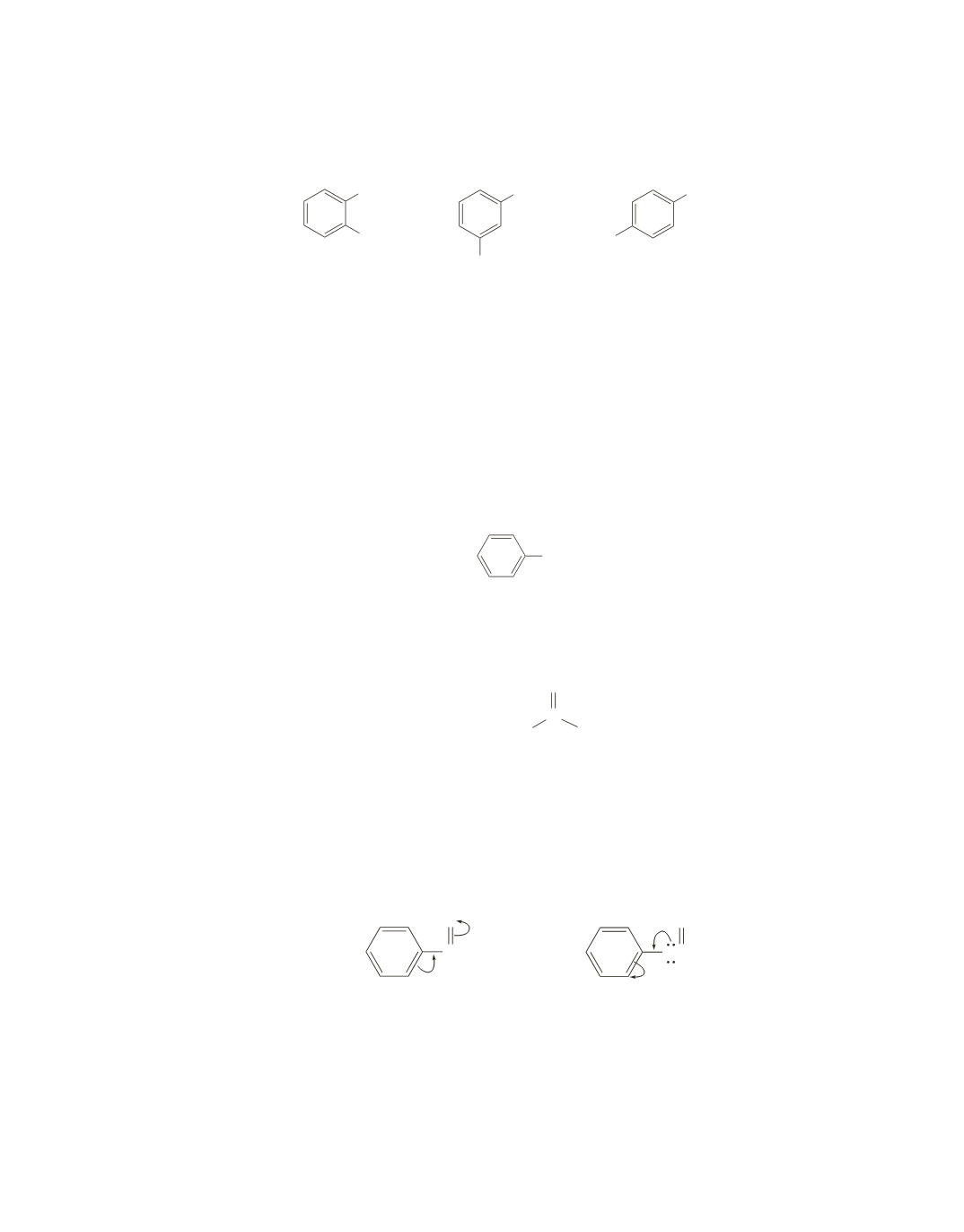
The substituent attached to the benzene ring in compound
A
withdraws electrons from the ring,
whereas the substituent attached to the benzene ring in compound
B
donates electrons into the benzene
ring. That one of the peaks of the benzene ring signal is at a higher frequency (farther downfield) than
usual (
7
8
ppm) suggests that an electron-withdrawing substituent is present on the benzene ring. This
is confirmed by the signal for the
CH
2
group at 4.3 ppm, indicating that the methylene group is adja-
cent to an oxygen. Thus, the spectrum is that of compound
A
.