



 471 / 912

Chapter 14 463
Copyright © 2017 Pearson Education, Inc.
17.
Solved in the text.
18.
The heights of the integrals for the signals in the spectrum are about 3.5 and 5.2. The ratio of the integrals,
therefore, is
5.2
>
3.5
=
1.5.
This matches the ratio of the integrals calculated for
B
. (Later we will see that
a signal at
7
ppm is characteristic of a benzene ring.)
C HC
CH
3
CH
3
ClCH
2
Br
2
CH
CHBr
2
CH
2
Cl
C CH
=
2 4
2
6
4
=
1.5
4
4
=
1.0
4
2
=
2
19.
The highest frequency signal in both spectra is the signal for the hydrogens bonded to the carbon that is
also bonded to the halogen. Because chlorine is more electronegative than iodine, that signal should be
at a higher frequency in the
1
H
NMR spectrum for 1-chloropropane than in the
1
H
NMR spectrum for
1-iodopropane. Therefore, the
first spectrum
is the
1
H
NMR spectrum for
1-iodopropane
, and the
second
spectrum
is the
1
H
NMR spectrum for
1-chloropropane
.
20.
C
is easiest to distinguish because it will have
two
signals, whereas
A
and
B
will each have
three
signals.
A
and
B
can be distinguished by looking at the splitting of their signals.
The signals in the
1
H
NMR spectrum of
A
will be (left to right across the spectrum):
triplet
,
triplet
,
multiplet
.
The signals in the
1
H
NMR spectrum of
B
will be (left to right across the spectrum):
doublet
,
multiplet
,
doublet
.
21.
From the molecular formula and the splitting patterns of the signals, the spectra can be identified as the
1
H
NMR spectrum of:
a.
O
C
CH
3
CH OH
Cl
b.
ClCH
2
CH
2
OH
C
O
22.
a.
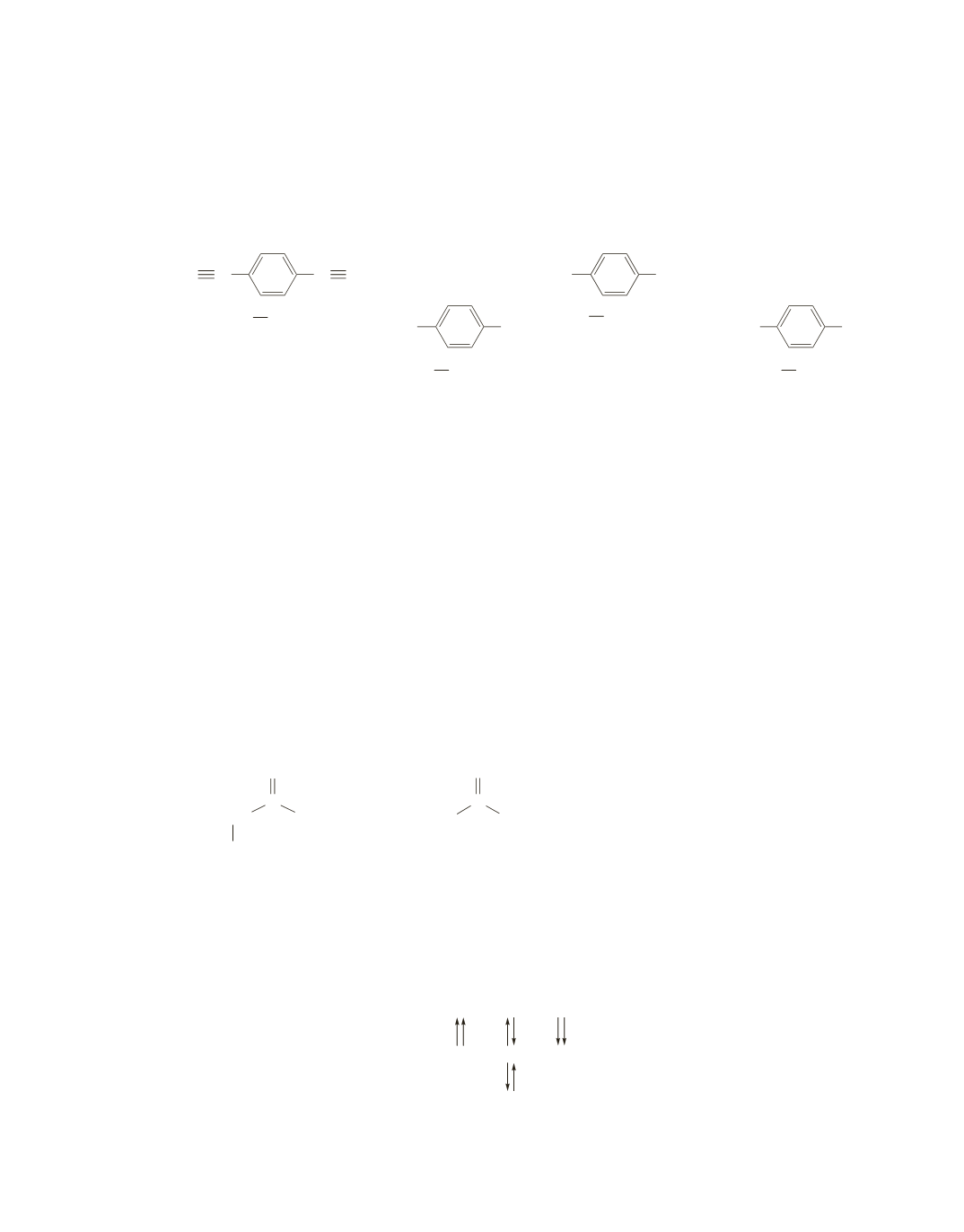
A triplet is caused by coupling to two equivalent protons on an adjacent carbon. The two protons can
be aligned in three different ways: both with the field, one with the field and one against the field, or
both against the field. That is why the signal is a triplet. There is only one way to align two protons that
are with the field or two protons that are against the field. However, there are two ways to align two
protons if one is with and one is against the field: with and against or against and with. Consequently,
the peaks in a triplet have relative intensities of 1:2:1.