


 429 / 912

Chapter 12 421
Copyright © 2017 Pearson Education, Inc.
35.
It is easier to break a C
¬
H bond than a C
¬
D bond.
Because a bromine radical is less reactive (and more selective) than a chlorine radical, a bromine radical
has a greater preference for the more easily broken C
¬
H bond. Bromination, therefore, would have a
greater deuterium kinetic isotope effect than chlorination.
36.
Br
Br
Br
Br
37.
a.
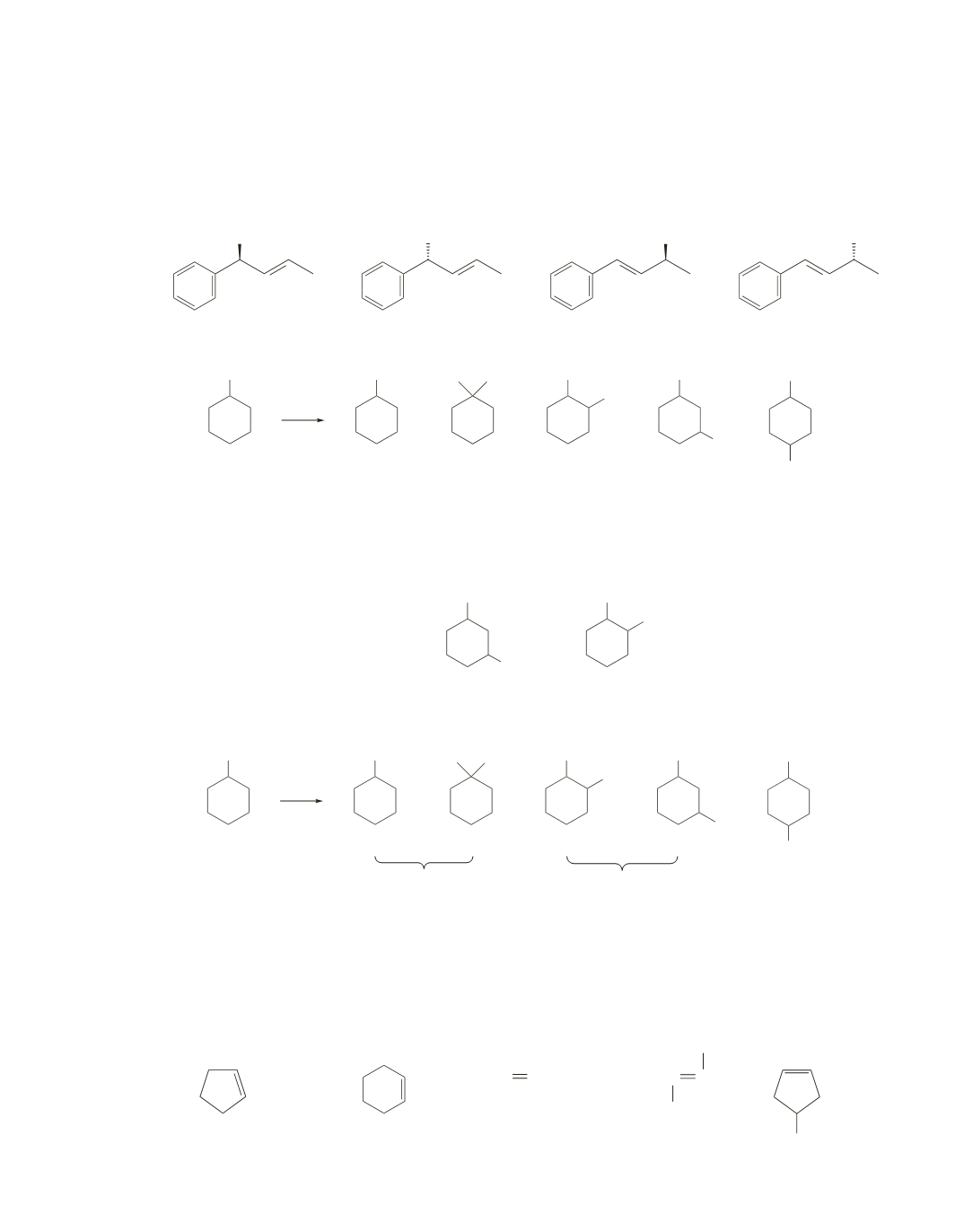
Five monochlorination products are possible.
CH
3
CH
2
Cl
CH
3
CH
3
CH
3
Cl
Cl
Cl
CH
3
Cl
Cl
2
hv
b.
The two compounds below are obtained in the greatest yield because each one can be formed by
removing one of four hydrogens to form a secondary radical. More of the compound on the left is
obtained because the methyl group in the compound on the right provides some steric hindrance to the
approach of the chlorine atom.
4
3
3.8
5
15.2
4
3
3.8
5
15.2
CH
3
Cl
CH
3
Cl
c.
The number of possible stereoisomers for each compound is indicated below each structure.
CH
3
CH
2
Cl
CH
3
CH
3
CH
3
Cl
Cl
Cl
CH
3
Cl
Br
2
hv
1
1
4
4
2
These have 0
asymmetric centers.
These have 2
asymmetric centers.
This does not have
an asymmetric center,
but has cis–trans isomers.
Therefore, a total of 12 stereoisomers can be obtained.
38.
For an alkene to form the same product whether it reacts with HBr in the presence or absence of peroxide,
it must be symmetrical about the double bond.
a.
b.
CH
3
CH
2
CH CHCH
2
CH
3
cis or trans
CH
3
C CCH
3
CH
3
CH
3