


 433 / 912

Chapter 12 425
Copyright © 2017 Pearson Education, Inc.
In Section 12.4, we saw that at room temperature, the relative rates are:
5.0 : 3.8 : 1
Therefore, we can conclude that at higher temperatures, the radical is less selective about which hydrogen
atom it removes.
45.
The chlorine radical is more reactive at the higher temperature
1
600
°
C
2
, so it is less selective.
46.
a.
Br
b.
Br
+
Br
c.
Br
+
Br
Br
+
Br
+
d.
Br
Br
+
e.
Br
Br
Br
+
+
f.
Br
+
Br
+
Br
+
Br
47.
a.
105
58
84
103
∆
H
°
=
bonds broken
-
bonds formed
∆
H
°
=
3
105 kcal
>
mol
+
58 kcal
>
mol
4
-
3
84 kcal
>
mol
+
103 kcal
>
mol
4
∆
H
°
=
163
-
187
=
-
24 kcal
>
mol
b.
∆
H
°
=
105
-
103
=
2 kcal
>
mol
∆
H
°
=
58
-
84
=
-
26 kcal
>
mol
Overall
∆
H
°
=
2
+
1
-
26
2
=
-
24 kcal
>
mol
c.
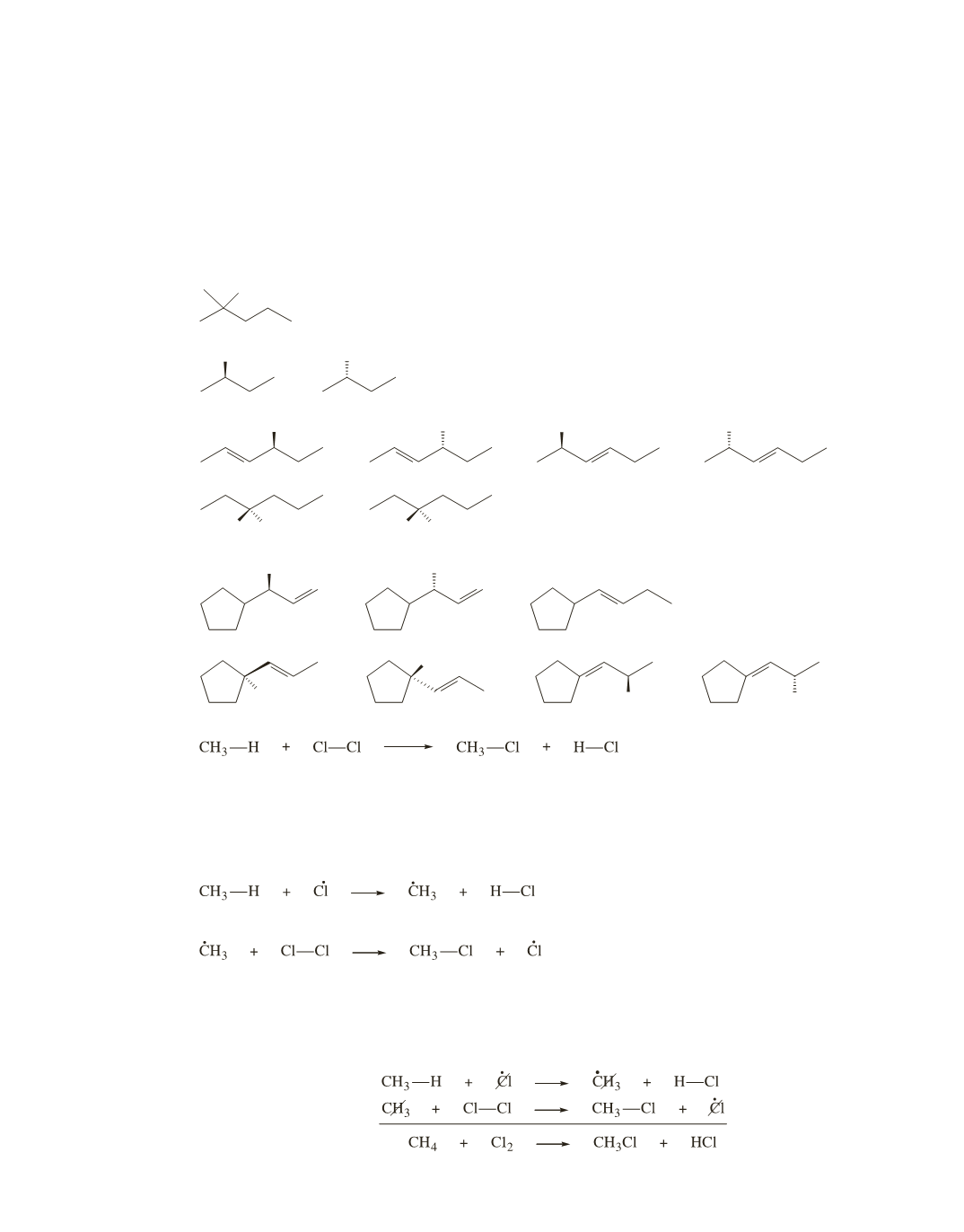
If you cancel the elements that are the same on opposite sides of the equations in part
b
and then add
the two equations, you are left with the equation in part
a
.