


 421 / 912

Chapter 12 413
Copyright © 2017 Pearson Education, Inc.
6.
a.
4 One of the 3 alkyl halides has an asymmetric center, so it has
R
and
S
stereoisomers.
b.
5 Two of the 3 alkyl halides has an asymmetric center, so each has
R
and
S
stereoisomers.
c.
8 Three of the 5 alkyl halides have an asymmetric center, so each has
R
and
S
stereoisomers.
d.
1
e.
12 Two of the 5 alkyl halides have two asymmetric asymmetric centers, so each has 4 stereoisomers.
One of the 5 alkyl halides has cis–trans stereoisomers.
f.
14 Two of the 6 alkyl halides have two asymmetric asymmetric centers, so each has 4 stereoisomers.
One of the 6 alkyl halides has one asymmetric center, so it has
R
and
S
stereoisomers.
One of the 6 alkyl halides has cis–trans stereoisomers.
g.
2
h.
5 One of the 4 alkyl halides has an asymmetric center, so it has
R
and
S
stereoisomers.
i.
5 One of the 4 alkyl halides has an asymmetric center, so it has
R
and
S
stereoisomers.
7.
Solved in the text.
8.
a.
The major product is obtained from removal of a secondary hydrogen.
CH
3
CHCHCH
3
CH
3
Cl
b.
The relative amounts of the four possible products are:
6
*
1
=
6 1
*
5
=
5 2
*
3.8
=
7.6 3
*
1
=
3
percentage of major product
=
7.6
21.6
*
100
=
35
,
9.
a.
Chlorination, because the halogen is substituting for a primary hydrogen.
b.
Bromination, because the halogen is substituting for a tertiary hydrogen.
c.
Because the molecule has only one kind of hydrogen, both chlorination and bromination will form
only one monohalogenated product.
10.
Solved in the text.
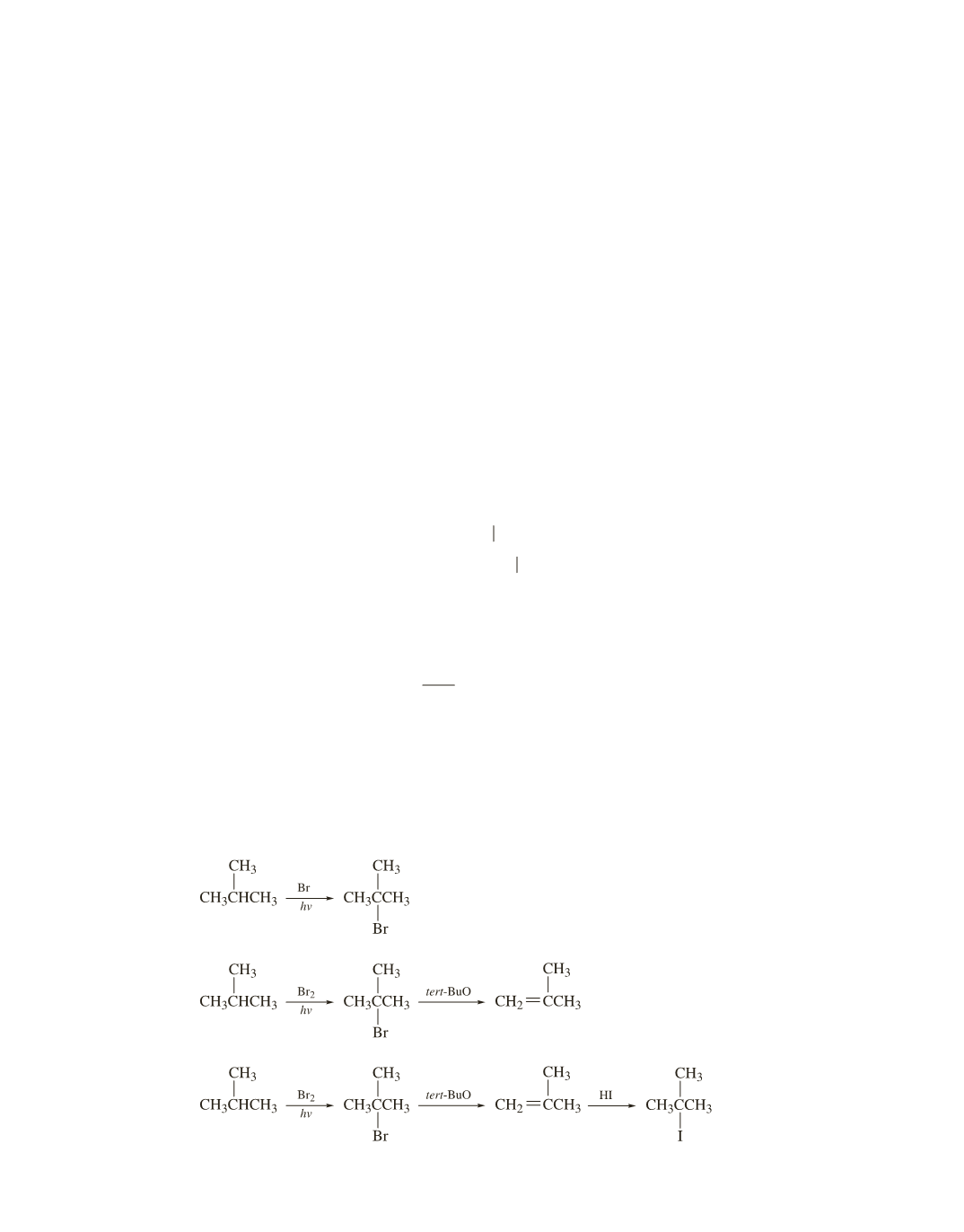
11.
a.
2
tert
−
2
tert
−
2
b.
c.