



 295 / 912

Chapter 8 287
Copyright © 2017 Pearson Education, Inc.
There is less delocalization onto oxygen by the lone pair in the compound with the benzene ring (path
a
)
because the lone pair can also be delocalized away from the oxygen into the benzene ring (path
b
).
CH
3
N
H
CH
3
N
H
a
a
a
b
b
b
..
..
CH
3
N
H
+
_
CH
3
N
H
_
C
O
C
O
C
O
C
O
CH
3
N
H
+
_
C
O
74.
Remember that an
sp
2
nitrogen is more electronegative than an
sp
3
nitrogen, and the more electronegative
the atom to which a hydrogen is attached, the stronger the acid. The stronger the acid, the weaker its conju-
gate base.
NH
2
This is the strongest base
because the lone pair is
localized and the nitrogen is
sp
3
hybridized.
N
The lone pair is localized and the
nitrogen is
sp
2
hybridized, which
is not as strong a base as an
sp
3
hybridized nitrogen.
NH
2
N
H
These are weak bases because
the lone-pair electrons are
delocalized.
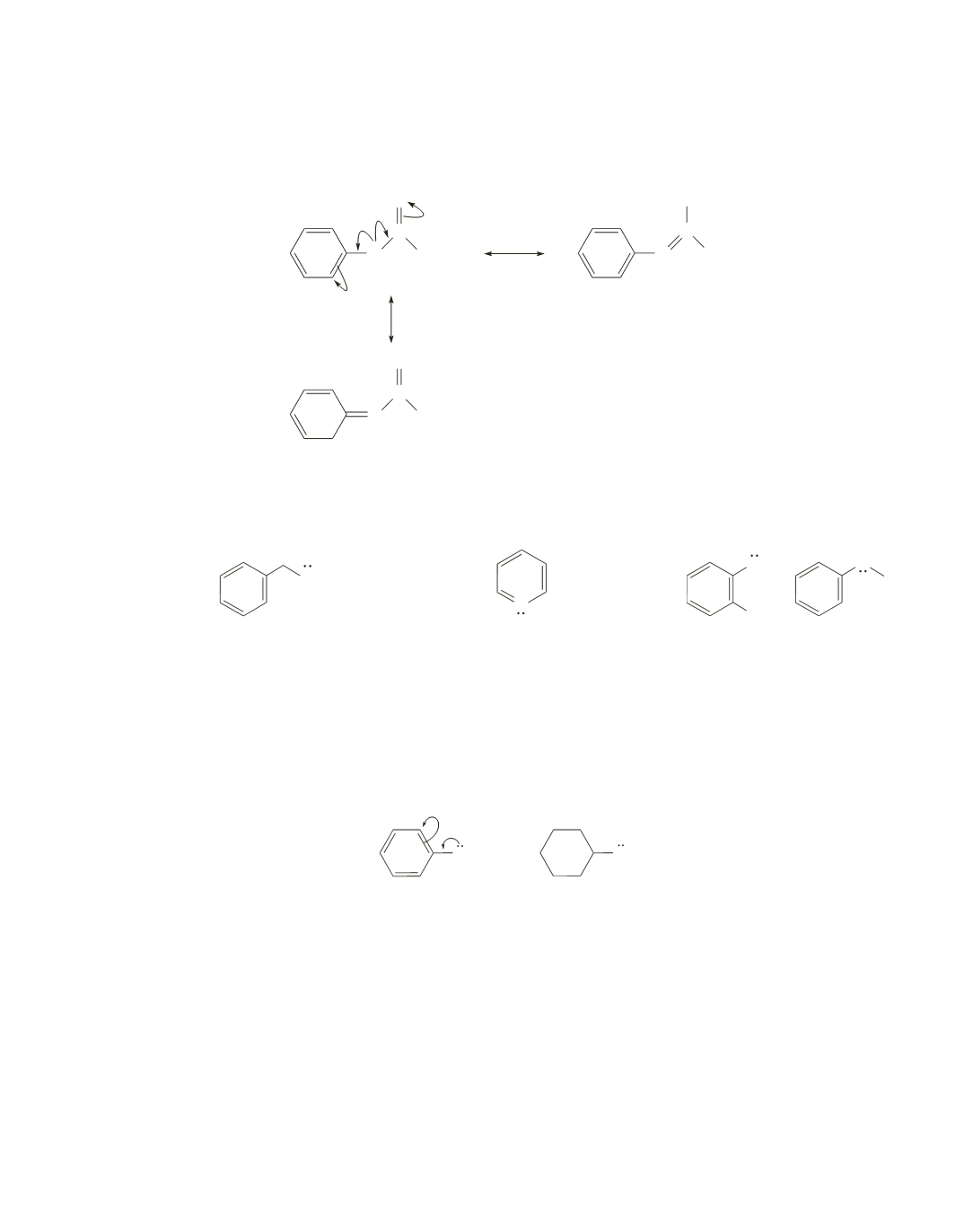
75.
The methyl group on benzene can lose a proton easier than the methyl group on cyclohexane because the
electrons left behind on the carbon in the former can be delocalized into the benzene ring. In contrast, the
electrons left behind in the other compound cannot be delocalized.
−
CH
2
CH
2
−
76.
The triphenylmethyl carbocation is stable because the positive charge is shared by 10 carbons (the central
carbon and three carbons of each of the three benzene rings) as a result of electron delocalization.