



 301 / 912

Chapter 8 293
Copyright © 2017 Pearson Education, Inc.
91.
a.
+
+
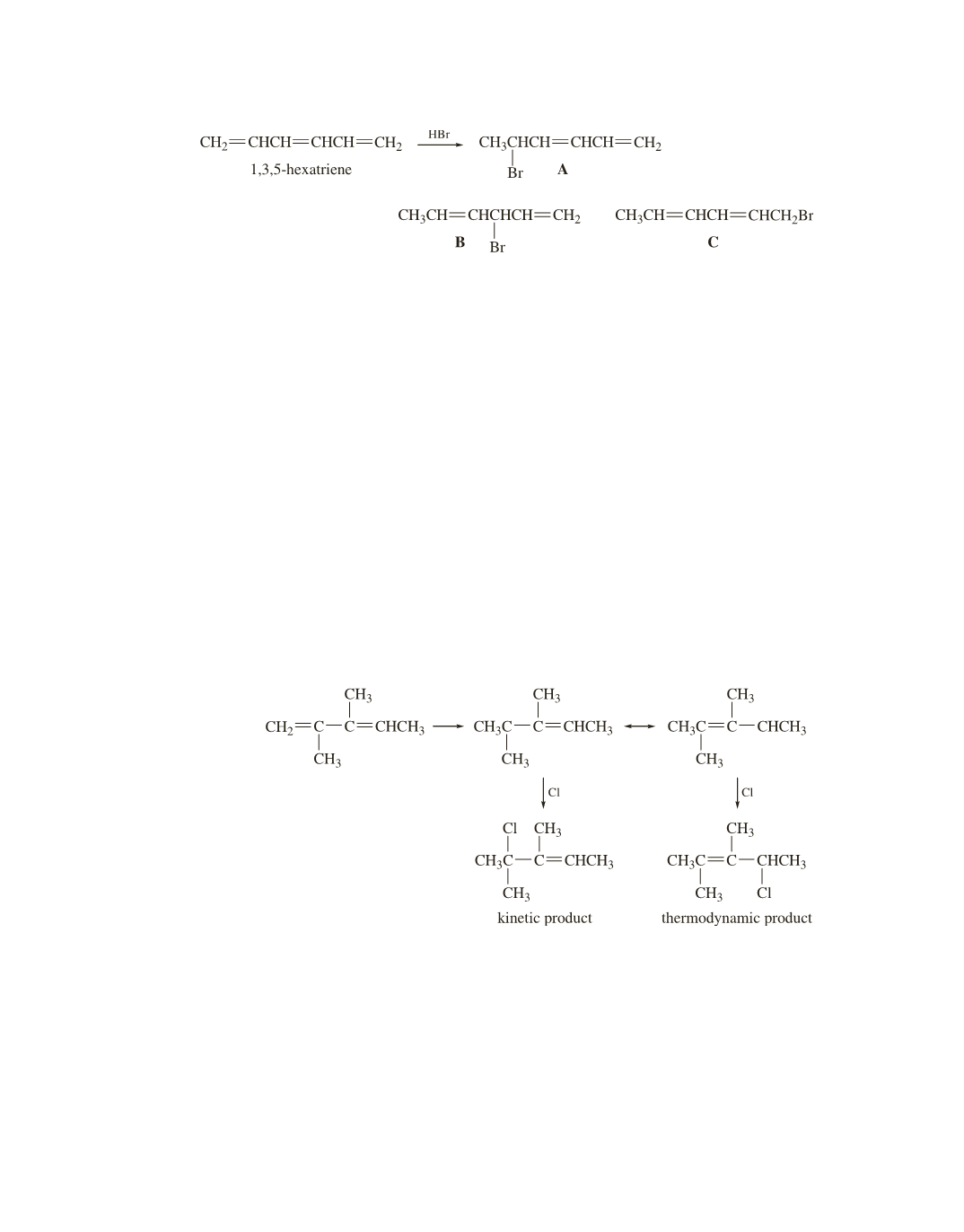
b. A
will predominate if the reaction is under kinetic control because it is the 1,2-product and, there-
fore, is the product formed most rapidly as a result of the proximity effect. Notice that
A
will be the
1,2-product regardless of which end of the conjugated system reacts with the electrophile.
c. C
will predominate if the reaction is under thermodynamic control because it is the most stable diene.
(It is the most substituted conjugated diene.)
92.
The diene is the nucleophile, and the dienophile is the electrophile in a Diels–Alder reaction.
a.
An electron-donating substituent in the diene will increase the rate of the reaction, because electron
donation increases its nucleophilicity.
b.
An electron-donating substituent in the dienophile will decrease the rate of the reaction, because elec-
tron donation decreases its electrophilicity.
c.
An electron-withdrawing substituent in the diene will decrease the rate of the reaction, because elec-
tron withdrawal decreases its nucleophilicity.
93.
a.
Addition of an electrophile to C-1 forms a carbocation with two resonance contributors, a
tertiary
allylic cation
and a
secondary allylic cation
. Addition of an electrophile to C-4 forms a carbocation
with two resonance contributors, a
tertiary allylic cation
and a
primary allylic cation
. Therefore,
addition to C-1 results in formation of the more stable carbocation intermediate, and the more stable
intermediate leads to the major products.
+
−
+
−
HCl