



 307 / 912

Chapter 8 299
Copyright © 2017 Pearson Education, Inc.
104.
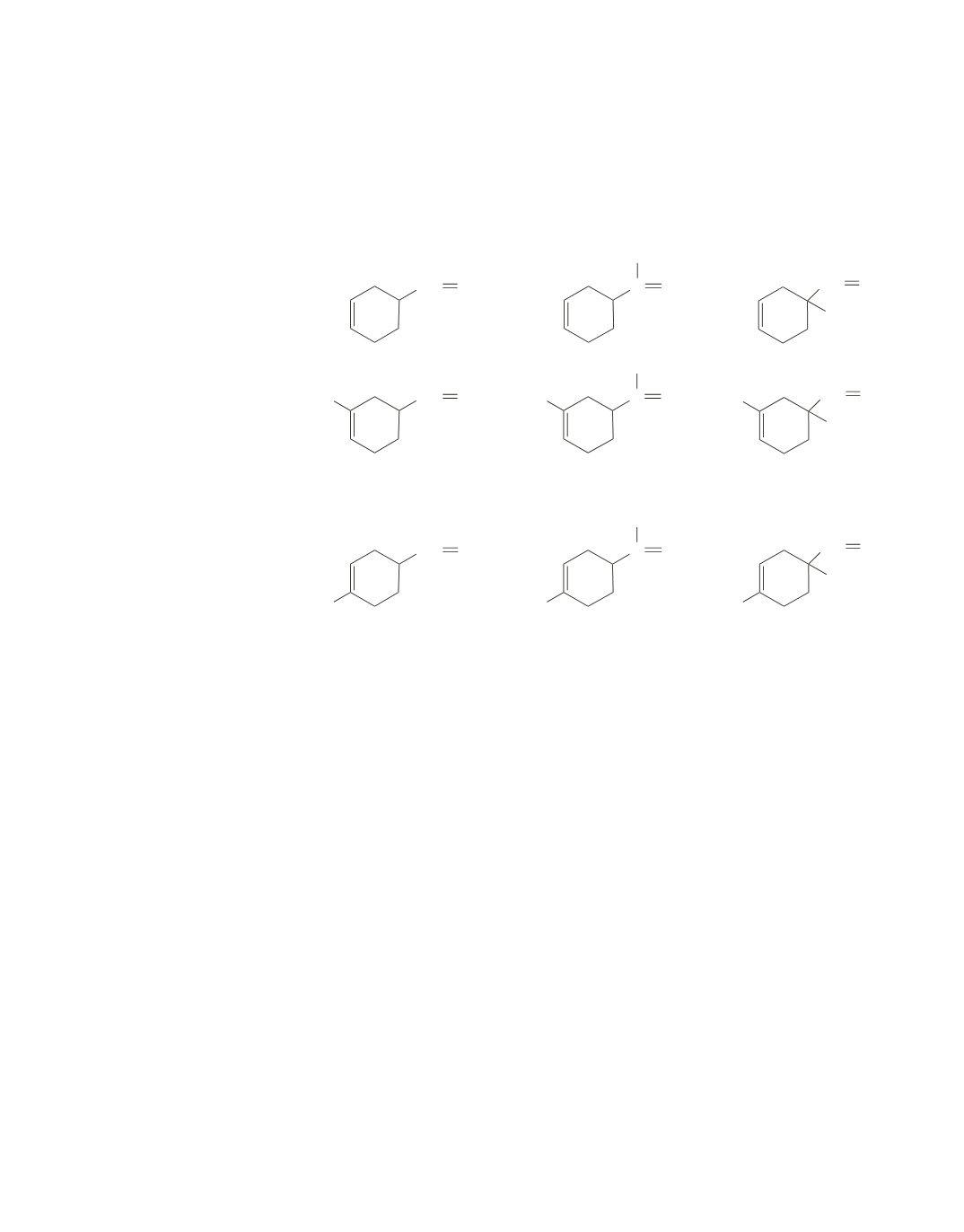
Nine of the compounds are shown below. Because each has one asymmetric center, each can have either
the
R
or
S
configuration. Therefore, 18 different products can be obtained.
CH CH
2
C CH
2
CH
3
CH CH
2
CH
3
CH CH
2
C CH
2
CH
3
CH
3
CH
3
CH
3
CH CH
2
CH
3
CH CH
2
C CH
2
CH
3
CH CH
2
CH
3
CH
3
CH
3
CH
3
1,3-Butadiene is
the electrophile.
The 3,4-bond of
2-methyl-1,3-butadiene
is the electrophile.
The 1,2-bond of
2-methyl-1,3-butadiene
is the electrophile.
1,3-Butadiene is
the nucleophile.
2-Methyl-1,3-butadiene
is the nucleophile
(the 1-position is on top).
2-Methyl-1,3-butadiene
is the nucleophile
(the 4-position is on top).
105.
2-Methyl-1,3-pentadiene (with conjugated double bonds) is more stable than 2-methyl-1,4-pentadiene (with
isolated double bonds). The rate-limiting step of the reaction is formation of the carbocation intermediate.
2-Methyl-1,3-pentadiene forms a more stable carbocation intermediate than does 2-methyl-1,4-pentadiene.
Because the more stable reactant forms the more stable carbocation intermediate, the relative free energies
of activation for the rate-limiting steps of the two reactions depend on whether the difference in the stabili-
ties of the reactants is greater or less than the difference in the stabilities of the transition states leading to
formation of the carbocation intermediates (which depend on the difference in stabilities of the carbocation
intermediates).
There is a significant difference in the stabilities of the carbocation intermediates because one is stabilized
by electron delocalization and one is not. The transitions states look more like the carbocation intermedi-
ates than like the alkenes.
Therefore, the difference in the stabilities of the reactants is less than the difference in the stabilities of the
transition states, so the rate of reaction of HBr with 2-methyl-1,3-pentadiene is the faster reaction. (If the
difference in the stabilities of the reactants had been greater than the difference in the stabilities of the tran-
sition states, the rate of reaction of HBr with 2-methyl-1,4-pentadiene would have been the faster reaction.)