


 309 / 912

Chapter 8 301
Copyright © 2017 Pearson Education, Inc.
109.
a.
Unless the reaction is being carried out under kinetic control, the amount of product obtained is not
dependent on the rate at which the product is formed, so the relative amounts of products obtained will
not tell you which product was formed faster.
b.
In a thermodynamically controlled reaction, the product distribution depends on the relative stabili-
ties of the products because the products come to equilibrium. Therefore, if the distribution of prod-
ucts does not reflect the relative stabilities of the products, the reaction must have been kinetically
controlled.
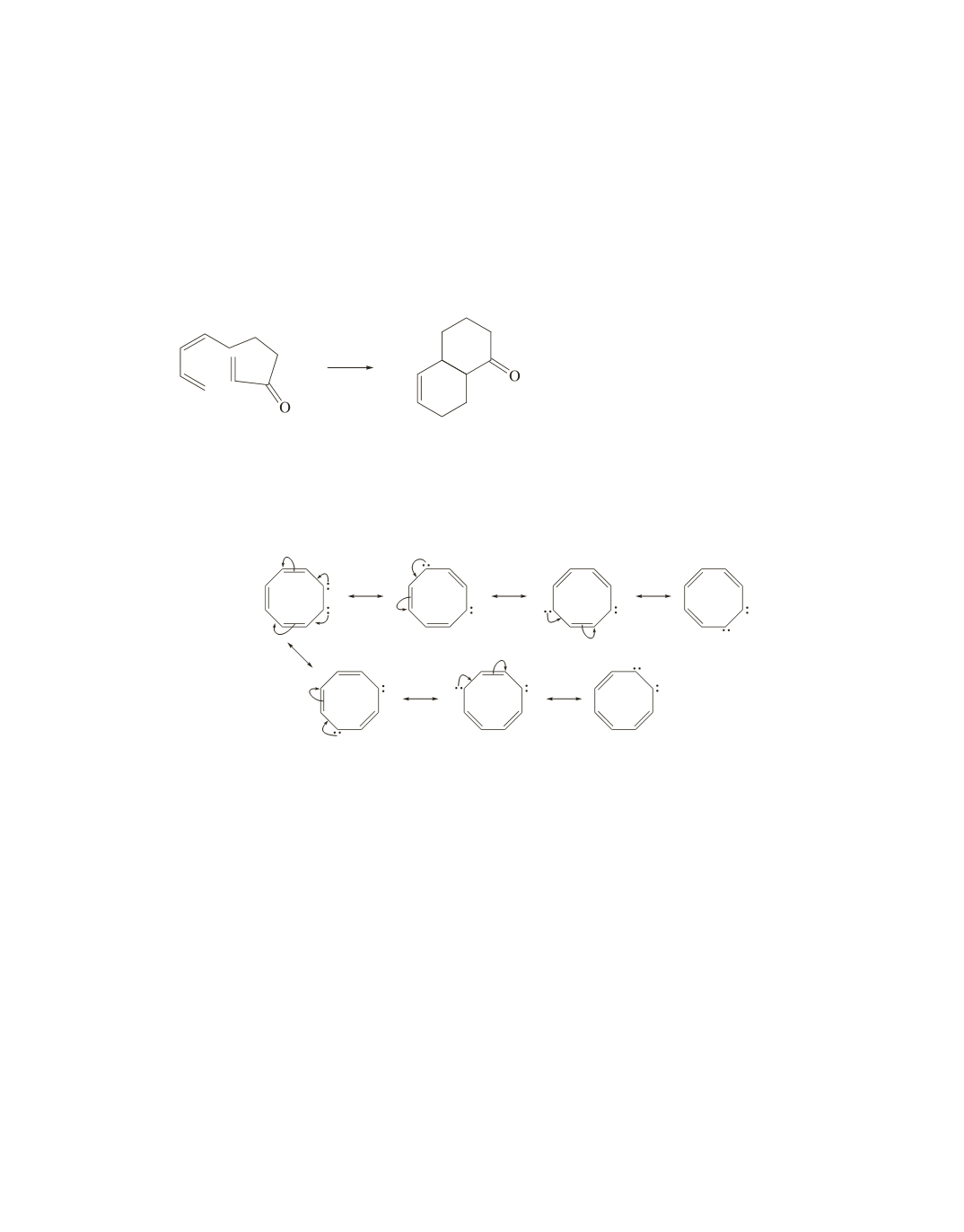
110.
1
2
3
4
5
6
7
1
4
5
6
7
3
2
First line up the conjugated diene and the
double bond of the dienophile in a way that
prepares them to undergo the Diels–Alder reac-
tion. Once they are lined up correctly, you can
rearrange the electrons to determine the product
of the reaction.
111.
a.
The three resonance contributors marked with an X are the least stable because in these contributors,
the two negative charges are on adjacent carbons.
b.
Because these contributors are the least stable, they make the smallest contribution to the hybrid.
−
−
X
−
−
−
−
−
−
X
−
−
−
−
X
−
−
a
a
b
b
b
a
112.
We have classified cyclobutadiene as antiaromatic. However, the recent observation that cyclobutadiene is
rectangular and the observation that there are two different 1,2-dideuterio-1,3-cyclobutadienes both indi-
cate that the
p
electrons are localized rather than delocalized. Localization of the
p
electrons prevents the
compound from being antiaromatic. Apparently, the extreme instability associated with being antiaromatic
causes cyclobutadiene to be rectangular.