



 294 / 912

286 Chapter 8
Copyright © 2017 Pearson Education, Inc.
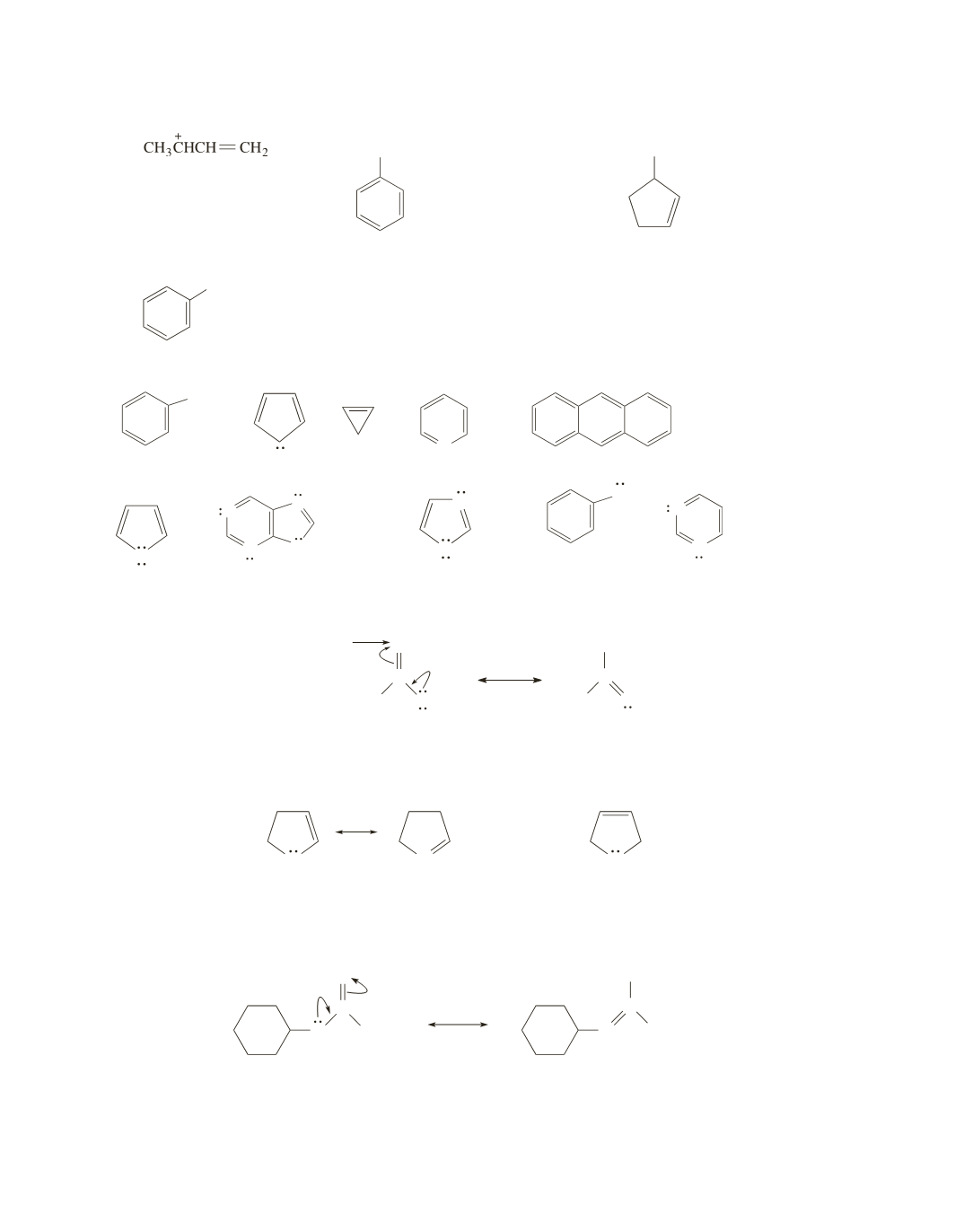
71.
a.
This makes the greater
contribution because the
positive charge is on a
secondary allylic carbon.
b.
O
−
This makes the greater
contribution because the
negative charge is on an
oxygen.
c.
CH
3
+
This makes the greater
contribution because the
positive charge is on
a tertiary allylic carbon.
d.
CH CH
3
CH
2
+
This makes the greater
contribution because a
secondary benzylic cation
is more stable than a
secondary alkyl cation.
72.
CH
2
+
+
N
+
H
O
N
N N
N
CH
H
N
O
_
N
N
−
2
73.
a.
The resonance contributors show that the carbonyl oxygen has the greater electron density.
+
_
CH
3
OCH
3
CH
3
OCH
3
C
O
C
O
carbonyl oxygen
b.
The compound on the right has the greater electron density on its nitrogen, because the compound
on the left has a resonance contributor with a positive charge on the nitrogen as a result of electron
delocalization.
N
H
N
H
+
−
N
H
c.
The compound with the cyclohexane ring has the greater electron density on its oxygen, because the
lone pair on the nitrogen can be delocalized only onto the oxygen.
CH
3
N
H
CH
3
N
H
a
a
a
b
b
..
CH
3
N
H
+
_
C
O
C
O
C
O
CH
3
N
H
+
_
C
O