



 289 / 912

Chapter 8 281
Copyright © 2017 Pearson Education, Inc.
60.
a.
The nitrogen atom (the atom at the bottom of the epm) in pyrrole has a partial positive charge because
it donates electrons by resonance into the ring.
b.
The nitrogen atom (the atom at the bottom of the epm) in pyridine cannot donate electrons by reso-
nance; it withdraws electrons from the ring inductively because it is the most electronegative atom in
the molecule. Thus, this nitrogen is electron-rich.
c.
The relatively electronegative nitrogen atom in pyridine withdraws electrons from the ring.
61.
A, B, C, E, F, L, M, N, O
62.
a
and
b.
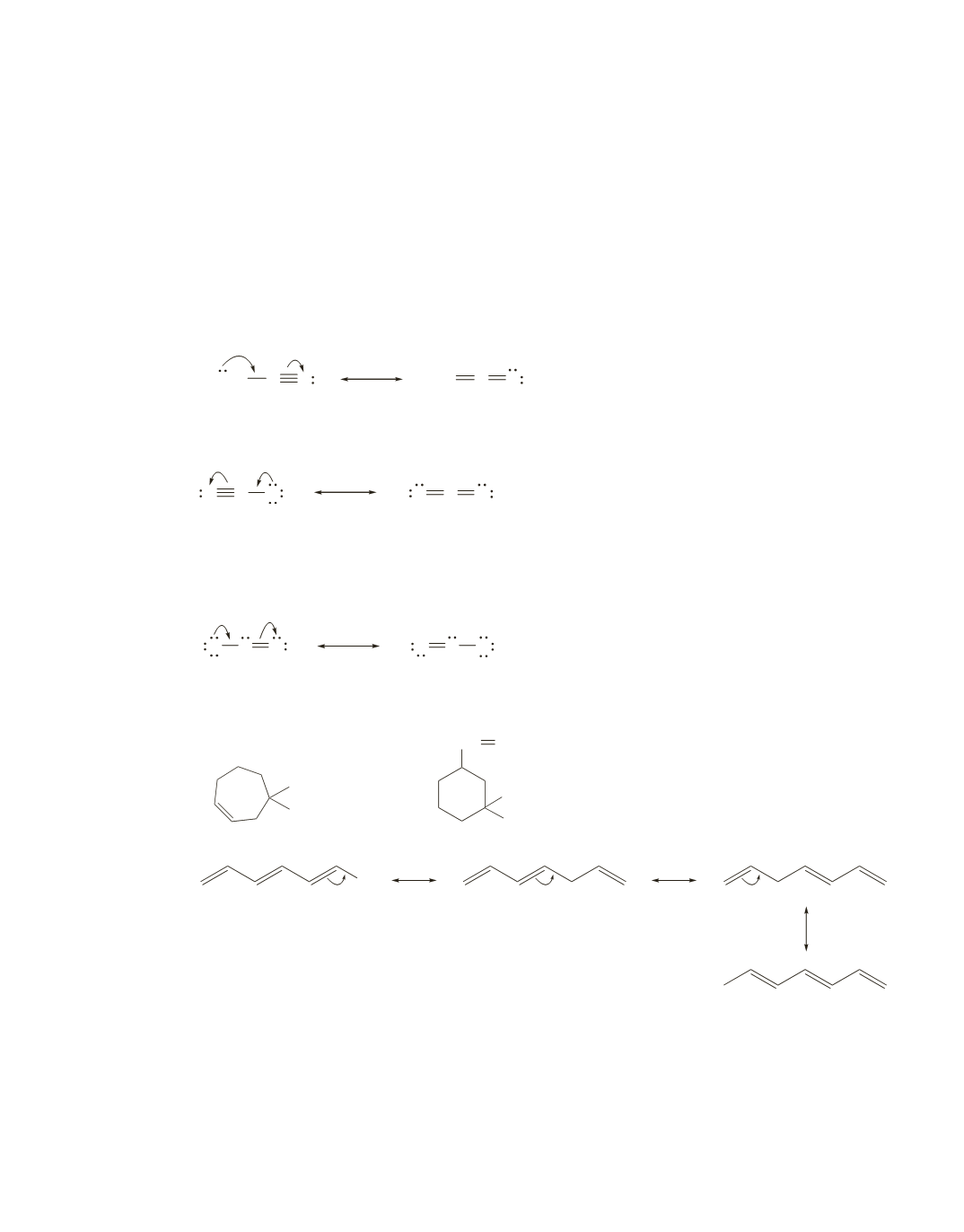
1.
+
+
_
_
CH
2
CH
2
N N
N N
More stable, because the
negative charge is on nitrogen
rather than on carbon.
2.
+
_
+
_
NN O
NN O
More stable because the
negative charge is on oxygen
rather than on nitrogen
(oxygen is more electronegative).
3.
_
_
O N O
O N O
Both are equally stable.
63.
In each case, the proton adds to the
sp
2
carbon that results in formation of a tertiary carbocation.
CH
3
Br
CH
3
Br
CH CH
2
a.
b.
64.
a.
+
+
+
+