


 285 / 912

Chapter 8 277
Copyright © 2017 Pearson Education, Inc.
41.
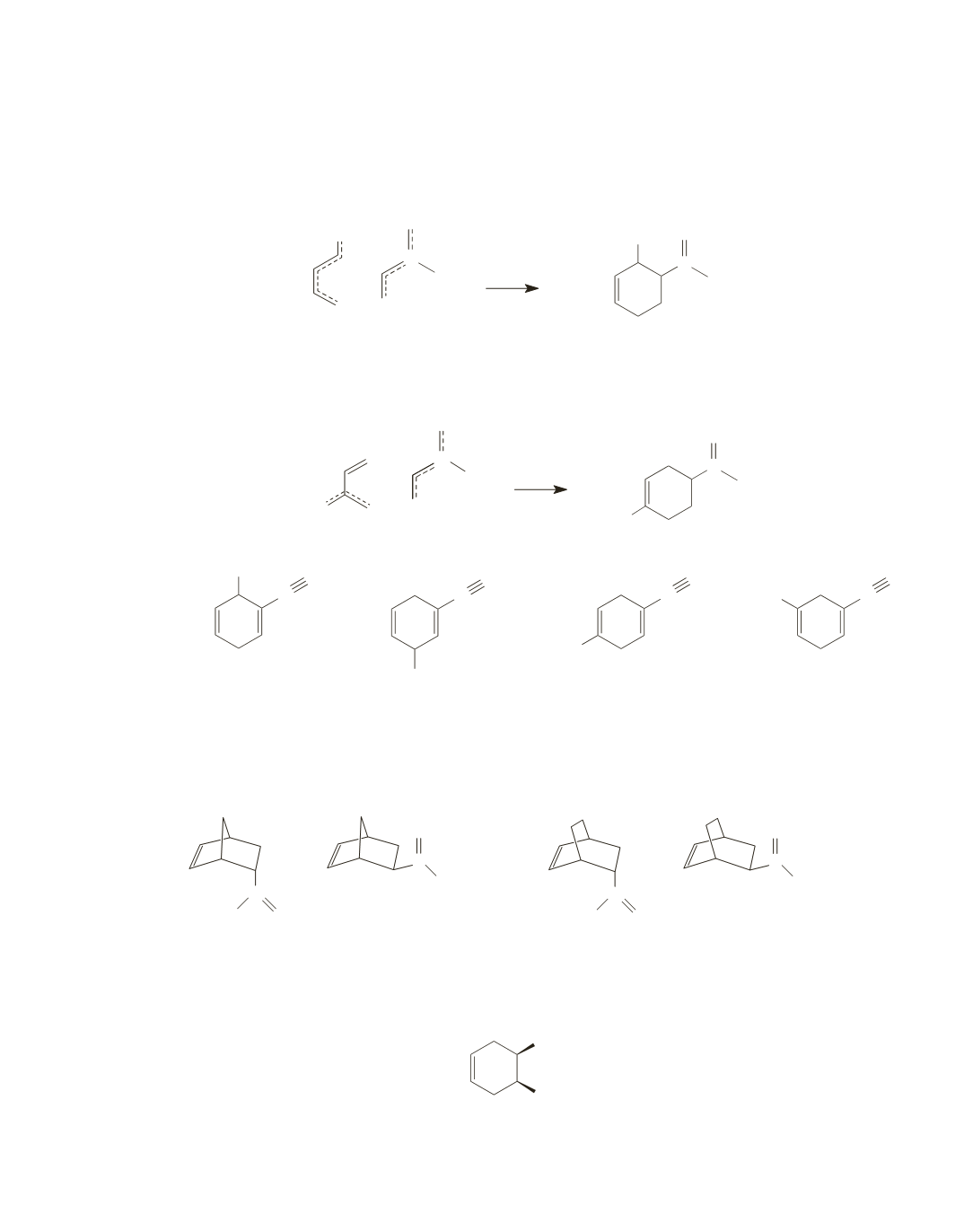
The resonance contributors show that if the electron-donating substituent is at the end of the conjugated
system, it and the electron-withdrawing substituent of the dienophile will be adjacent to one another in the
major product of the Diels–Alder reaction.
C
O OCH
3
OCH
3
C
O
δ
+
δ
+
δ
_
_
δ
If the electron-donating substituent is not at the end of the conjugated system, it and the electron-withdrawing substituent of the dienophile will be opposite each other in the major product of the Diels–
Alder reaction.
δ
+
CH
3
O
C
O
δ
+
δ
_
δ
_
C
O
CH
3
O
42.
C
N
a.
C
N
CH
3
CH
3
CH
3
CH
3
+
C
N
b.
C
N
+
43.
A
and
C
will not react, because they are both locked in an
s
-trans conformation.
D
and
E
will react, because they are both locked in an
s
-cis conformation.
B
and
F
will react, because they can rotate into an
s
-cis conformation.
44.
CH
3
C
O
CH
3
C
O
a.
b.
C
O
CH
3
C
O
CH
3
45.
Solved in the text.
46.
a.
It is not optically active, because it is a meso compound.
(It has two asymmetric centers and a plane of symmetry.)
Cl
Cl