



 384 / 912

376 Chapter 10
Copyright © 2017 Pearson Education, Inc.
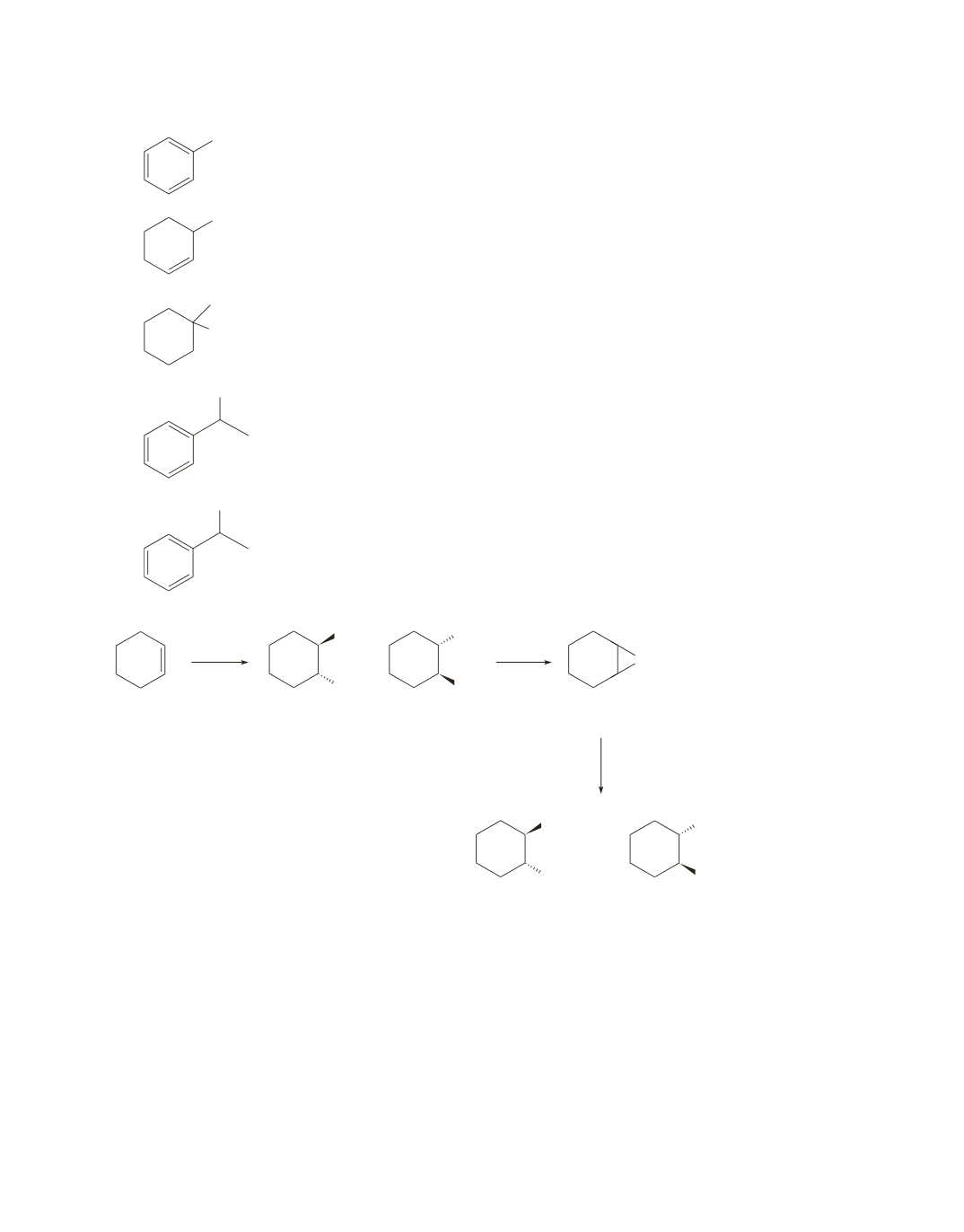
56.
a.
CH
2
CH
2
OH
The other alcohol cannot undergo dehydration to form an alkene,
because its
b
-carbon is not bonded to a hydrogen.
b.
OH
The rate-limiting step in a dehydration is carbocation formation.
A secondary allylic cation is more stable than a secondary alkyl
carbocation and therefore is formed more rapidly.
c.
CH
3
OH
A tertiary alkyl carbocation is more stable than a secondary alkyl
carbocation.
d.
OH
A secondary benzylic cation is more stable than a secondary alkyl
carbocation.
e.
OH
A secondary benzylic cation is more stable than a primary alkyl
carbocation.
57.
C
B
A
+
O
HO
−
H
2
O
Br
2
Br
OH
1. NaH
2.
+
+
H
2
O
+
H
3
O
Br
OH
D
OH
OH
E
OH
OH