


 383 / 912

Chapter 10 375
Copyright © 2017 Pearson Education, Inc.
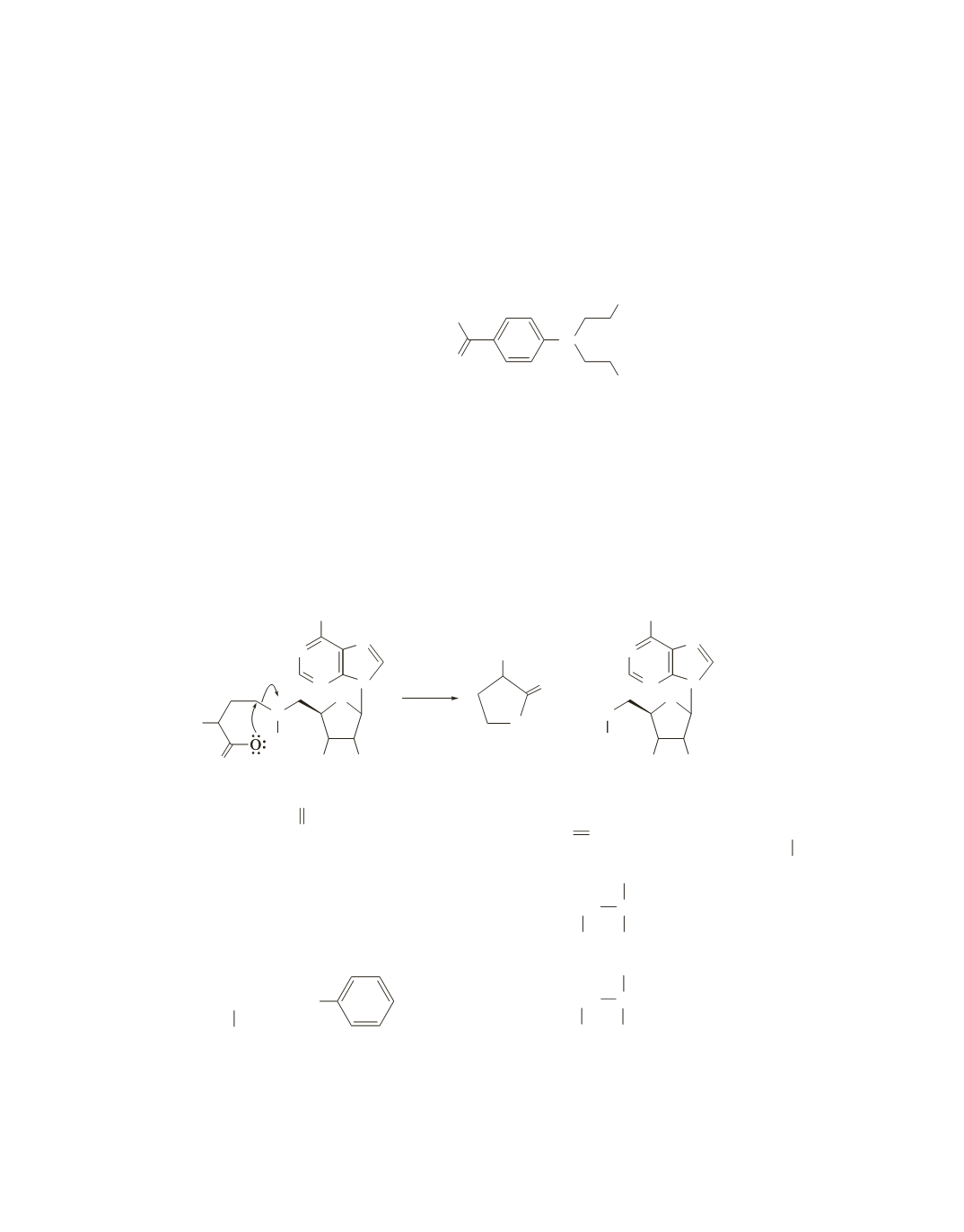
51.
The first compound is too insoluble.
The second compound is used clinically; it has fewer carbons than the first compound, so it is more soluble
in water.
The third compound is less reactive than the second compound because the lone pair on the nitrogen can be
delocalized into the benzene ring. Therefore, the lone pair is less apt to displace a chloride ion and form the
three-membered ring that is needed for the compound to be an alkylating agent.
H
O
Cl
Cl
N
52.
Melphalan is a good alkylating reagent because the group on the side chain makes the compound water
soluble. The group can delocalize electrons into the benzene ring so that it is not as reactive as the too
reactive compound in Problem 51.
53.
Cyclophosphamide, carmustine, and chloroambucil are less reactive than mechlorethamine because, un-
like the lone-pair electrons on the nitrogen of mechlorethamine, the lone-pair electrons on the nitrogen of
the other three compounds can be delocalized. Therefore, these compounds are less apt to form the three-
membered ring that is needed for the compound to be an alkylating agent.
54.
+
+
NH
2
N
N
O
S
N
OH HO
CH
3
N
NH
3
O
O
+
H
3
N
O
−
NH
2
+
N
N
O
N
OH HO
CH
3
N
S
55.
a.
CH
3
CH
2
CH
2
OCCH
3
O
b.
CH
3
CH
2
CH
2
CH
2
Br
c.
CH
3
CHCH
2
CH
2
O
CH
3
d.
CH
3
CH CHCH
3
e.
CH
3
CCH
3
CH
3
CH
2
CH
OH
CH
3
O
f.
CH
3
CCH
3
CH
3
CH
2
CH
OCH
3
OH
g.
CH
3
CHCH
2
CH
2
Cl
CH
3