



 319 / 912

Special Topic II
311
Copyright © 2017 Pearson Education, Inc.
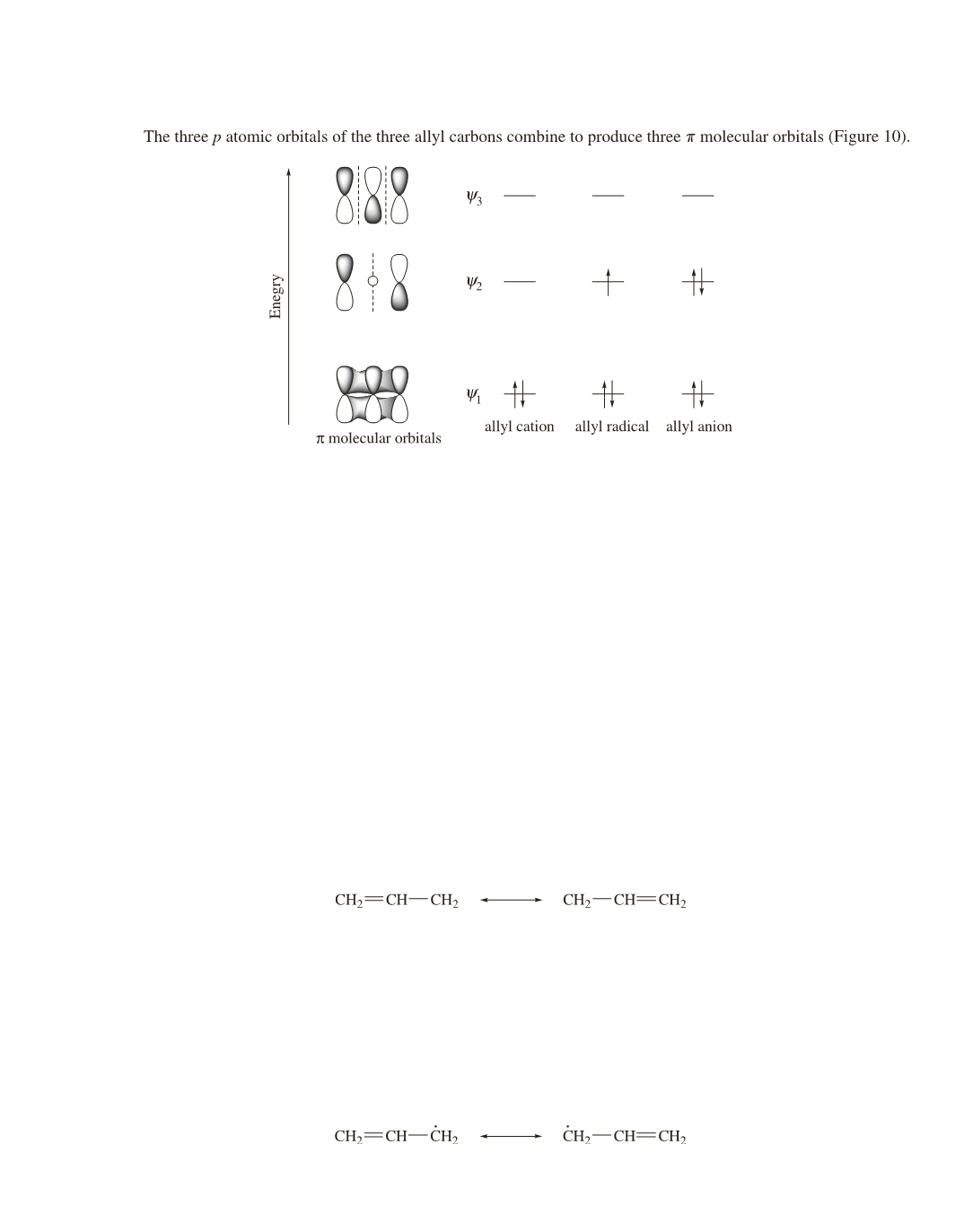
The bonding MO
1
c
1
2
encompasses the three carbons. In an acyclic system, the number of bonding MOs al-
ways equals the number of antibonding MOs. Therefore, when there is an odd number of MOs, one of them must
be a nonbonding molecular orbital;
c
2
is the nonbonding MO. We have seen (Section 8.8) that as the energy of
the MO increases, the number of nodes increases. Consequently,
c
2
must have a node—in addition to the one that
c
1
has—that bisects the
p
orbitals. The only symmetrical position for a node to pass through in
c
2
is through the
middle carbon. You also know that it needs to pass through the middle carbon because that is the only way
c
2
can
be fully antisymmetric, which it must be since
c
1
and
c
3
are symmetric (recall that MOs alternate between being
symmetric and antisymmetric; Section 8.8.)
You can see why
c
2
is called a nonbonding molecular orbital—there is no overlap between the
p
orbital on the
middle carbon and the
p
orbital on either of the end carbons. Notice that a nonbonding MO has the same energy as
the isolated
p
atomic orbitals. The third MO
1
c
3
2
is an antibonding MO.
The two
p
electrons of the allyl cation are in the bonding MO, which means they are spread out over all three
carbons. Consequently, the two carbon–carbon bonds are identical, with each having some double-bond character.
The resonance contributors show that the positive charge is shared equally by the end carbon atoms, which is
another way of showing that the stability of the allyl cation is due to electron delocalization:
+
+
The contributing resonance structures show that when a nucleophile such as Br
-
reacts with an allyl cation, the
Br
-
can bond to either of the end carbons—because they share the positive charge—but cannot bond to the middle
carbon. Likewise, MO theory shows that only the end carbons have an empty orbital with which the filled orbital of
Br
-
can overlap. The central carbon has a node, so there can be no interaction with this carbon.
The allyl radical has two electrons in the bonding MO, so these electrons are spread over all three carbon atoms.
The third electron is in the nonbonding MO. The MO diagram shows that the third electron is shared equally by the
end carbons with none of the electron density residing on the middle carbon. This agrees with what the resonance
contributors show:
+
−
Figure 10. The distribution of the electrons in the molecular orbitals of the allyl cation, the allyl radical, and
the allyl anion.