


 257 / 912

Chapter 7 249
Copyright © 2017 Pearson Education, Inc.
31.
The student named only one correctly.
a.
4-methyl-2-hexyne
b.
7-bromo-3-heptyne
c.
correct
d.
2-pentyne
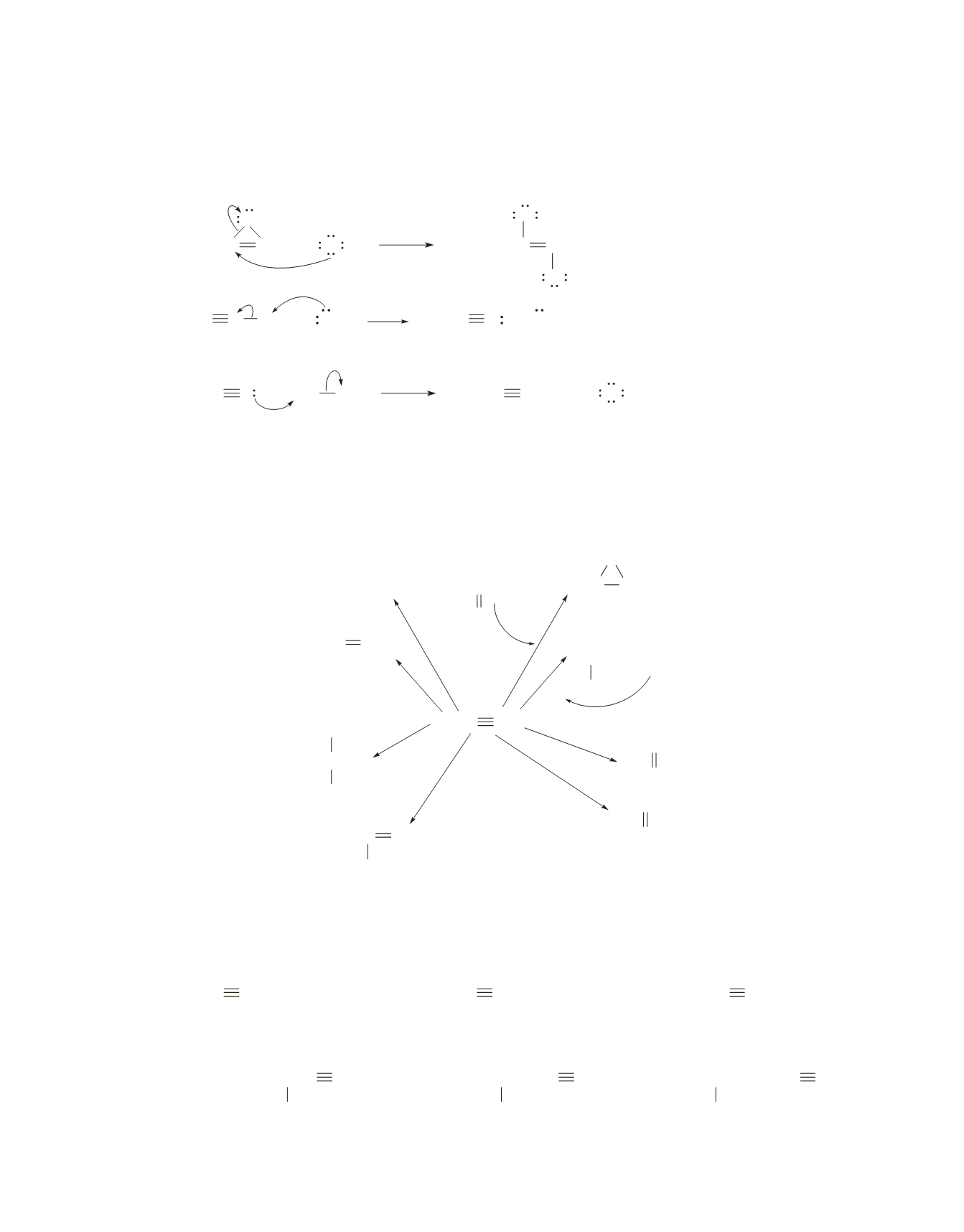
32.
+
–
Br
+
Br
Br
Br
electrophile nucleophile
CH
3
CH
2
C CH
CH
3
CH
2
C CCH
CH
3
C C
electrophile
nucleophile
NH
2
+
CH
3
C C
+
H
NH
3
–
–
+
–
Br
electrophile
(Methyl bromide is an electrophile because the carbon has a partial positive charge since
bromine is more electronegative than carbon.)
nucleophile
CH
3
Br
CH
3
C CCH
3
CH
3
C C
−
33.
a.
5-bromo-2-hexyne
b.
5-methyl-2-octyne
c.
5,5-dimethyl-2-hexyne
d.
6-chloro-2-methyl-3-heptyne
e.
1,5-cyclooctadiene
f.
1,6-dimethyl-1,3-cyclohexadiene
34.
RCH
2
CH
3
RCHCH
3
Br
RCH CH
2
RCCH
3
RCCH
3
O
RC CH
excess HBr
H
2
O/H
2
SO
4
+
HgSO
4
H
2
/Lindlar catalyst
excess
H
2
, Pd/C
1 equiv HBr
1. H
2
/Lindlar catalyst
2. HBr
Br
Br
RC CH
2
Br
1. R
2
BH/THF
2. HO
–
, H
2
O
2
, H
2
O
RCH
2
CH
O
RCOOH
RCH CH
2
O
O
1. H
2
, Lindlar catalyst
2.
35.
a.
First draw the straight-chain compounds with seven carbons; then draw the straight-chain compounds
with six carbons and one methyl group; then draw the straight-chain compounds with five carbons and
two methyl groups (or with one ethyl group). Naming them will tell you if you have drawn one com-
pound more than once because if two compounds have the same name, they are the same compound.
HC CCH
2
CH
2
CH
2
CH
2
CH
3
1-heptyne
pentylacetylene
CH
3
C CCH
2
CH
2
CH
2
CH
3
2-heptyne
butylmethylacetylene
CH
3
CH
2
C CCH
2
CH
2
CH
3
3-heptyne
ethylpropylacetylene
CH
3
CH
2
CH
2
CHC CH
3-methyl-1-hexyne
CH
3
CH
3
CH
2
CHCH
2
C CH
4-methyl-1-hexyne
CH
3
CH
3
CHCH
2
CH
2
C CH
5-methyl-1-hexyne
isopentylacetylene
CH
3
*
*