



 246 / 912

238 Chapter 6
Copyright © 2017 Pearson Education, Inc.
97
.
2-Methylpropene will be hydrated more rapidly.
1.
It is more reactive than the chloro-substituted alkene, because the electron-withdrawing chlorine makes
the alkene less nucleophilic.
2.
The carbocation intermediate that 2-methylpropene forms (and, therefore, the transition state leading
to its formation) is more stable, because the electron-withdrawing chlorine increases the amount of
positive charge on the carbon.
98
.
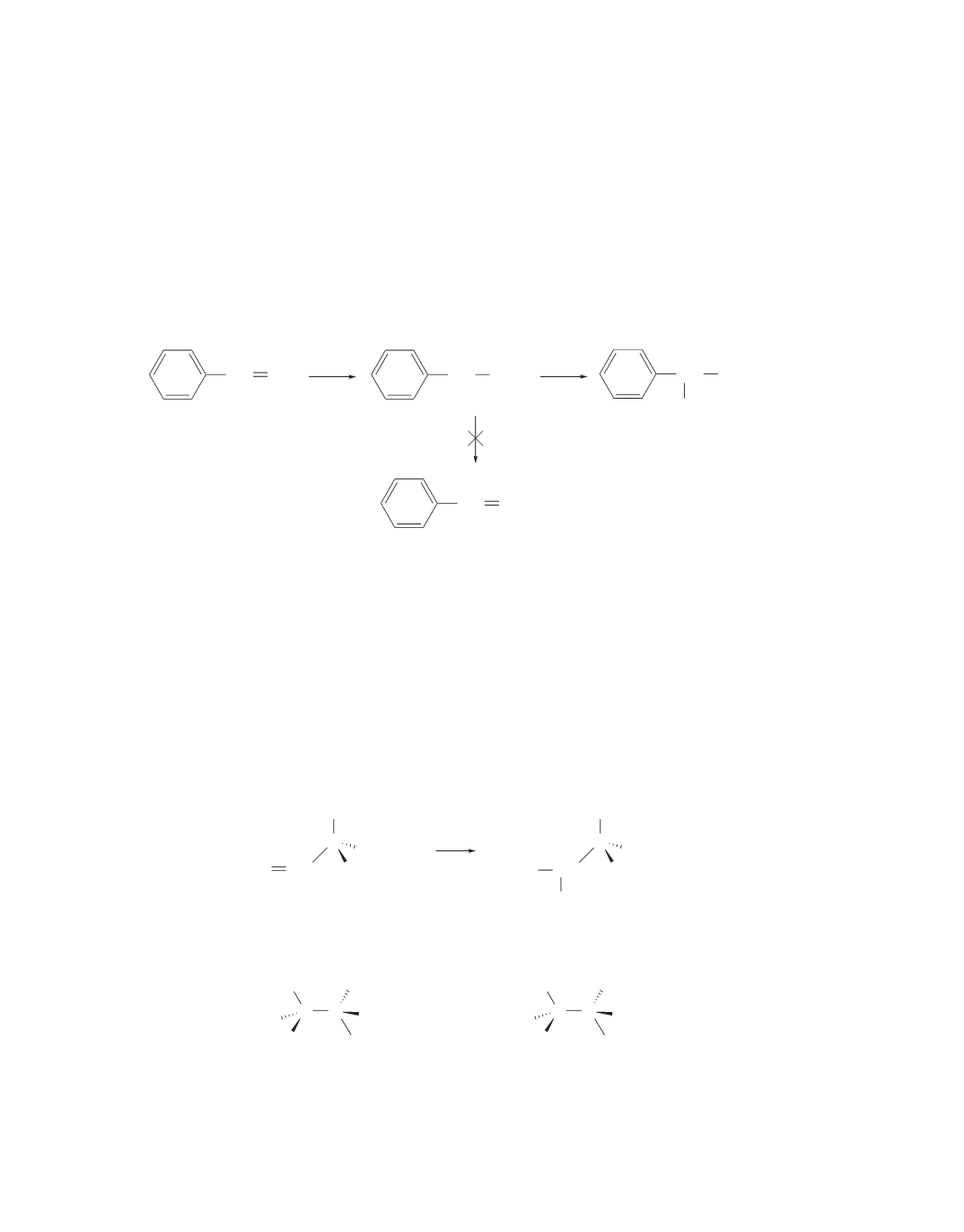
It tells us that the first step of the mechanism is the slow step. If the first step is slow, the carbocation will
react with water in a subsequent fast step, which means that the carbocation will not have time to lose a
proton to reform the alkene, so all the deuterium atoms (D) will be retained in the unreacted alkene.
CH CD
2
CH CHD
2
H
2
SO
4
CH CHD
2
+
OH
H
2
O
fast
CH CHD
D
+
+
If the first step is not the slow step, an equilibrium will be set up between the alkene and the carbocation,
and because the carbocation could lose either H
+
or D
+
when it reforms the alkene, all the deuterium atoms
would not be retained in the unreacted alkene.
99
.
Because fumarate is the trans isomer and it forms an erythro product, the enzyme must catalyze the anti
addition of D
2
O. (Recall: CIS-SYN-ERYTHRO allows TRANS-ANTI-ERYTHRO but does not allow
TRANS-SYN-ERYTHRO, because two terms must be changed.)
100
.
When
S
-3-methyl-1-pentene reacts with Cl
2
, a compound with a new asymmetric center
1
*
2
is formed. The
relative position of the groups around the asymmetric center does not change because no bonds to it are
broken during the course of the reaction.
CH
3
S
S
C
CH
H
CH
2
CH
3
CH
2
(
S
)-3-methyl-1-pentene
Cl
2
CH
3
C H
CH
2
CH
3
CH
Cl
ClCH
2
*
The new asymmetric center can have either the
R
or
S
configuration. Therefore, a pair of diastereomers is
obtained.
(2
R
,3
S
)-1,2-dichloro-3-methylpentane (2
S
,3
S
)-1,2-dichloro-3-methylpentane
CC
CH
2
CH
3
Cl
ClCH
2
CH
3
H
H
H
S R
C C
Cl
ClCH
2
CH
2
CH
3
H
CH
3
S S