


 249 / 912

Chapter 6 241
Copyright © 2017 Pearson Education, Inc.
c.
CH
3
Br
d.
OH
CH
3
6.
Indicate the carbocations that you would expect to rearrange to give a more stable carbocation.
CH
3
CH
2
CHCH
3
CH
3
CH
2
CHCHCH
3
CH
3
+
+
+
+
CH
3
3
CH
7.
Indicate whether each of the following statements is true or false:
a.
The addition of Br
2
to 1-butene to form 1,2-dibromobutane is a concerted reaction.
T F
b.
The reaction of 1-butene with HCl forms 1-chlorobutane as the major product.
T F
c.
The reaction of HBr with 3-methylcyclohexene is more highly regioselective
than is the reaction of HBr with 1-methylcyclohexene.
T F
d.
The reaction of an alkene with a carboxylic acid forms an epoxide.
T F
e.
A catalyst increases the equilibrium constant of a reaction.
T F
f.
The addition of HBr to 3-methyl-2-pentene is a stereospecific reaction.
T F
g.
The addition of HBr to 3-methyl-2-pentene is a stereoselective reaction.
T F
h.
The addition of HBr to 3-methyl-2-pentene is a regioselective reaction.
T F
8.
Draw all the products that are obtained from each of the following reactions, indicating the stereoisomers
that are formed:
a.
1-butene
+
HCl
b.
2-pentene
+
HBr
9.
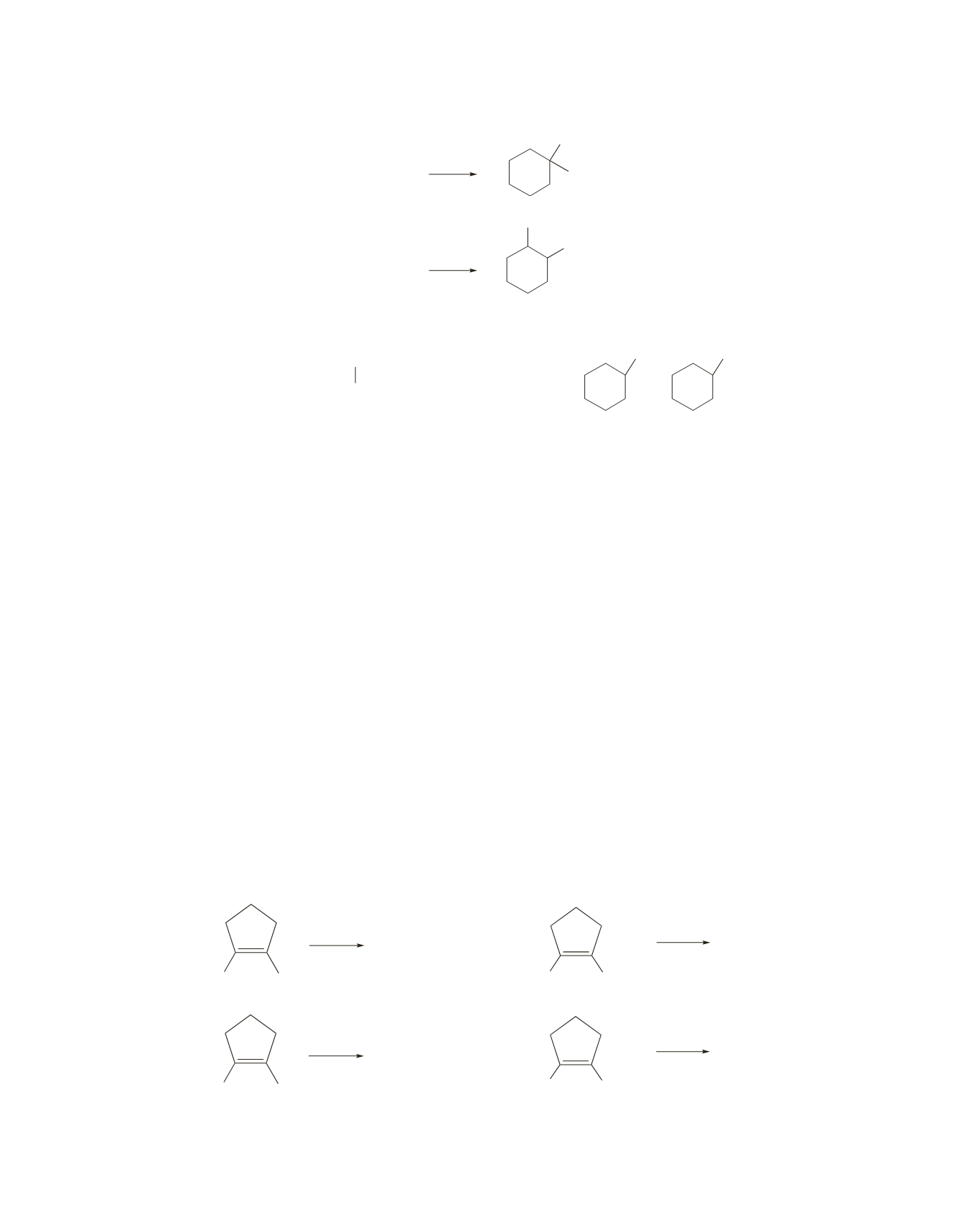
Draw the stereoisomers that are obtained from each of the following reactions:
a.
CH
3
Br
2
CH
2
Cl
2
CH
3
b.
CH
2
CH
3
CH
3
Br
2
CH
2
Cl
2
c.
CH
3
CH
3
H
2
Pd/C
d.
CH
2
CH
3
CH
3
H
2
Pd/C
c.
trans
-3-hexene
+
Br
2
d.
trans
-3-heptene
+
Br
2