


 111 / 912

Chapter 2 103
Copyright © 2017 Pearson Education, Inc.
59.
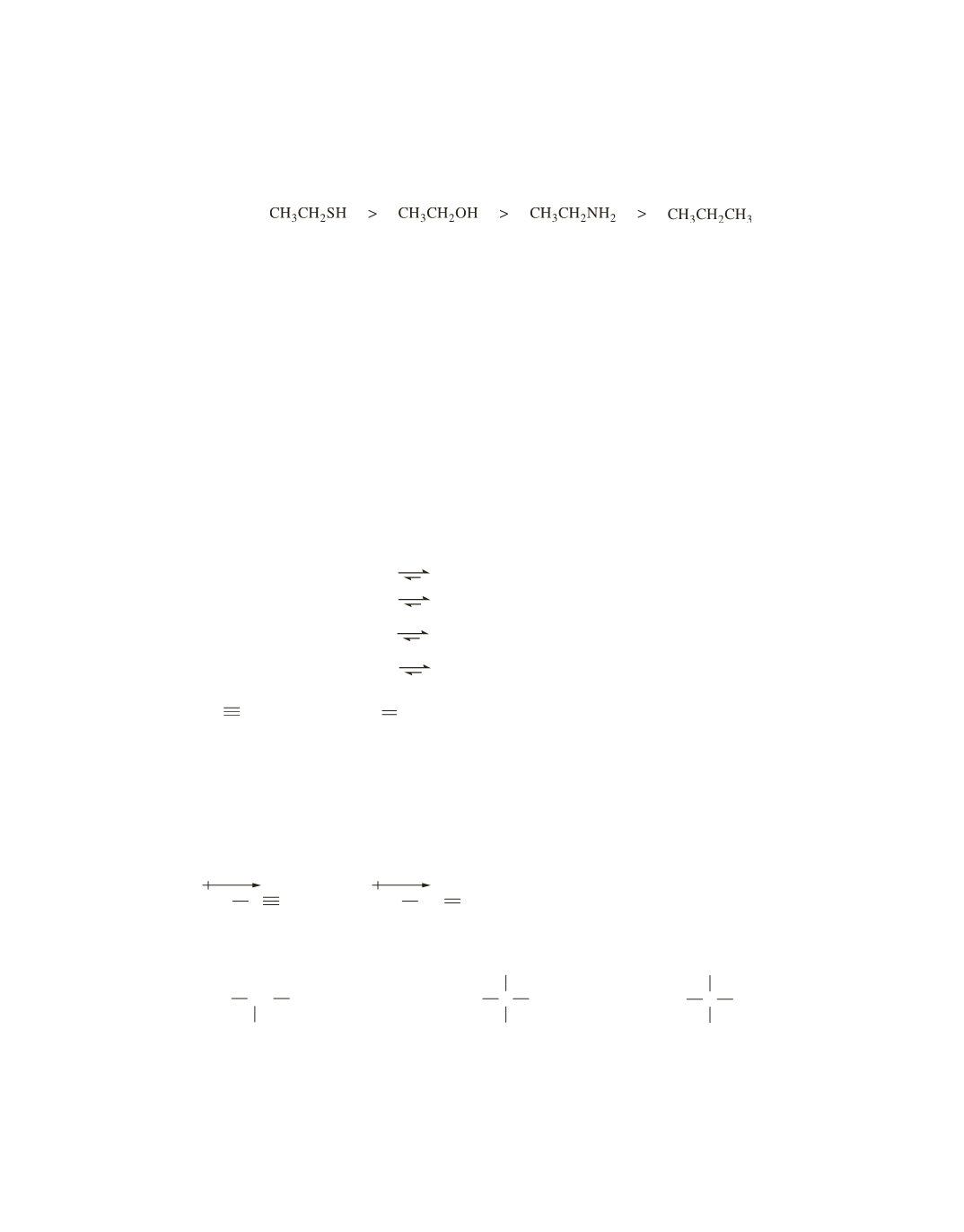
O is more electronegative than N, which is more electronegative than C.
Therefore, the alcohol is more acidic than the amine, which is more acidic than the alkane.
S is larger than O, so
CH
3
CH
2
SH
is more acidic than
CH
3
CH
2
OH.
60.
If the pH of the solution is less than the
p
K
a
of the compound, the compound will be in its acidic form (with
the proton).
If the pH of the solution is greater than the
p
K
a
of the compound, the compound will be in its basic form
(without the proton).
a.
CH
3
COOH
at pH
=
3
CH
3
COO
−
CH
3
COO
−
CH
3
COO
−
at pH
=
6
at pH
=
10
at pH
=
14
b.
at pH = 3
at pH = 6
at pH = 10
at pH = 14
+
3 2 3
3 2 3
3 2 3
3 2 2
+
+
CH CH NH
CH CH NH
CH CH NH
CH CH NH
c.
at pH = 3 CF CH OH
at pH = 6 CF CH OH
at pH = 10 CF CH OH
at pH = 14 CF CH O
−
2 3
2 3
2 3
2 3
61.
In all four reactions, the products are favored at equilibrium. (Recall that the equilibrium favors formation
of the weaker acid.)
a.
−
3
3
CH COOH + CH O
−
3
3
CH COO + CH OH
b.
3 2
2
CH CH OH + NH
−
−
3 2
3
CH CH O + NH
c.
3
3 2
CH COOH + CH NH
+
3
3 3
CH COO + CH NH
−
d.
3 2
CH CH OH + HCl
+
3 2 2
CH CH OH + Cl
−
62.
a.
HC CCH
2
OH > CH
2
CHCH
2
OH > CH
3
CH
2
CH
2
OH
b.
These three compounds differ only in the group that is attached to
CH
2
OH.
The more electronegative
the group attached to
CH
2
OH,
the stronger the acid because inductive electron withdrawal stabilizes
the conjugate base, and the more stable the base, the stronger its conjugate acid. An
sp
carbon is more
electronegative than an
sp
2
carbon, which is more electronegative than an
sp
3
carbon.
63.
The direction of the dipole will be toward the more electronegative of the two atoms that are sharing the
bonding electrons.
a.
CH
3
C CH
b.
CH
2
CH
3
CH
64.
In each compound, the nitrogen atom is the atom most apt to be protonated because it is the stronger base.
a.
CH
3
CH
2
NH
3
+
CH
OH
b.
CH
3
OH
+
C
NH
3
CH
3
c.
CH
3
CH
2
OH
+
C
NH
3
CH
3