


 610 / 912

602 Chapter 18
Copyright © 2017 Pearson Education, Inc.
11.
OH
a.
I
Br
NH
2
c.
Cl
Br
b.
O N
2
O
C
H
NO
2
12.
a.
1,3,5-tribromobenzene
b.
meta
-nitrophenol or 3-nitrophenol
c.
para
-bromomethylbenzene or 1-bromo-4-methylbenzene
d.
ortho
-dichlorobenzene or 1,2-dichlorobenzene
e.
meta
-bromomethylbenzene or 1-bromo-3-methylbenzene
f.
2-ethyl-4-iodoaniline
13.
Solved in the text.
14.
When a halogen is attached to a benzene ring, it can donate electrons by resonance and withdraw electrons
inductively. We saw in Problem 13 that fluorobenzene is more reactive than chlorobenzene because fluo-
rine is better at donating electrons by resonance. A halogen attached to a methyl group can only withdraw
electrons inductively. Because fluorine is more electronegative than chlorine, it is better at withdrawing
electrons as well. Therefore, chloromethylbenzene is more reactive than fluoromethylbenzene.
15.
a.
phenol
7
toluene
7
benzene
7
bromobenzene
7
nitrobenzene
b.
toluene
7
chloromethylbenzene
7
dichloromethylbenzene
7
difluoromethylbenzene
16.
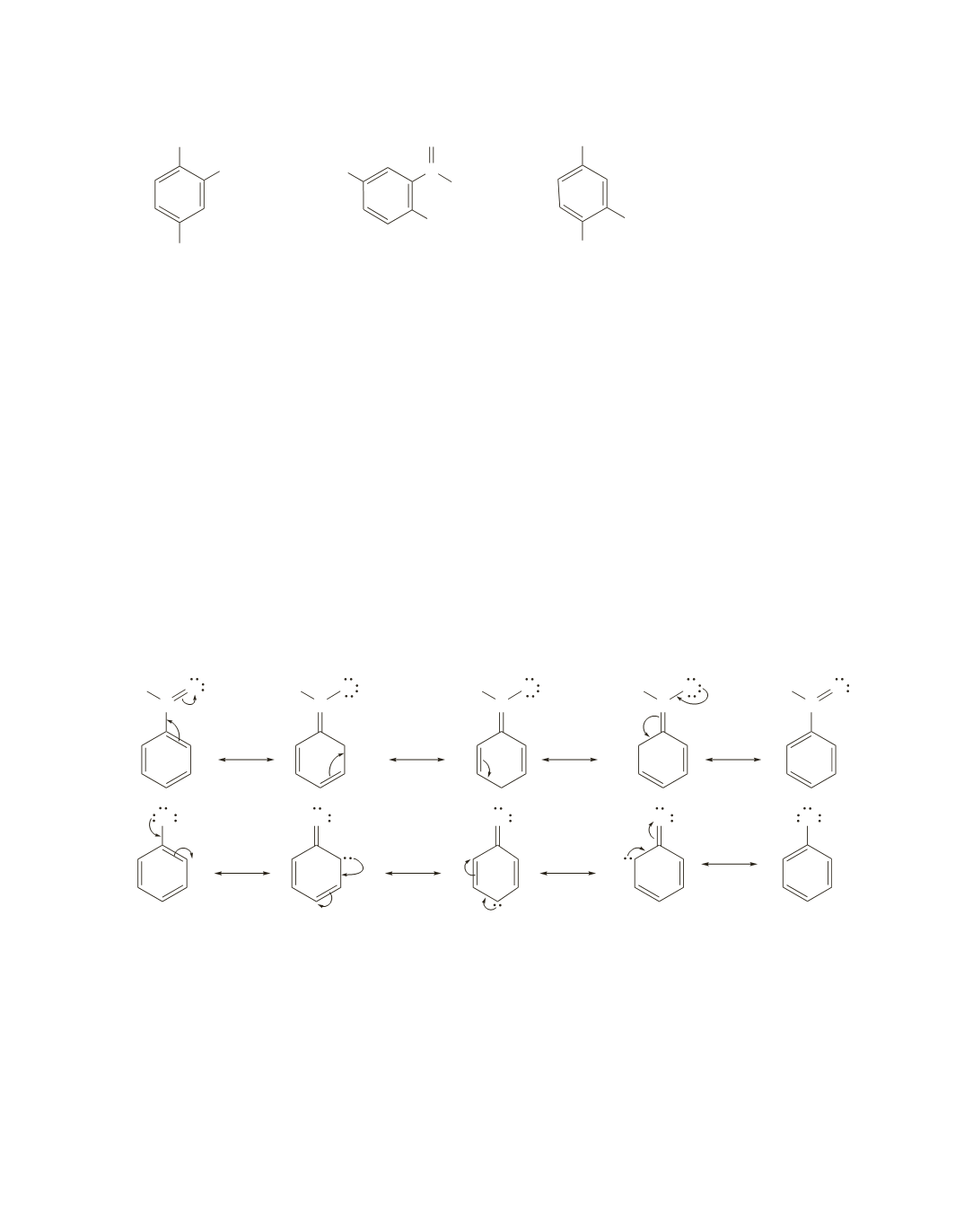
a.
C
H O
+
+
+
O
−
C
H
O
−
C
H
O
−
C
H
O
C
H
b.
Cl
Cl
Cl
Cl
Cl
+
−
+
−
+
−