


 549 / 912

Chapter 16 541
Copyright © 2017 Pearson Education, Inc.
69.
a.
three signals in its
1
H NMR
spectrum
b.
three signals in its
13
C NMR
spectrum
1. excess CH
3
MgBr
2. HCl
CH
3
CCH
2
CH
2
CCH
3
CH
3
OH
CH
3
OH
OCH
3
CH
2
CH
2
CH
3
C
O
C
O
70.
1. CH
3
MgBr
2. HCl
CH
3
CH
2
CHCH
3
OH
HCl
CH
3
OH
excess
CH
3
CH
2
CCH
3
OCH
3
OCH
3
CH
3
CH
2
H
CH
3
CH
2
CH
3
C
O
C
O
NaOCl
CH
3
COOH
0
°
C
71.
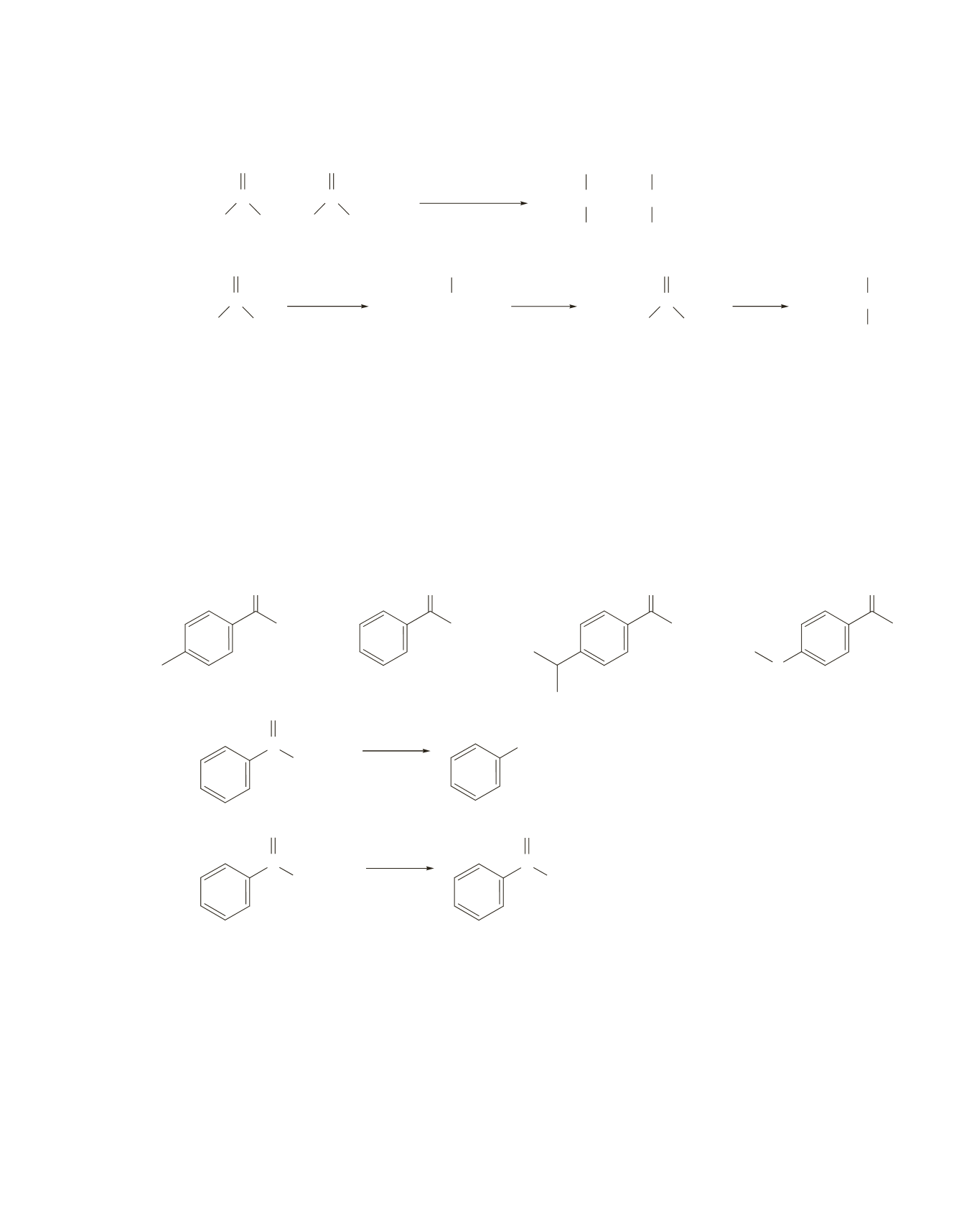
Electron withdrawal from the benzene ring increases the electrophilicity of the carbonyl carbon, which
makes it more reactive.
Electron donation into the benzene ring decreases the electrophilicity of the carbonyl carbon, which makes
it less reactive.
The first compound is the most reactive toward nucleophilic addition because the nitro substituent
withdraws electrons from the benzene ring inductively and by resonance.
The third compound is less reactive than the compound without a substituent on the benzene ring because
the isopropyl substituent donates electrons into the benzene ring by hyperconjugation.
The fourth compound is least reactive because the ethoxy substituent donates electrons strongly into the
benzene ring by resonance.
H
O
O N
2
H
O
H
H
O
O
>
>
>
O
72.
a.
NHCH
3
CH
2
NHCH
3
1. LiAlH
4
2. H
2
O
C
O
b.
NHCH
3
C
O
OH
C
O
HCl
H
2
O,