



 448 / 912

440 Chapter 13
Copyright © 2017 Pearson Education, Inc.
23.
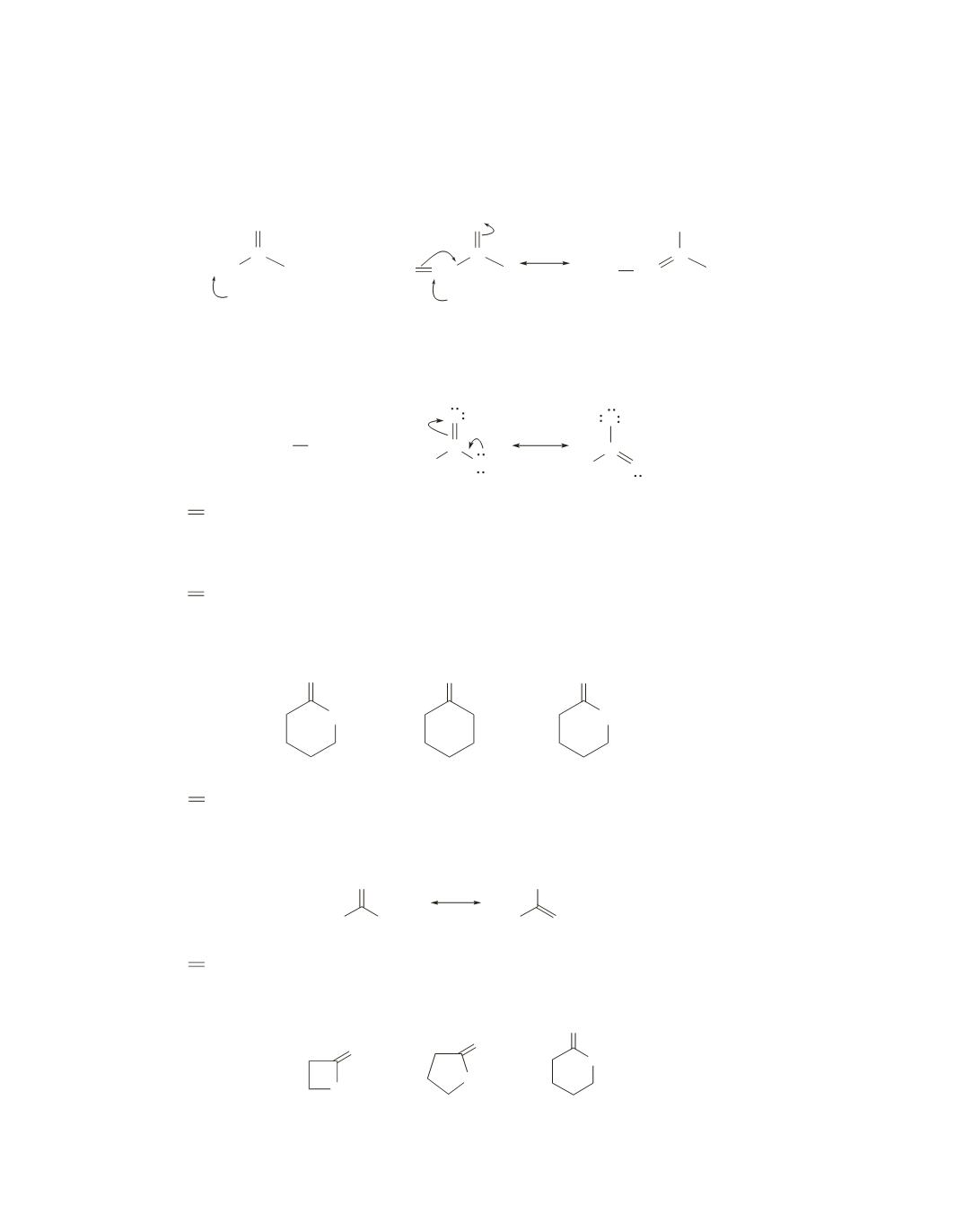
A carbonyl group bonded to an
sp
3
carbon exhibits an absorption band at a larger wavenumber because
a carbonyl group bonded to an
sp
2
carbon of an alkene has greater single-bond character as a result of
electron delocalization.
O
C
RCH
2
+
sp
3
O
C
CH
sp
2
RCH
O
C
CH RCH
−
24.
The C
¬
O bond of the alcohol is a pure single bond. In contrast, the C
¬
O bond of the carboxylic acid
has double-bond character, so it is a stronger bond and, therefore, takes more energy to stretch it.
+
RCH
2
OH
C
O
OH R
C
O
OH R
_
25.
a.
The
C O
absorption band of an ester occurs at the largest wavenumber because the carbonyl group of
an ester has the most double-bond character, since the predominant effect of the ester oxygen atom is
inductive electron withdrawal.
The
C O
absorption band of an amide occurs at the smallest wavenumber because the carbonyl group
of an amide has the least double-bond character, since the predominant effect of the amide nitrogen
atom is electron donation by resonance.
O
>
O
>
O
O
NH
b.
The
C O
absorption of the four-membered ring lactone occurs at the highest wavenumber because it
is the least able to accommodate double-bond character in the ring, which is required if the carbonyl
group is to have any single-bond character.
O
OR R
O
OR R
+
–
The
C O
absorption of the six-membered ring lactone occurs at the lowest wavenumber because it is
the most able to accommodate double-bond character in the ring.
O
O
O
O
O
O
>
>