



 162 / 912

154 Chapter 3
Copyright © 2017 Pearson Education, Inc.
81.
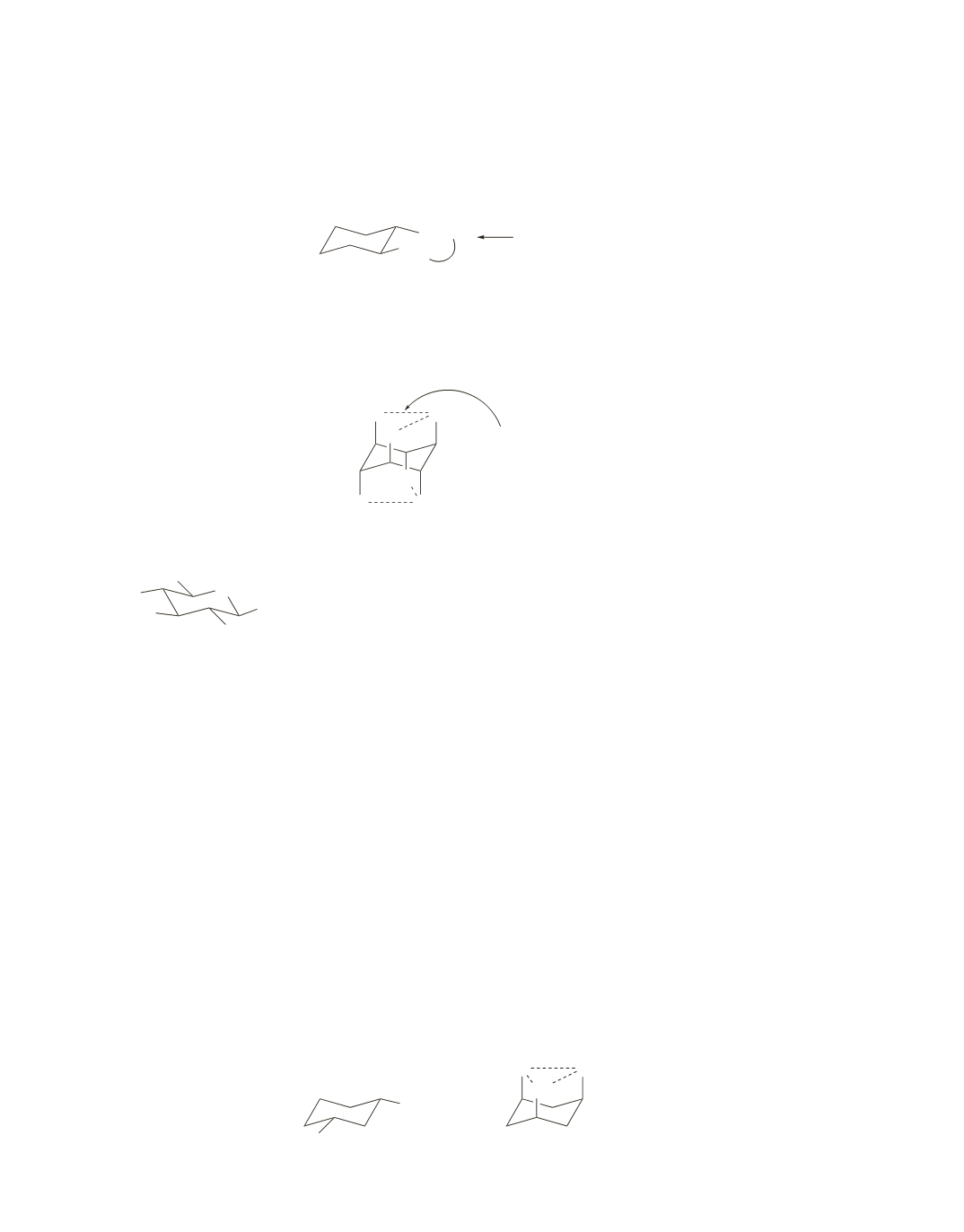
One chair conformer of
trans
-1,2-dimethylcyclohexane has both substituents in equatorial positions, so
it does not have any 1,3-diaxial interactions. However, the figure on the right on the middle of page 130
of the text shows that the two methyl substituents are gauche to each other (as they would be in gauche
butane; see Figure 3.15 on page 128), giving it a strain energy of 0.87 kcal
>
mol.
CH
3
CH
3
a gauche
interaction
The other chair conformer of
trans
-1,2-dimethylcyclohexane has both substituents in axial positions.
When a substituent is in an axial position, it experiences two 1,3-diaxial interactions. This chair conformer,
therefore, has a total of four 1,3-diaxial interactions. Each diaxial interaction is between a
CH
3
and an H,
so each results in a strain energy of 0.87 kcal
>
mol. Therefore, this chair conformer has a strain energy of
3.48 kcal
>
mol
1
4
*
0.87
=
3.48
2
.
H
CH
3
H
H
H
CH
3
a 1,3-diaxial
interaction
Therefore, one conformer is 2.61 kcal
>
mol (3.48 – 0.87) more stable than the other.
82.
O
HO
HO
CH
2
OH
OH
OH
83.
a.
5-methyl-3-hexanol
b.
1-bromo-2-propylcyclopentane
c.
2-methyl-3-pentanol
d.
5-bromo-2-methyloctane
e.
1,5-hexanediol
f.
6-bromo-2-hexanol
g.
4-ethyl-3-methylcyclohexanol
h.
4-bromo-1-ethyl-2-methylcyclohexane
i.
3-butyl-4-methylcyclopentanamine
84.
a.
1-Hexanol has a higher boiling point than 3-hexanol because the alkyl group in 1-hexanol has stronger
London dispersion forces, because the OH group of 3-hexanol makes it more difficult for its six
carbons to lie close to the six carbons of another molecule of 3-hexanol.
b.
The floppy ethyl groups in diethyl ether make it difficult for the water molecules to approach the oxygen
in order to engage in hydrogen bonding. Therefore, it is less soluble in water than is tetrahydrofuran, in
which the alkyl groups are pinned back in a ring.
85.
One of the chair conformers of
cis
-1,3-dimethylcyclohexane has both substituents in equatorial positions,
so there are no unfavorable 1,3-diaxial interactions. The other chair conformer has three 1,3-diaxial
interactions, two between a
CH
3
and an H and one between two
CH
3
groups.
We know that a 1,3-diaxial interaction between a
CH
3
and an H is 0.87 kcal
>
mol. Subtracting 1.7, for
the two interactions between a
CH
3
and an H, from 5.4 (the energy difference between the two conformers)
results in a value of 3.7 kcal
>
mol for the 1,3-diaxial interaction between the two
CH
3
groups.
CH
3
CH
3
H
CH
3
CH
3