



 163 / 912

Chapter 3 155
Copyright © 2017 Pearson Education, Inc.
86.
Because bromine has a larger diameter than chlorine, one would expect bromine to have a greater preference
for the equatorial position that would be indicated by a larger
∆
G
°
.
However, Table 3.9 on page 128 of the text
shows that it has a smaller
∆
G
°
,
indicating that it has less preference for the equatorial position than chlorine has.
The C—Br bond is longer than the C—Cl bond, which causes bromine to be farther away than chlorine
from the other axial substituents. Apparently, the longer bond more than offsets the larger diameter.
87.
a.
7-bromo-6-ethyl-5-decanol
b.
5-chloro-3-ethyl-2,7-dimethylnonane
c.
7,7-dimethyl-3-nonanol
88.
Problem 81 shows that the energy difference between the two chair conformers is 2.61 kcal
>
mol.
To calculate the equilibrium constant needed to answer the question, see Problem 19 on page 204
of the textbook.
∆
G
°
=
-
2.61 kcal
>
mol
∆
G
°
=
-
RT
ln
K
eq
-
2.61 kcal
>
mol
=
-
1.986
*
10
-
3
kcal
>
mol K
*
298 K
*
ln
K
eq
-
2.61 kcal
>
mol
=
-
0.5918 kcal
>
mol ln
K
eq
ln
K
eq
=
4.41
K
eq
=
82.3
=
both equatorial
both axial
=
82.3
1
percentage of molecule
with both groups in
equatorial positions
=
both equatorial
both equatorial
+
both axial
*
100
=
82.3
82.3
+
1
*
100
=
98.8%
89.
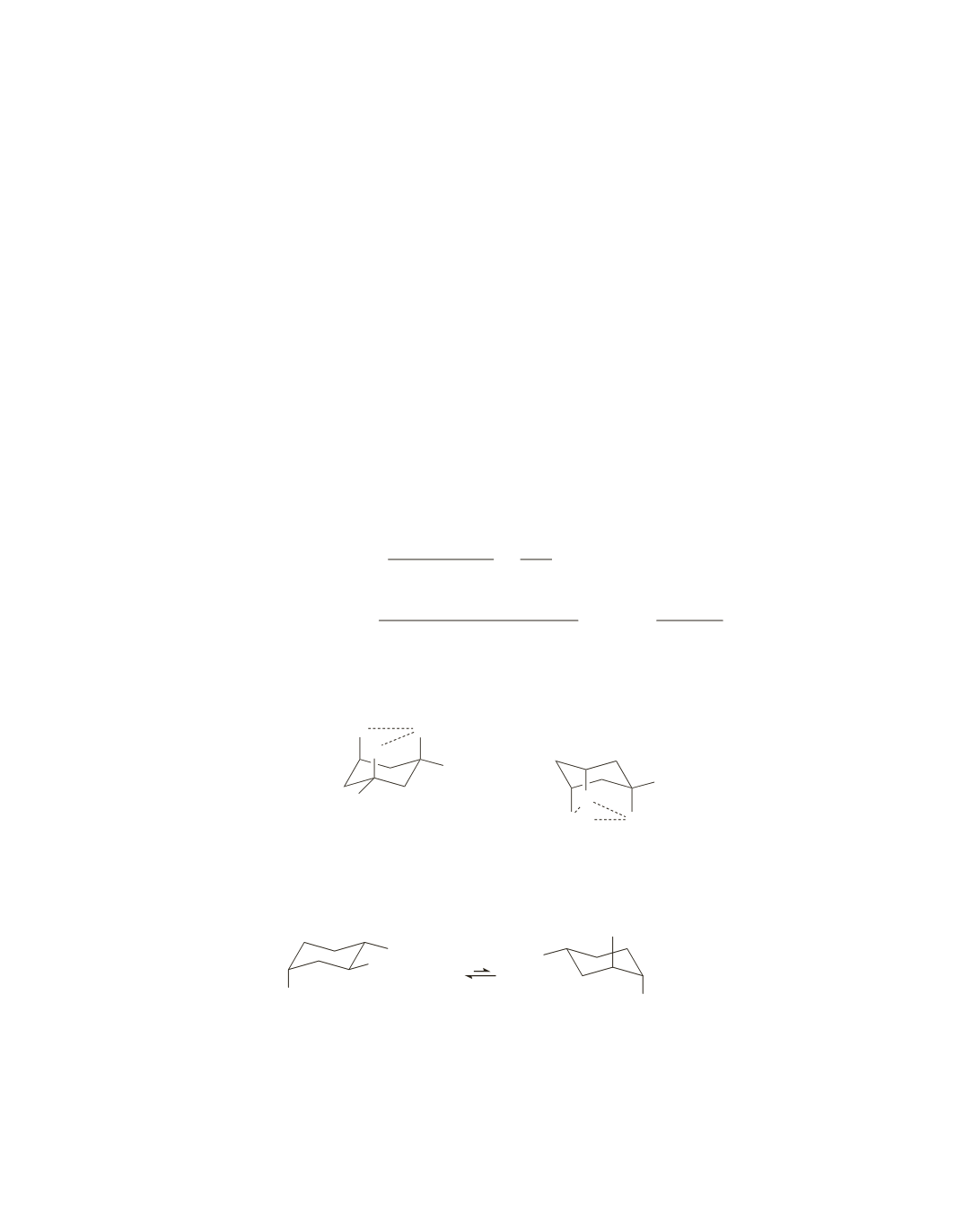
The conformer on the left has two 1,3-diaxial interactions between a
CH
3
and an
H
1
2
*
0.87 kcal
>
mol
2
for a total strain energy of 1.7 kcal
>
mol.
CH
3
H
H
CH
3
CH
3
CH
3
CH
3
H
CH
3
The conformer on the right has three 1,3-diaxial interactions, two between a
CH
3
and an H (1.7 kcal
>
mol)
and one between two
CH
3
groups (3.7 kcal
>
mol; see Problem 85) for a total strain energy of 5.4 kcal
>
mol.
Therefore, the conformer on the left predominates at equilibrium.
90.
CH
3
CH
3
CH
2
CH
3
CH
3
CH
3
CH
2
CH
3
Because the ethyl and methyl substituents
are on adjacent carbons, they experience a
gauche interaction.
There are two 1,3-diaxial interactions
between a CH
3
and an H.
0.96
+
0.87
+
0.87
=
2.7 kcal
>
mol
There are two 1,3-diaxial interactions between
a CH
3
and an H and two 1,3-diaxial interactions
between a CH
3
CH
2
and an H.
0.87
+
0.87
+
1.00
+
1.00
=
3.7 kcal
>
mol