


 636 / 912

628 Chapter 18
Copyright © 2017 Pearson Education, Inc.
66.
a.
The halogens withdraw electrons inductively and donate electrons by resonance. Because they all
deactivate the benzene ring toward electrophilic aromatic substitution, we know that their electron-
withdrawing effect is stronger than their electron-donating effect. Therefore, an
ortho
-halo-substituted
benzoic acid is a stronger acid than benzoic acid.
b.
Because fluorine is the weakest deactivator of the halogens (Table 18.1), we know that overall it
donates electrons better than the other halogens. Therefore,
ortho
-fluorobenzoic acid is the weakest of
the
ortho
-halo-substituted benzoic acids.
c.
The smaller the halogen, the more electronegative it is and, therefore, the better it is at withdrawing
electrons inductively. The smaller the halogen, the better it is at donating electrons by resonance
because a 2
p
orbital of carbon overlaps a 2
p
orbital of a halogen better than a 3
p
orbital of a halogen
and overlaps a 3
p
orbital better than a 4
p
orbital. Therefore, Br does not withdraw electrons as well as
Cl, and Br does not donate electrons as well as Cl, so their p
K
a
values are similar.
67.
a.
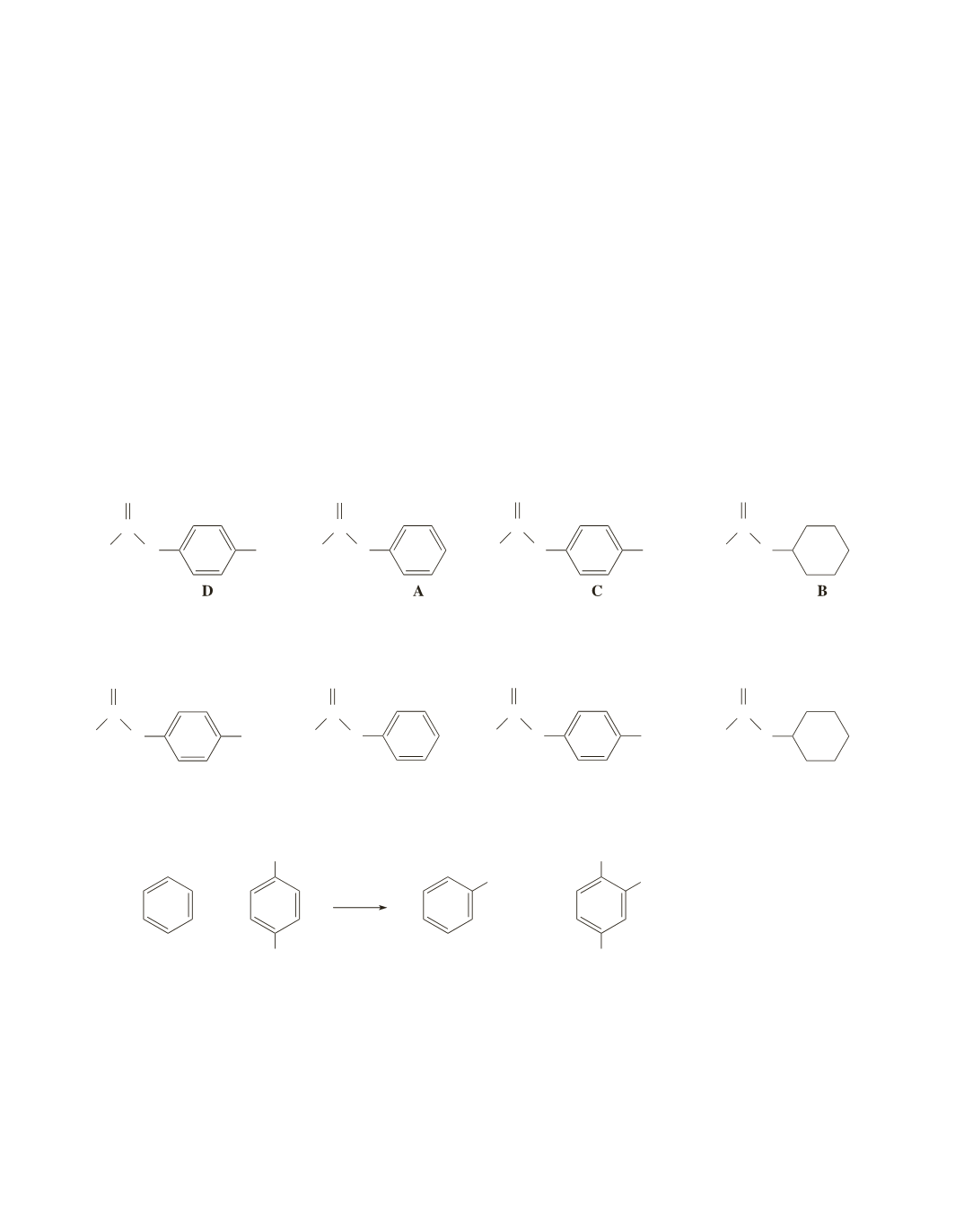
The weaker the base attached to the acyl group, the stronger its electron-withdrawing ability; therefore,
the easier it is to form the tetrahedral intermediate. (
para
-Chlorophenol is a stronger acid than phenol,
so the conjugate base of
para
-chlorophenol is a weaker base than the conjugate base of phenol, etc.)
Cl
>
>
CH
3
>
O CH
3
O CH
3
O CH
3
O CH
3
C
O
C
O
C
O
C
O
b.
The tetrahedral intermediate collapses by eliminating the OR group. The lower the basicity of the OR
group, the easier it is to eliminate.
Cl
>
>
CH
3
>
O CH
3
O CH
3
O CH
3
O CH
3
C
O
C
O
C
O
C
O
Thus, the rate of both formation of the tetrahedral intermediate and collapse of the tetrahedral interme-
diate is decreased by increasing the basicity of the OR group.
68.
a.
+
NO
2
+
+
NO
2
CH
3
CH
3
NO
2
CH
3
CH
3
para
-xylene
minor product
major product
b.
The major product is 1,4-dimethyl-2-nitrobenzene.
para
-Xylene is more reactive than benzene toward electrophilic aromatic substitution. The methyl
groups activate the ortho positions, so all four positions on the ring are activated. Attack on any one of
the four leads to the same compound.