


 621 / 912

Chapter 18 613
Copyright © 2017 Pearson Education, Inc.
35.
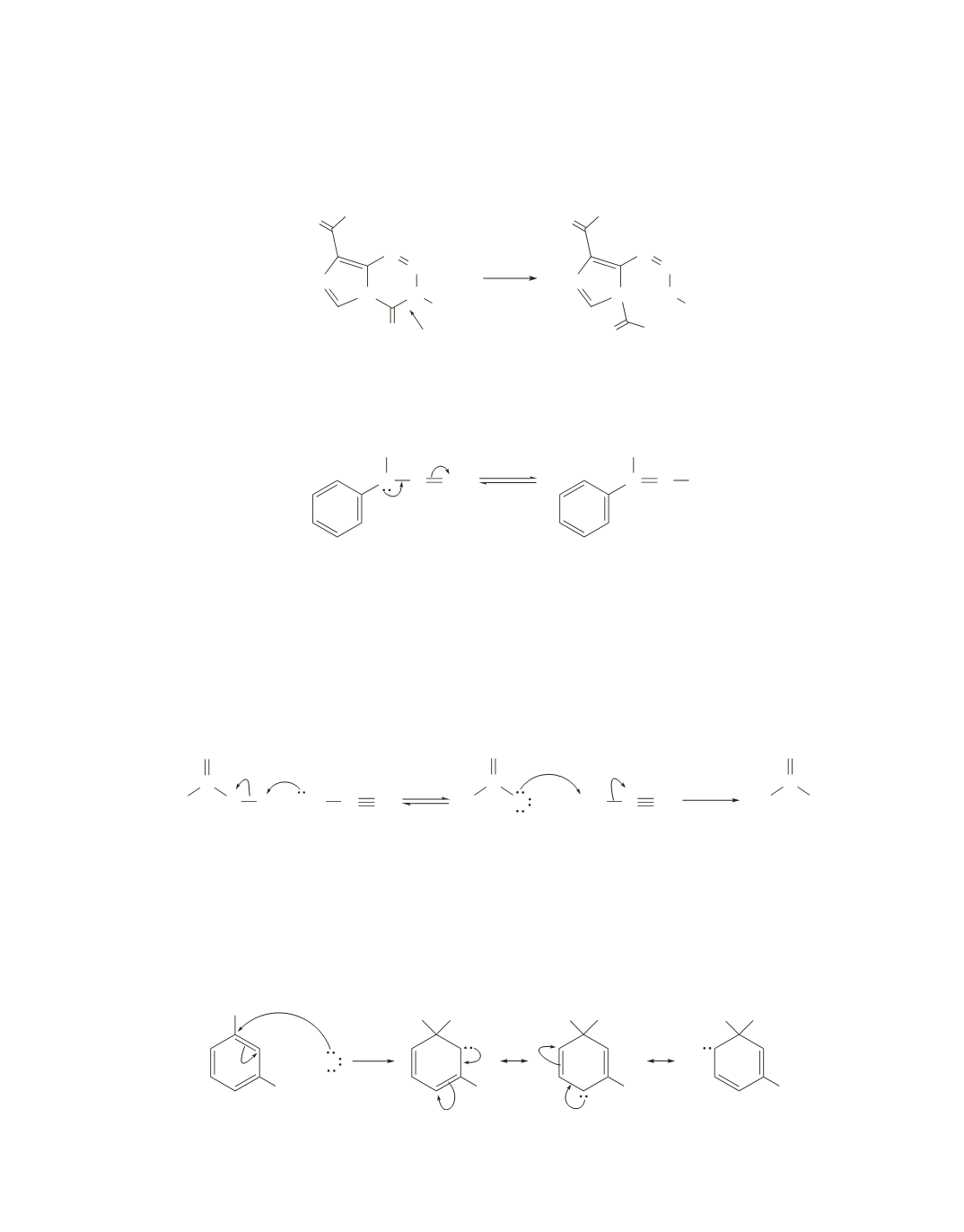
Immediately after hydrolysis of the amide bond, carbon dioxide is lost. We know then that the indicated
amide bond is the one that is hydrolyzed because carbon dioxide can then be lost since the electrons left
behind can be delocalized onto the carbonyl oxygen.
NH
2
O
O
CH
3
N
N
N N
N
H
2
O
NH
2
O
O
CH
3
N
N
HN
N
N
O
−
36.
The nitrosamine formed from a secondary amine cannot form a diazonium ion when the nitrogen–nitrogen
double bond is formed because the nitrogen cannot lose its positive charge by losing a proton. Therefore,
the reaction stops at the nitrosamine.
CH
3
N N O
CH
3
N N O
−
+
nitrosamine
37.
Note: Diazomethane is both explosive and toxic, so it should be synthesized only in small amounts by
experienced laboratory workers.
The first step of the reaction is formation of the methyldiazonium ion as a result of removal of a proton
from the carboxylic acid by diazomethane.
In the second step of the reaction, the carboxylate ion displaces nitrogen gas
1
N
2
2
from the methyldiazo-
nium ion in an S
N
2 reaction. High yields are obtained because the only side product is a gas.
+
CH
2
N N
+
−
diazomethane
O
+
CH
3
N N
+
−
methyldiazonium
ion
OCH
3
N
2
+
C
O
R O H
C
O
R
C
O
R
38.
From the resonance contributors, you can see that the reason that
meta
-chloronitrobenzene does not react
with hydroxide ion is because the negative charge that is generated on the benzene ring cannot be delocal-
ized onto the nitro substituent.
Electron delocalization onto the nitro substituent can occur only if the nitro substituent is ortho or para to
the site of nucleophilic attack.
Cl
NO
2
+
HO
−
NO
2
OH Cl
−
NO
2
OH Cl
−
NO
2
OH Cl
−