


 60 / 912

52
Spectroscopy Problems
Copyright © 2017 Pearson Education, Inc.
These fragments can be pieced together two ways. Because the most deshielded signal in the spectrum
(the one at 5.0 ppm) is the proton bonded to the central carbon of the isopropyl group, that carbon must be
attached directly to the oxygen. Thus, the compound is
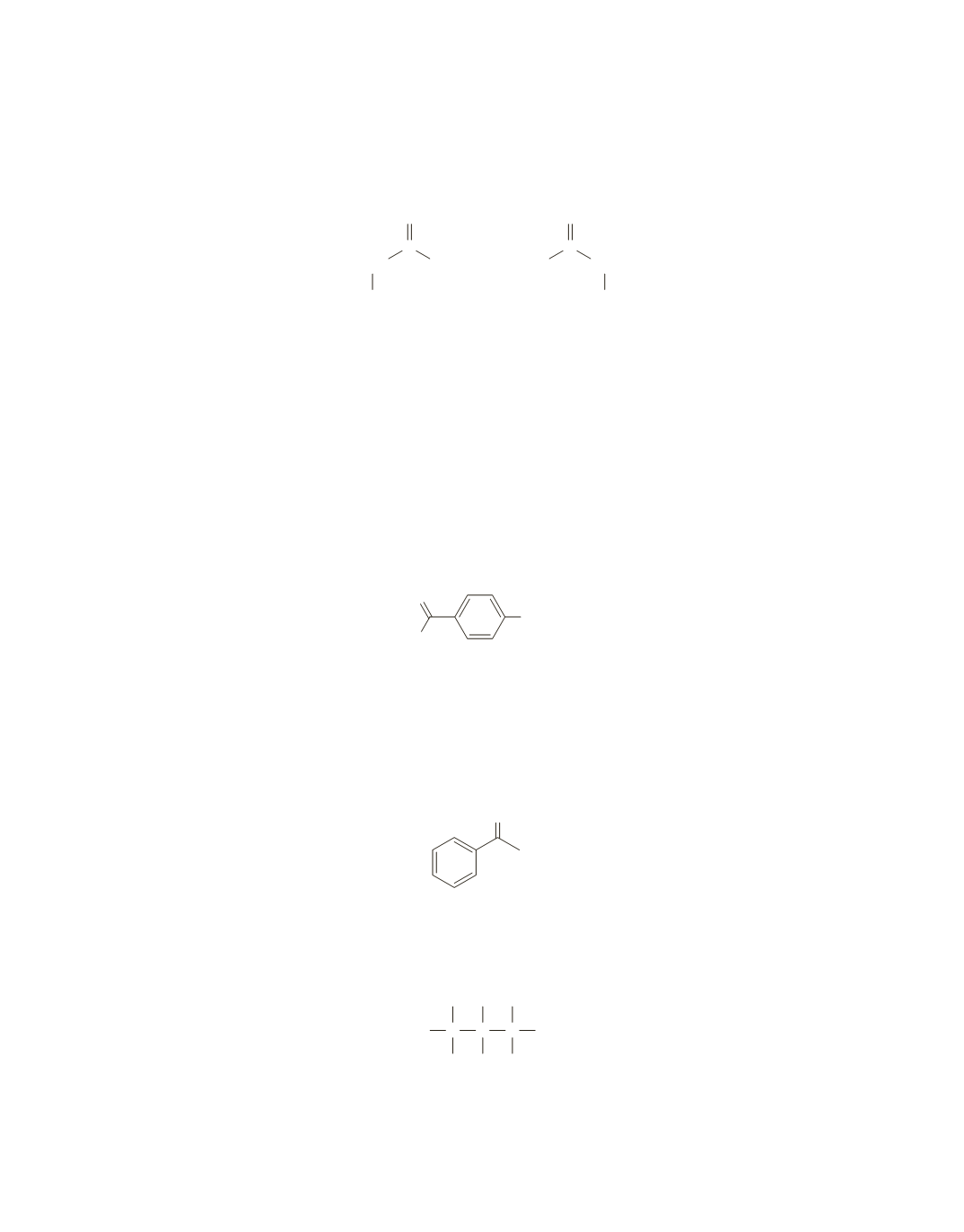
isopropyl acetate
.
methyl 2-methylpropanoate
isopropyl acetate
OCH
3
CH
3
CH
CH
3
C
O
OCHCH
3
CH
3
CH
3
C
O
21.
The IR spectrum shows an absorption at
1700 cm
-
1
for a
C
“
O
stretch and a very broad absorption
(2300–3300
cm
-
1
) for an
O
¬
H
stretch, indicating that the compound is a carboxylic acid. Intermolecular
hydrogen bonding explains the broad nature of this peak as well as the broader-than-expected carbonyl
peak absorption. The proton of the carboxylic acid gives a singlet at 12.4 ppm in the NMR spectrum.
The two doublets (7.5 and 7.9 ppm) that each integrate to 2 protons indicate a 1,4-disubstituted benzene ring.
Subtracting the disubstituted benzene ring and the COOH group from the molecular formula leaves
CH
2
Br.
Therefore, we know that the second substituent is a bromomethyl group; it gives the singlet at
4.7 ppm.
Therefore, the compound that gives the spectrum is the one shown here.
CH
2
Br
HO
O
22.
The signals with chemical shifts in the range of 7–8 ppm are due to benzene-ring protons. Because the
three signals integrate to a total of 5 protons, we know that the benzene ring is monosubstituted.
The singlet at 10 ppm indicates the hydrogen of an aldehyde or a carboxylic acid. Because only one
oxygen is in the molecular formula, we know that the compound is an aldehyde. Thus, the compound is
benzaldehyde
—a compound with a monosubstituted benzene ring and an attached aldehyde.
O
H
23.
In the first spectrum, the doublet
( 1.7 ppm)
that integrates to 6 protons and the septet
( 4.2 ppm)
that
integrates to 1 proton indicate an isopropyl group. When the isopropyl group is subtracted from the
molecular formula, only a Br remains. Thus, the compound is
2-bromopropane
.
C H
H
H
C
H
H H
H
Br
C