



 581 / 912

Chapter 17 573
Copyright © 2017 Pearson Education, Inc.
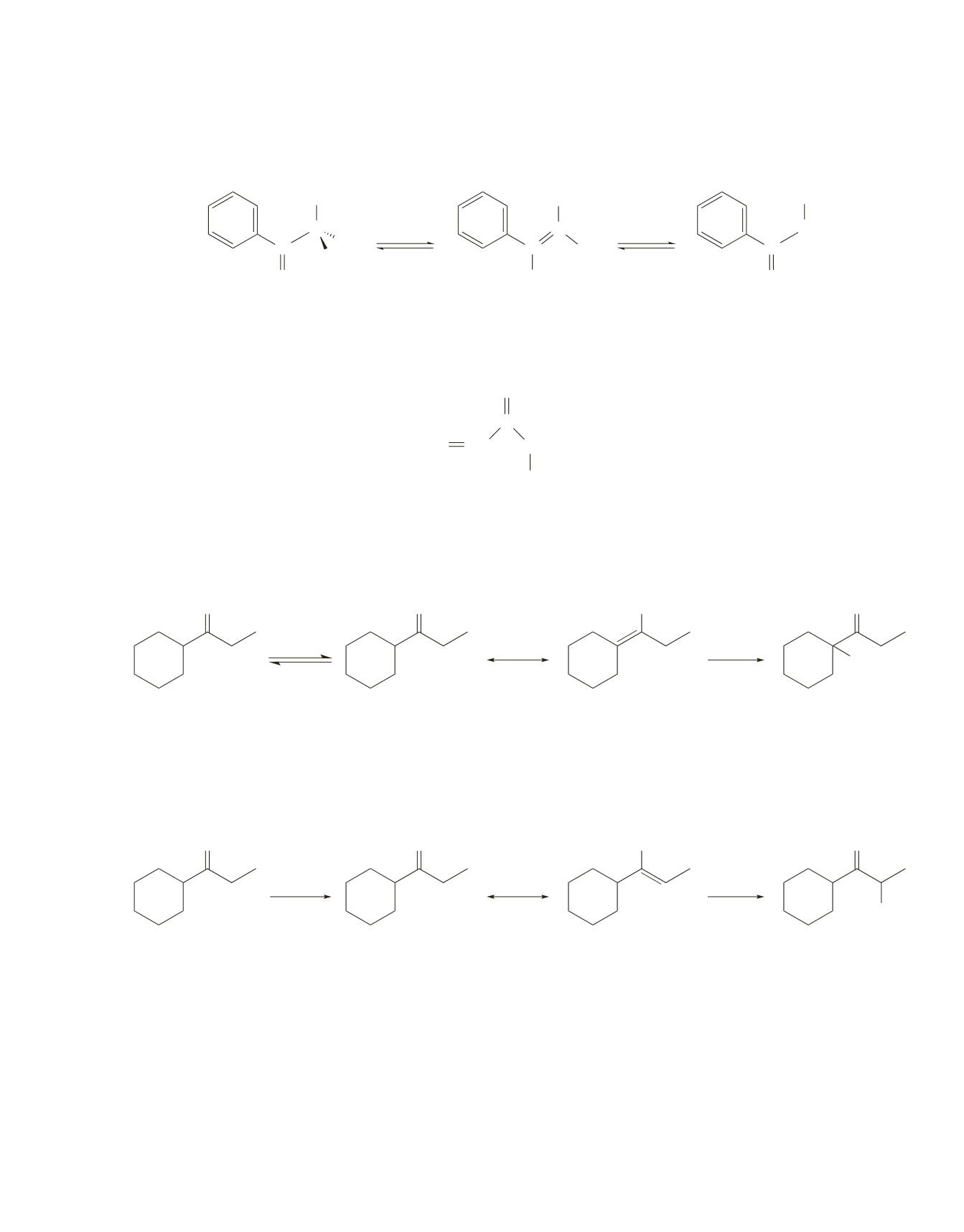
54.
When the ketone enolizes, the asymmetric center is lost. When the enol reforms the ketone, an asymmetric
center is created; the
R
and
S
enantiomers can be formed equally easily, so a racemic mixture is obtained.
C
O
C
CH
2
CH
3
CH
3
H
C
O
C
OH
C
CH
3
CH
2
CH
3
CH
2
CH
3
CHCH
3
∗
(
R
)-2-methyl-1-
phenyl-1-butanone
*
You need a ketone with an
a
-carbon that is an asymmetric center. Racemization occurs when an
a
-hydrogen is removed from the asymmetric center.
CH
2
CH CHCH
2
CH
3
CH
3
C
O
*
55.
At 0 °C, enolate ion formation is reversible, so the major product of the reaction is the thermodynamic
enolate—the one obtained by removing a proton from the more substituted
a
-carbon. Therefore, the
deuterium will substitute for a hydrogen attached to the more substituted
a
-carbon.
O
O
−
O
−
O
D
thermodynamic enolate
D
2
O
LDA/THF
At
-
78 °C, enolate ion formation is irreversible, so the major product of the reaction is the kinetic enolate—
the one obtained by removing a proton from the less substituted
a
-carbon. Therefore, the deuterium will
substitute for a hydrogen attached to the less substituted
a
-carbon.
LDA/THF
O
kinetic enolate
D
O
O
−
O
−
D
2
O