


 441 / 912

Chapter 13 433
Copyright © 2017 Pearson Education, Inc.
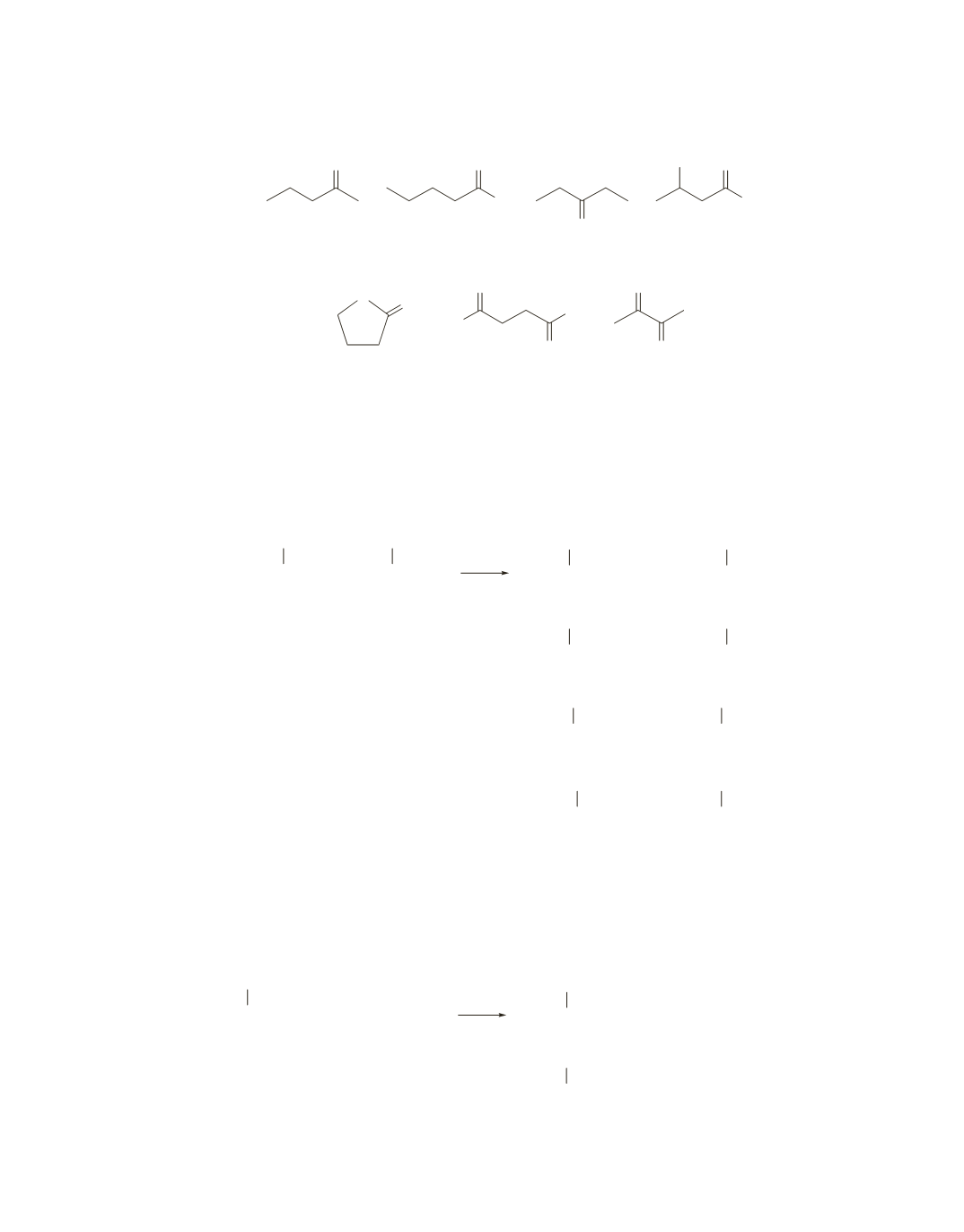
If the compound contains one oxygen, the molecular formula is C
5
H
10
O. Some possible structures are:
O
O
H
O
O
H
If the compound contains two oxygens, the molecular formula is C
4
H
6
O
2
. Some possible structures are:
O
O
H
H
O
O
O O
b.
Because the compound has an even-numbered mass, we know that it does not contain one nitrogen atom
(see Problem 7). It could, however, contain two nitrogen atoms (C
4
H
10
N
2
). A possible structure is:
H
2
NCH
2
CH
“
CHCH
2
NH
2
8.
A hydrocarbon with molecular formula C
9
H
20
has a molecular mass of 128.
Because C
9
H
20
=
C
n
H
2
n
+
2
, we know that the hydrocarbon has no rings and no
p
bonds.
The hydrocarbon is
2,6-dimethylheptane
.
CH
3
CHCH
2
CH
2
CH
2
CHCH
3
CH
3
CH
3
CH
3
CH
CH
3
CH
3
CHCH
2
CH
3
CH
2
CH
2
CHCH
3
CH
3
CH
3
CH
CH
3
CH
2
CH
2
CH
2
CHCH
3
CH
3
CH
3
CHCH
2
CH
3
CH
2
CH
2
CHCH
3
CH
3
m/z
= 43
m/z
= 85
m/z
= 57
m/z
= 71
+
+
+
+
.
.
.
.
CH
2
CH
2
CH
2
CHCH
3
CH
3
+
+
+
+
2-Methyloctane is also expected to give a base peak of
m
>
z
=
43 because it, too, forms a secondary (isopropyl
carbocation) together with a primary radical, and all other cleavages that form primary radicals form primary
carbocations. However, we would expect fragments with
m
>
z
=
29 and 99 to be present to the same extent
as those with
m
>
z
=
57, 85, and 71. Because fragments with
m
>
z
=
29 and 99 are not mentioned, we can
conclude that the hydrocarbon is more likely to be 2,6-dimethylheptane than 2-methyloctane.
CH
3
CHCH
2
CH
2
CH
2
CH
2
CH
2
CH
3
CH
3
CH
3
CHCH
2
CH
2
CH
2
CH
2
CH
3
CH
2
CH
3
m/z
= 99
+
.
CH
3
CHCH
2
CH
2
CH
2
CH
2
CH
3
CH
2
CH
3
m/z
= 29
+
.
+
+