


 184 / 912

176 Chapter 4
Copyright © 2017 Pearson Education, Inc.
76.
a.
1
R
2
-3-bromo-2,5-dimethylhexane
c.
1
2
R
,4
S
,6
S
2
-4-chloro-6-methyl-2-octanol
b.
1
2
R
,4
R
2
-4-methyl-2-hexanol
77.
Compounds
A
,
D
,
E
,
F
,
I
, and
J
have a stereoisomer that is achiral.
Compounds
A
,
D
,
F
,
I
, and
J
have two asymmetric centers bonded to identical substituents.
Therefore, there are three stereoisomers, one of which is an achiral meso compound.
Compounds
E
and
H
do not have any asymmetric centers; they have cis and trans stereosiomers,
so each is achiral and, therefore, each has an achiral stereoisomer.
Compounds
B
and
G
each have two asymmetric centers bonded to different substituents.
Therefore, there are four stereoisomers, all of which are chiral.
Compound
C
does not have any asymmetric centers.
Therefore, it is achiral and does not have any stereoisomers.
78.
a.
Cl
Cl
Cl
Cl
Cl
Cl
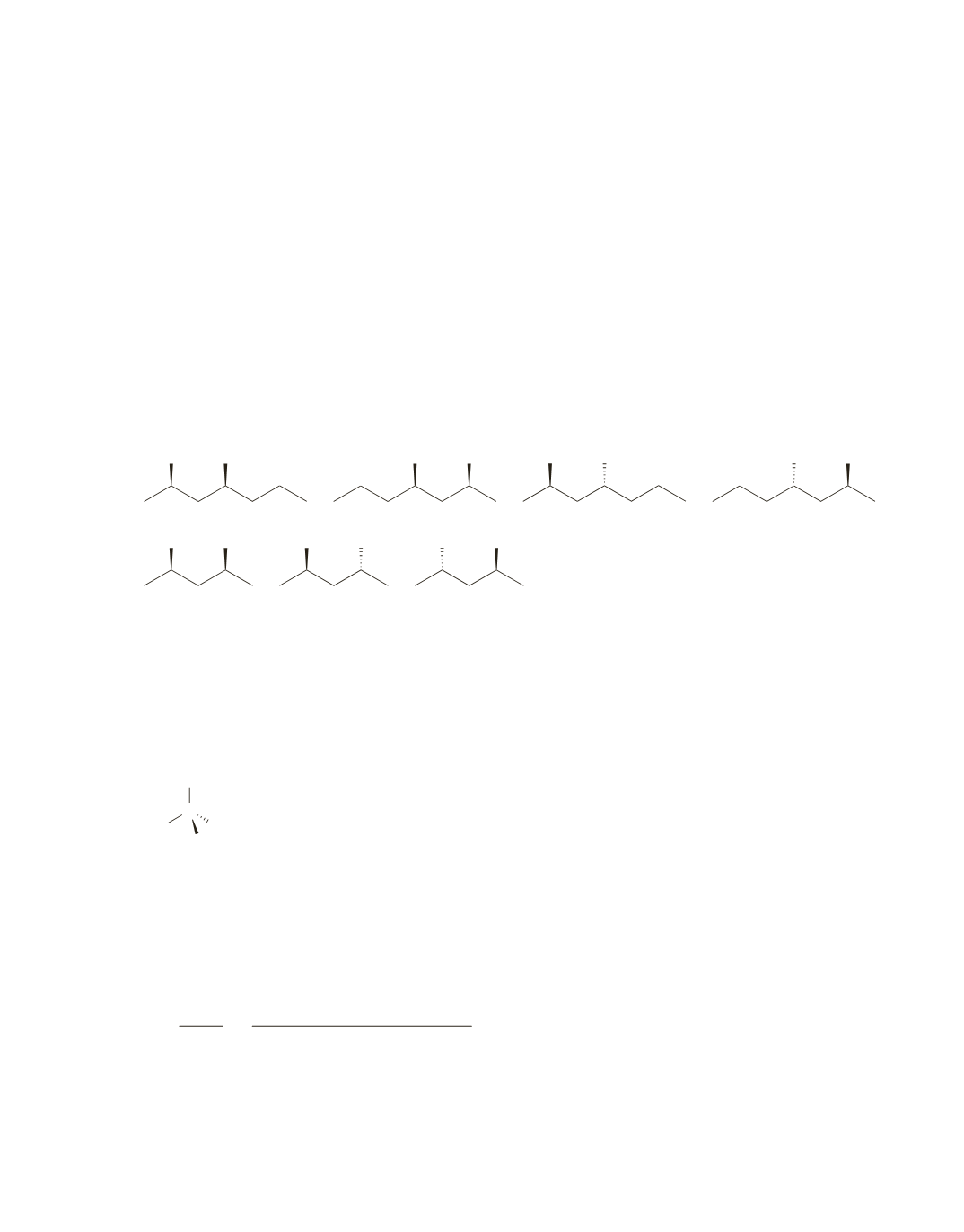
Cl
Cl
b.
Cl
Cl
Cl
Cl
Cl
Cl
79.
a.
One asymmetric center has the same configuration in both compounds; the other asymmetric center
has the opposite configuration in both. Therefore, the compounds are diastereomers.
b.
Both asymmetric centers in one compound have the opposite configuration in the other, so the com-
pounds are enantiomers.
c.
They are identical because if one is flipped over, it will superimpose on the other.
d.
They are constitutional isomers because the atoms are hooked up differently; one compound is
1-chloro-2-methylcyclopentane, and the other is 1-chloro-3-methylcyclopentane.
80.
a.
CH
2
COOH
CH
2
COOH
C
COOH
HO
1
4
3
2
14
(
S
)-citric acid
b.
The reaction is catalyzed by an enzyme. Only one stereoisomer is typically formed in an enzyme-
catalyzed reaction because an enzyme has a chiral binding site that allows reagents to be delivered to
only one side of the functional group of the reactant.
c.
The product of the reaction is achiral, because if it does not have a
14
C
label, the two
CH
2
COOH
groups are identical, so it does not have an asymmetric center.
81.
3
a
4
=
a
l
*
c
=
-
18
°
3
2.0 dm
4 3
1.5 g in 100 mL
4
=
-
6.0
82.
a.
identical
e.
constitutional isomers
b.
identical
f.
diastereomers
c.
enantiomers
g.
constitutional isomers
d.
constitutional isomers
h.
enantiomers