


 171 / 912

Chapter 4 163
Copyright © 2017 Pearson Education, Inc.
10.
a.
b.
Cl
Cl
c.
Cl
Cl
d.
HO
H O
HO
H O
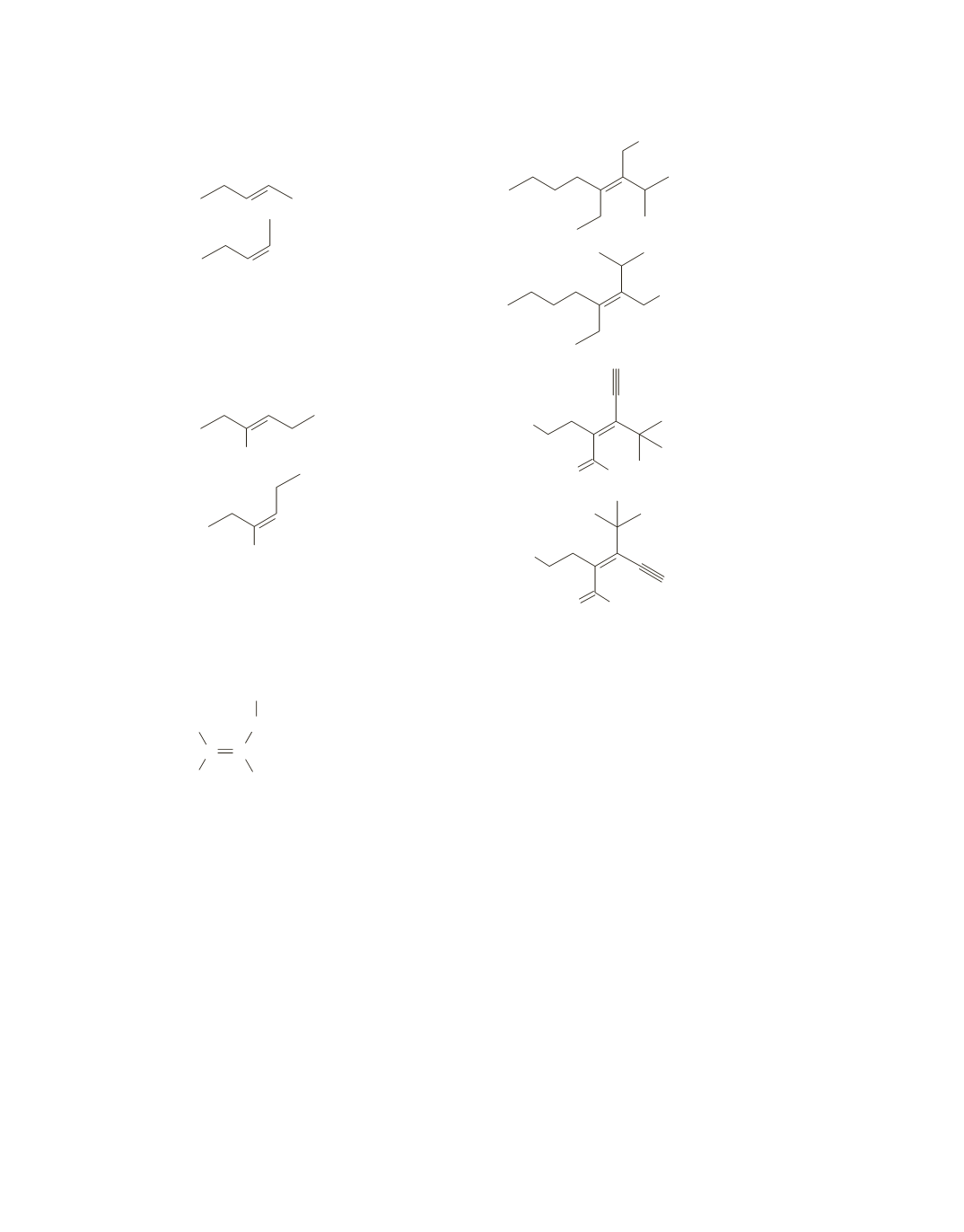
11.
a.
1
E
2
-2-heptene
b.
1
Z
2
-3,4-dimethyl-2-pentene
c.
1
Z
2
-1-chloro-3-ethyl-4-methyl-3-hexene
12.
H
C
H
3
C
C
CH
2
CH
2
CH
2
CH
3
CHCH
3
CH
3
13.
a
,
b
,
c
,
f
, and
h
are chiral.
d
,
e
, and
g
are each superimposable on its mirror image. These, therefore, are achiral.
14.
a
,
c
, and
f
have asymmetric centers.
15.
Solved in the text.
16.
a
,
c
, and
f
, because to be able to exist as a pair of enantiomers, the compound must have an asymmetric
center (except in the case of certain compounds with unusual structures; see Problem 103).
17.
a.
It has one asymmetric center.
b.
It has three stereocenters.